Thai Vowels Chart: All 32 Vowels with Sound, Length and Position
Every Thai vowel with its sound, whether it is short or long, where it sits around the consonant, and how often you will meet it. Plus the four written forms most charts forget.
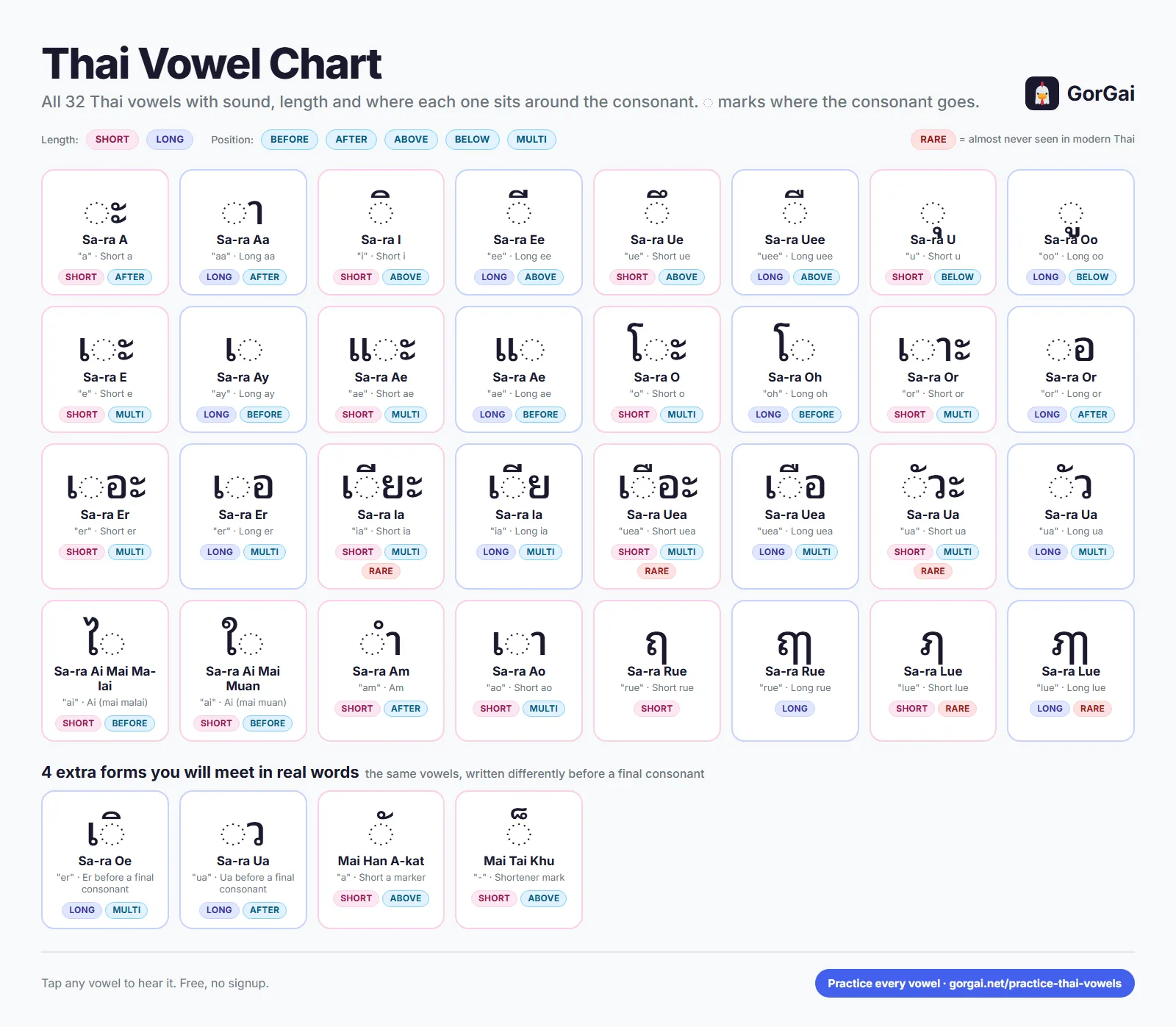
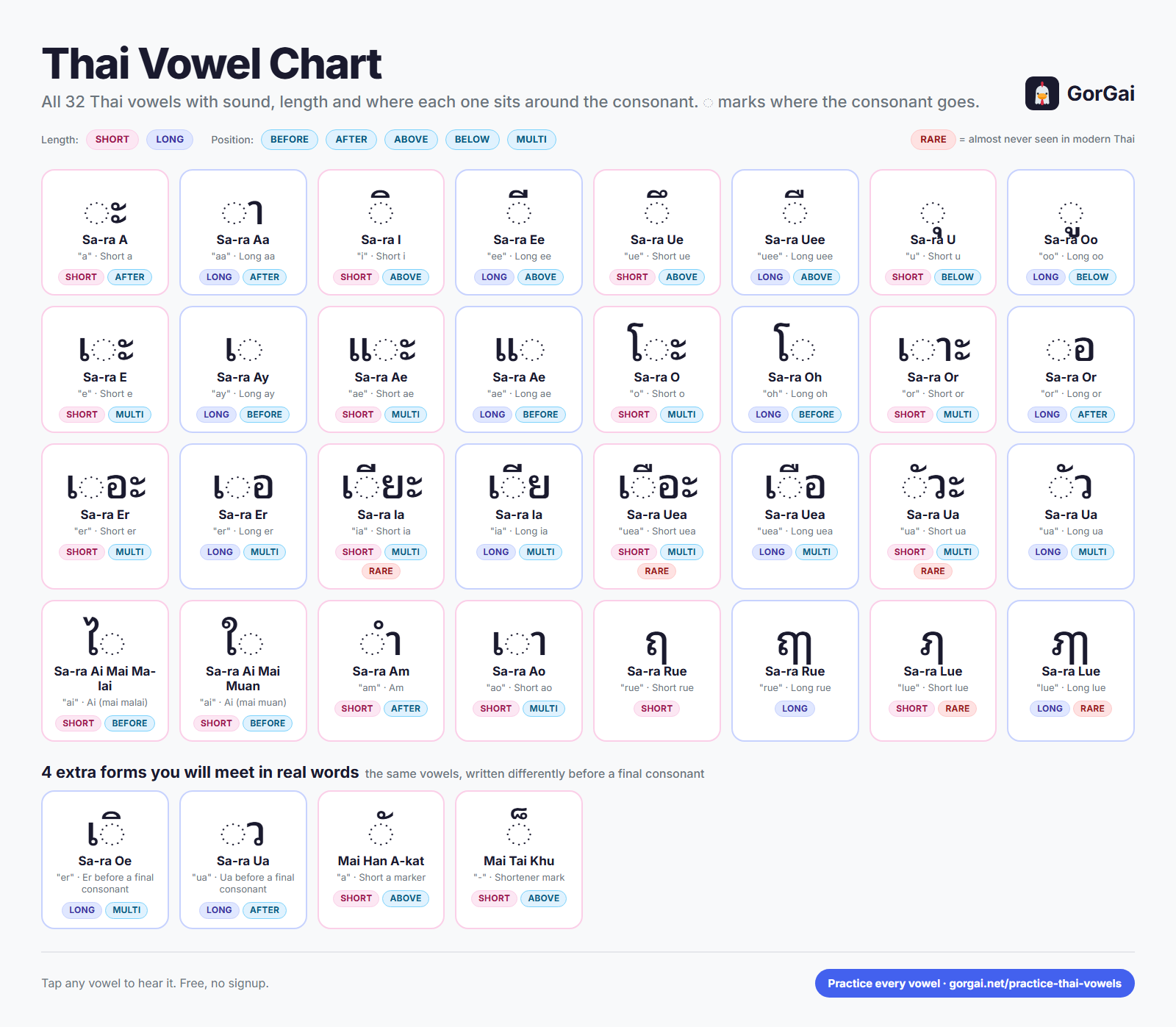
All 32 Thai vowels and the 4 extra written forms. Pink is short, indigo is long. The dotted circle ◌ is where the consonant goes.
🐔
pls whitelist us :(
We promise our ads will never get in the way of your learning.
An ad was meant to go here. Ads are what keep GorGai free, and not one of them is allowed inside the practice area, so nothing ever pops up while you are tracing.
The 32 Thai vowels in one table
The traditional list, in the traditional order: the nine short and long pairs first, then the diphthongs, then the special forms. Rank is how often each vowel appears in written Thai, from the ThaiStat corpus: ◌า (long aa) is the most common vowel in the language by a wide margin, and the last five you can safely ignore for months.
Vowel
Name
Romanized
Sound
Length
Position
Rank
◌ะ
สระอะ
Sa-ra A
"a"
short
after
#6
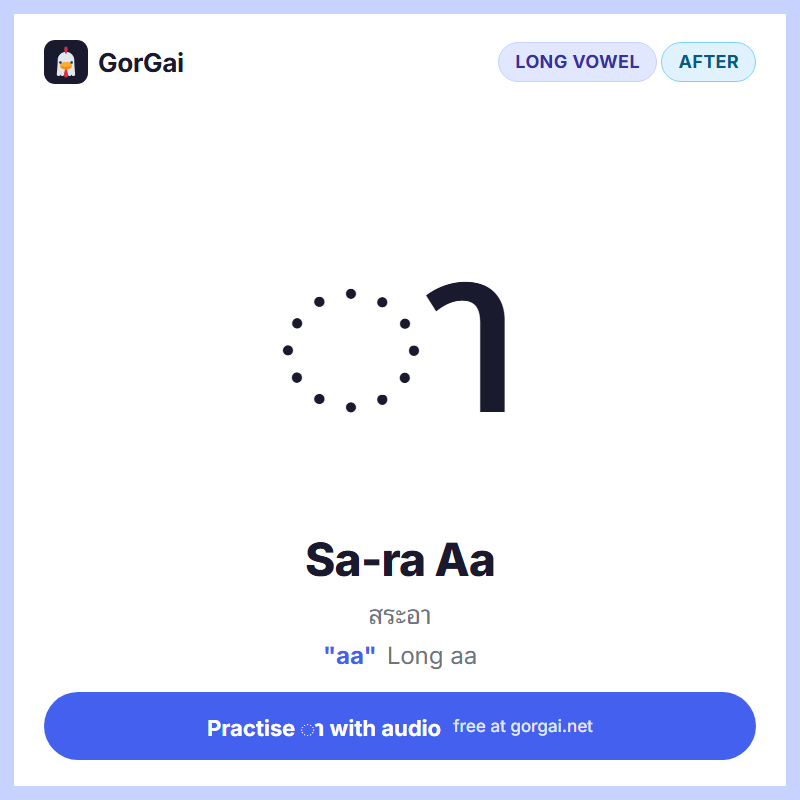
◌า
สระอา
Sa-ra Aa
"aa"
long
after
#1
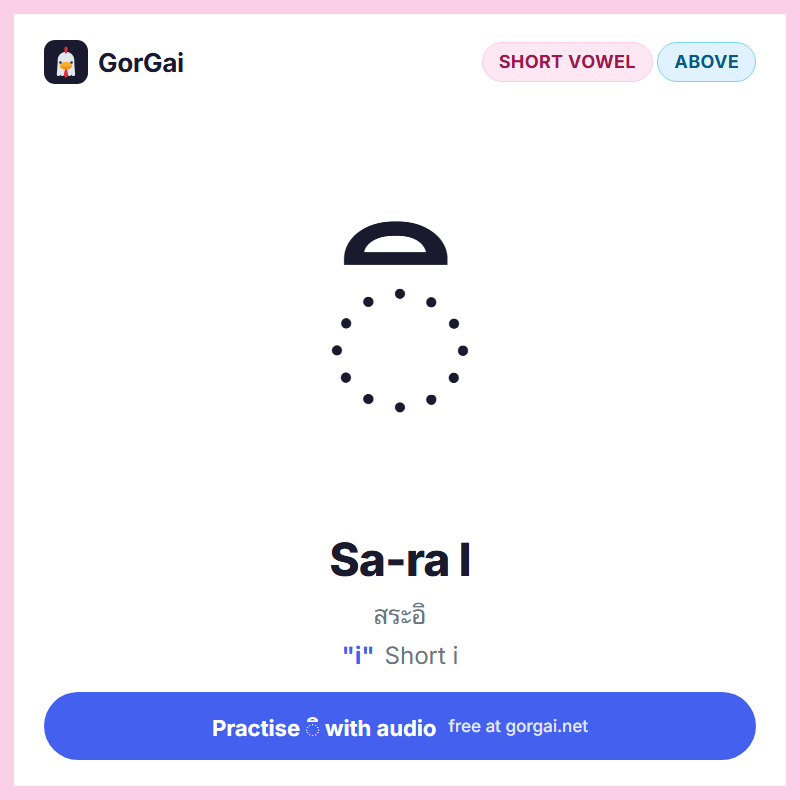
◌ิ
สระอิ
Sa-ra I
"i"
short
above
#5
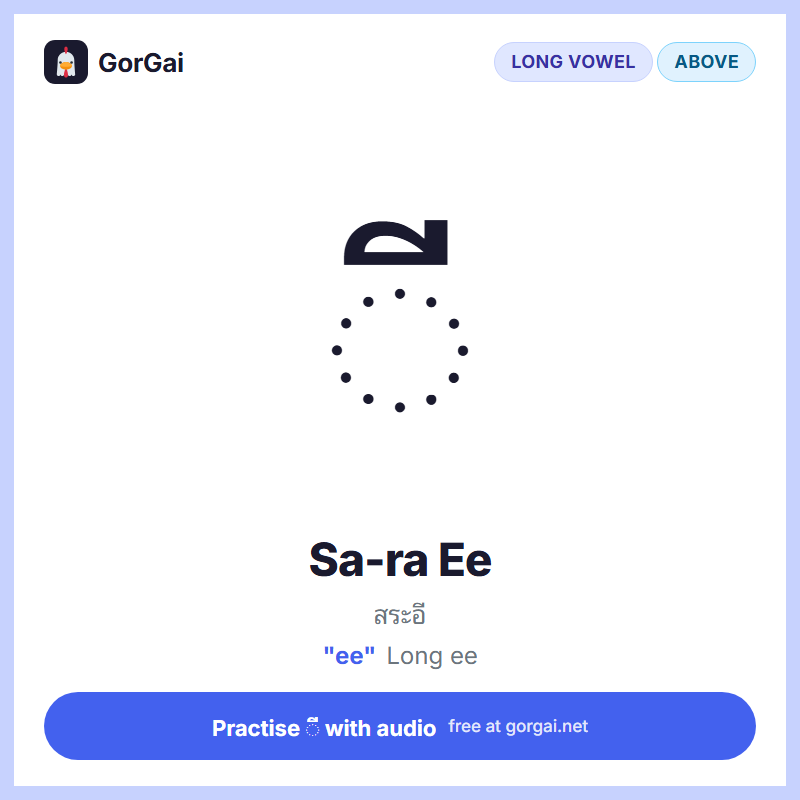
◌ี
สระอี
Sa-ra Ee
"ee"
long
above
#4
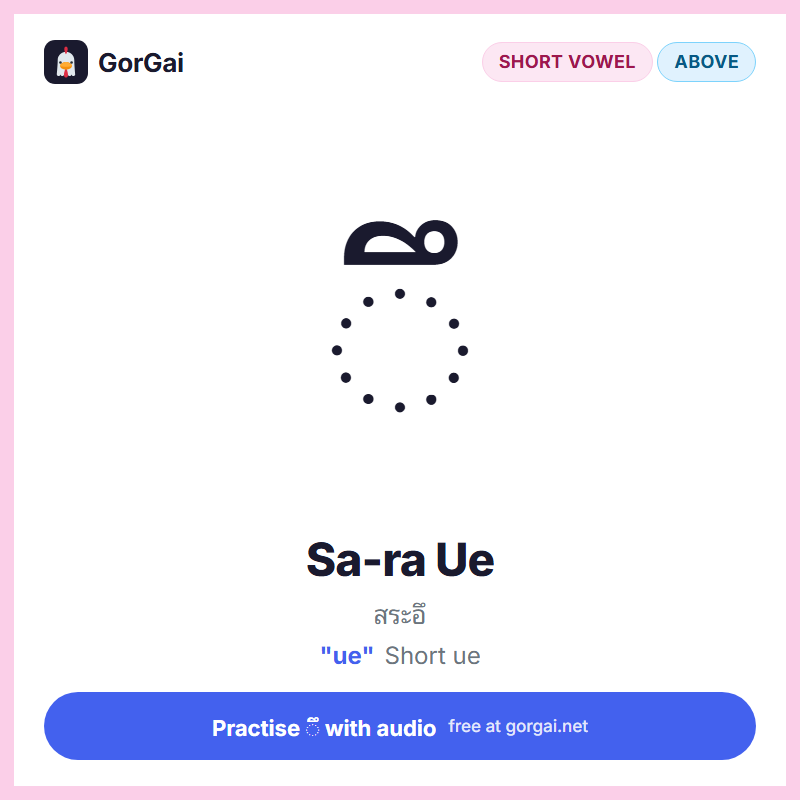
◌ึ
สระอึ
Sa-ra Ue
"ue"
short
above
#17
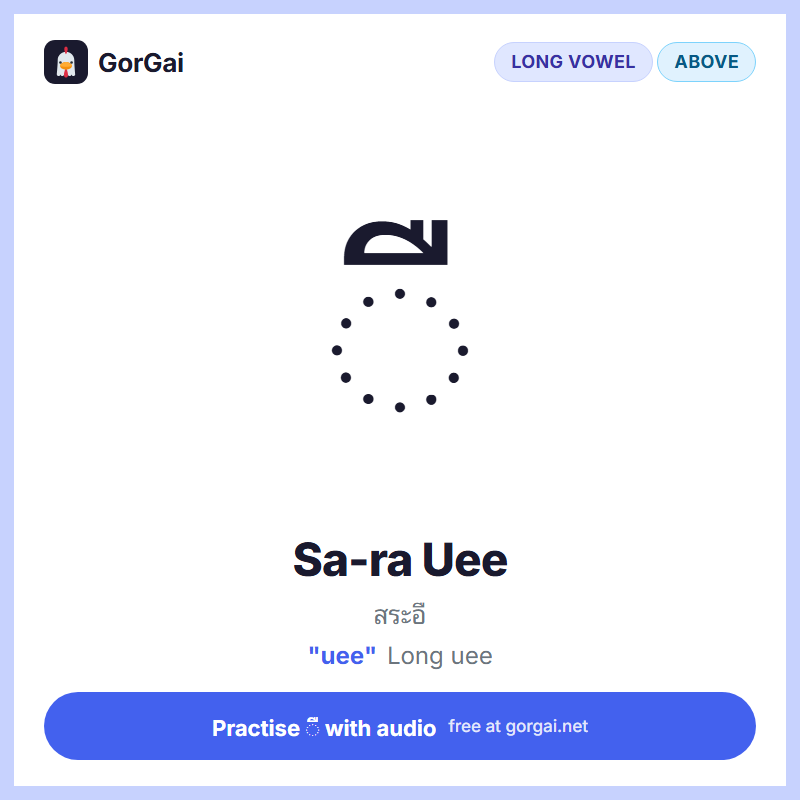
◌ื
สระอื
Sa-ra Uee
"uee"
long
above
#18
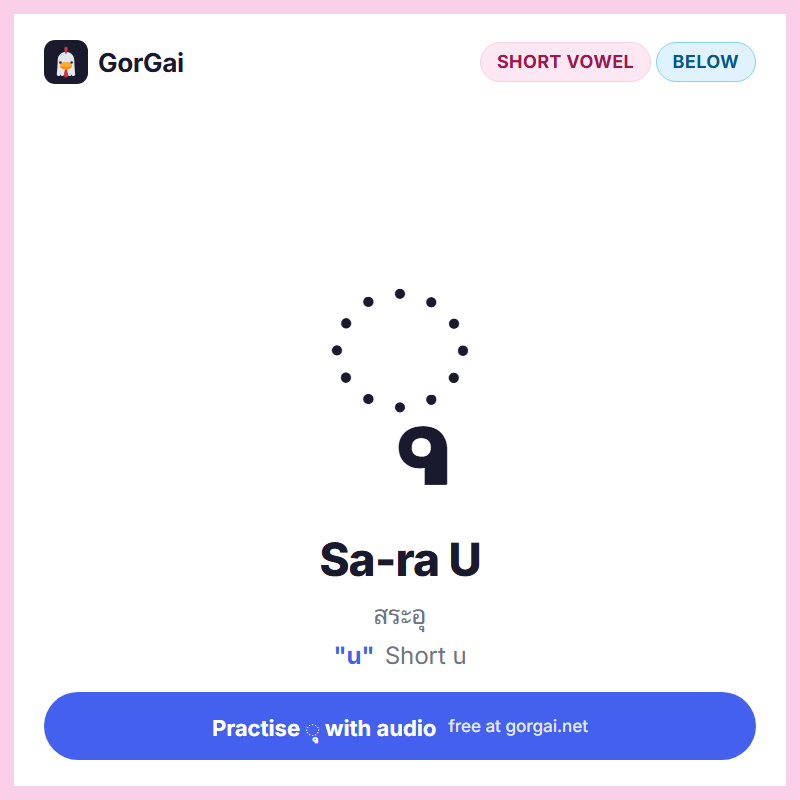
◌ุ
สระอุ
Sa-ra U
"u"
short
below
#10
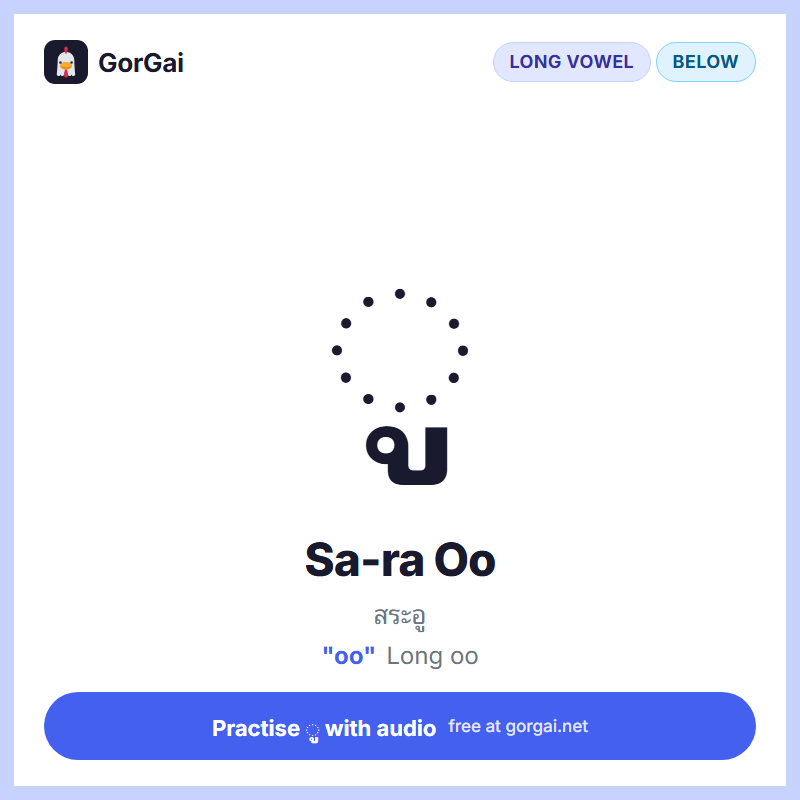
◌ู
สระอู
Sa-ra Oo
"oo"
long
below
#11
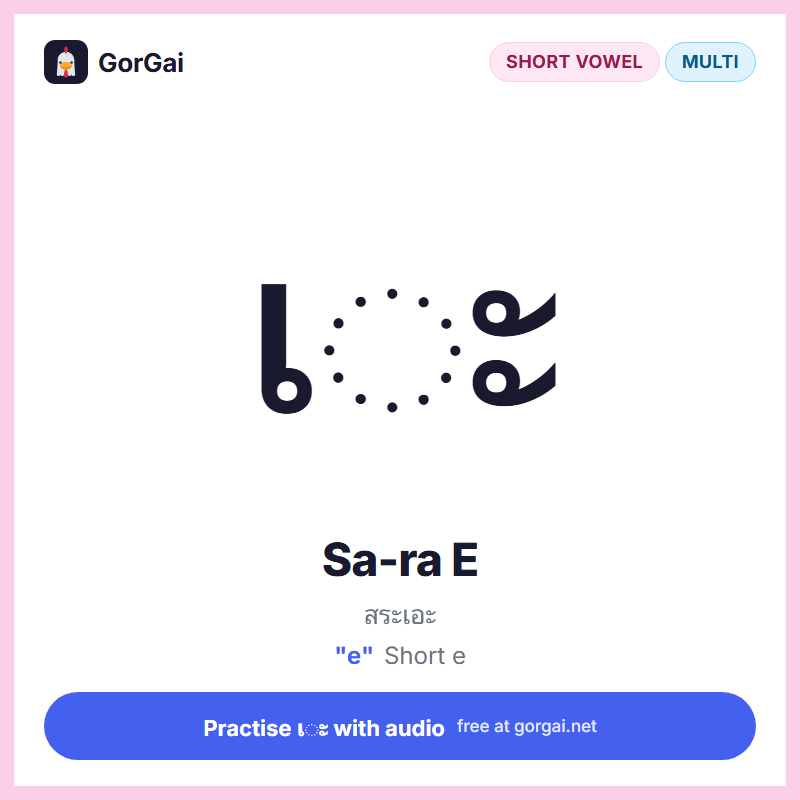
เ◌ะ
สระเอะ
Sa-ra E
"e"
short
multi
#21
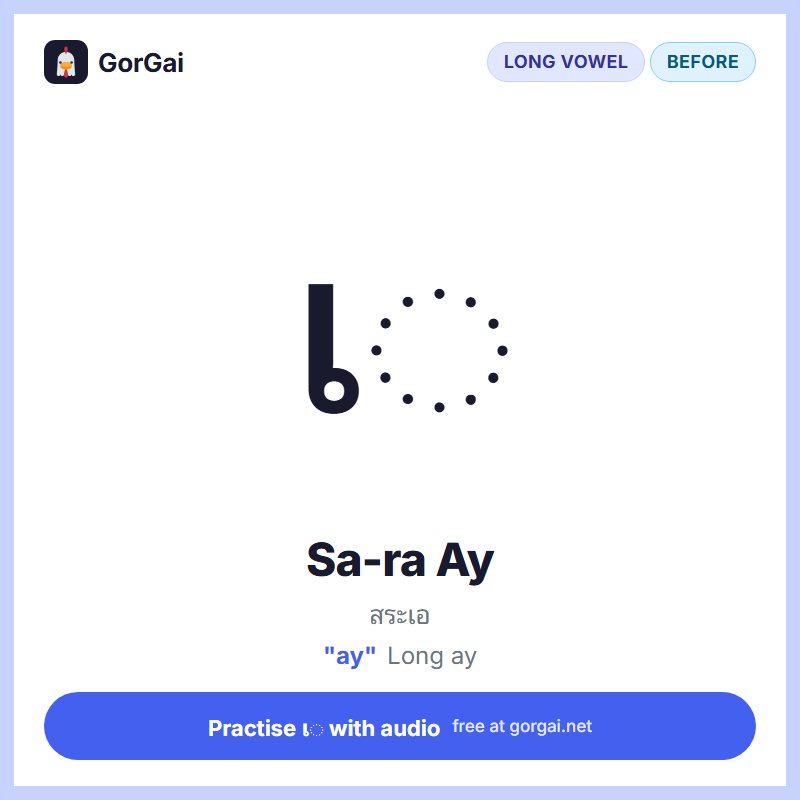
เ◌
สระเอ
Sa-ra Ay
"ay"
long
before
#2
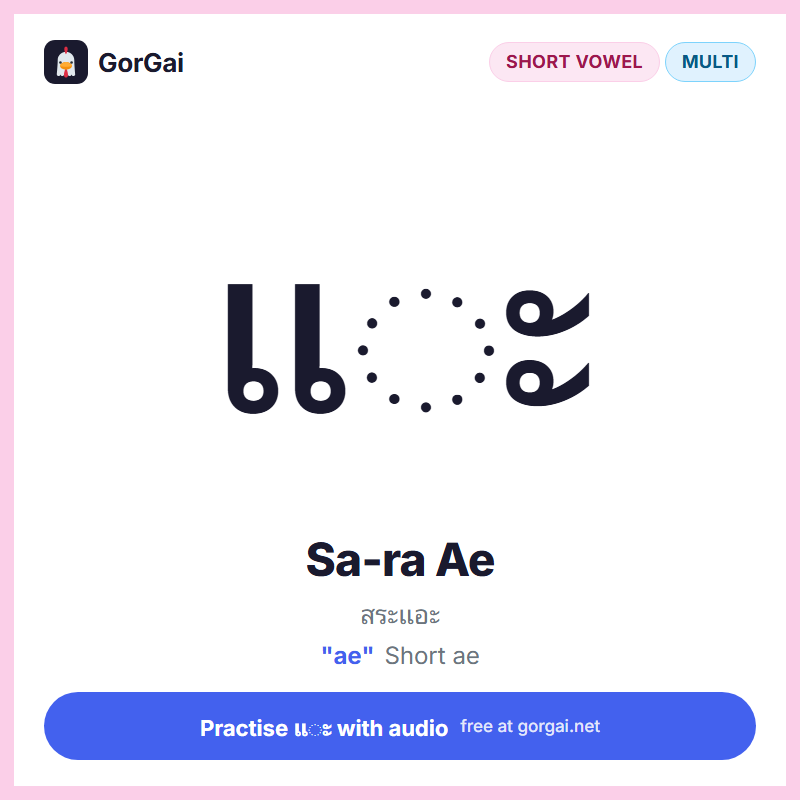
แ◌ะ
สระแอะ
Sa-ra Ae
"ae"
short
multi
#23
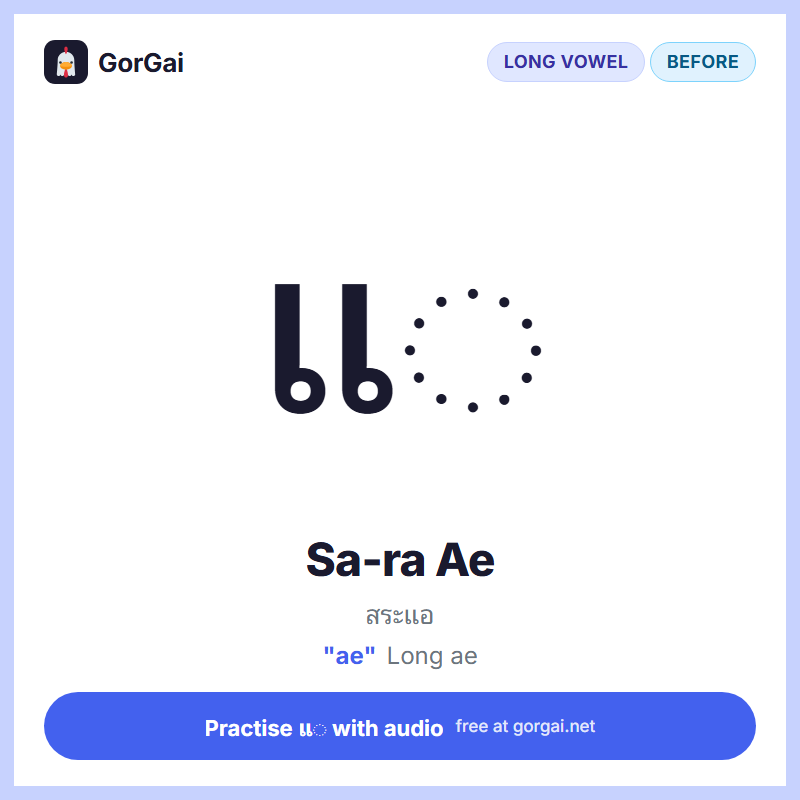
แ◌
สระแอ
Sa-ra Ae
"ae"
long
before
#7
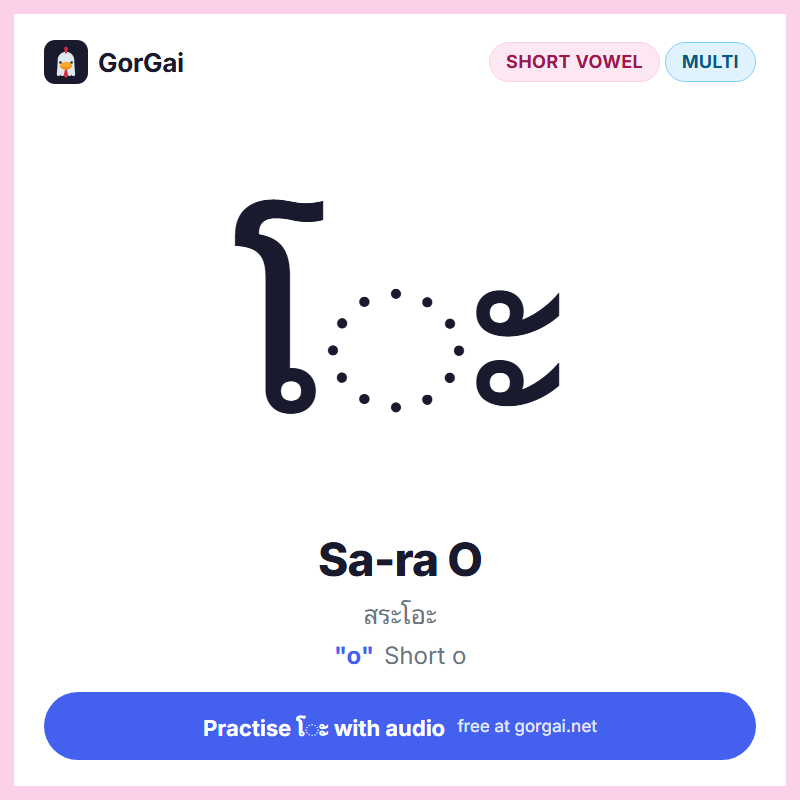
โ◌ะ
สระโอะ
Sa-ra O
"o"
short
multi
#24
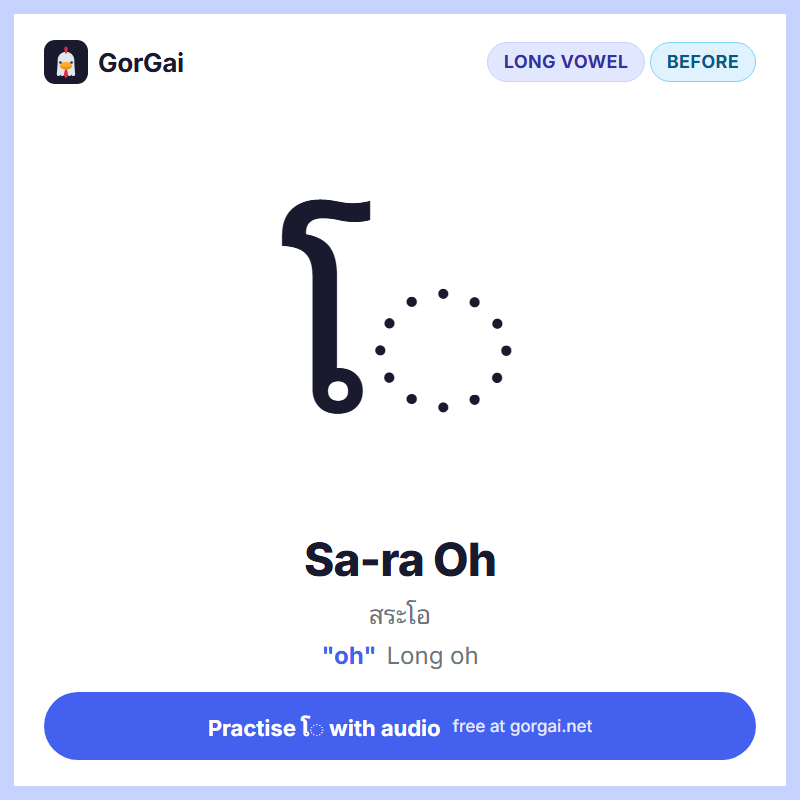
โ◌
สระโอ
Sa-ra Oh
"oh"
long
before
#13
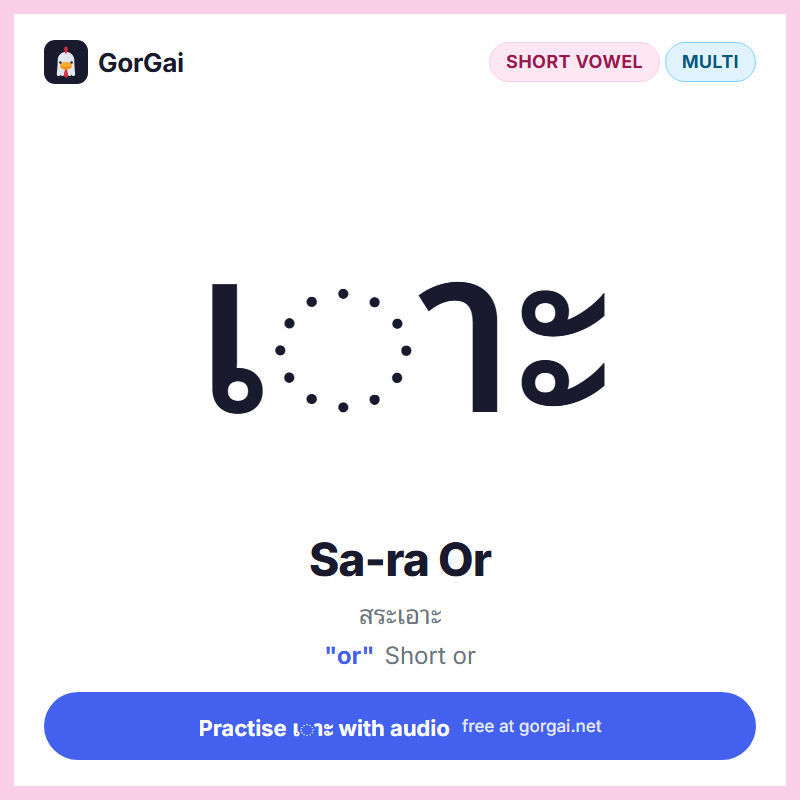
เ◌าะ
สระเอาะ
Sa-ra Or
"or"
short
multi
#25
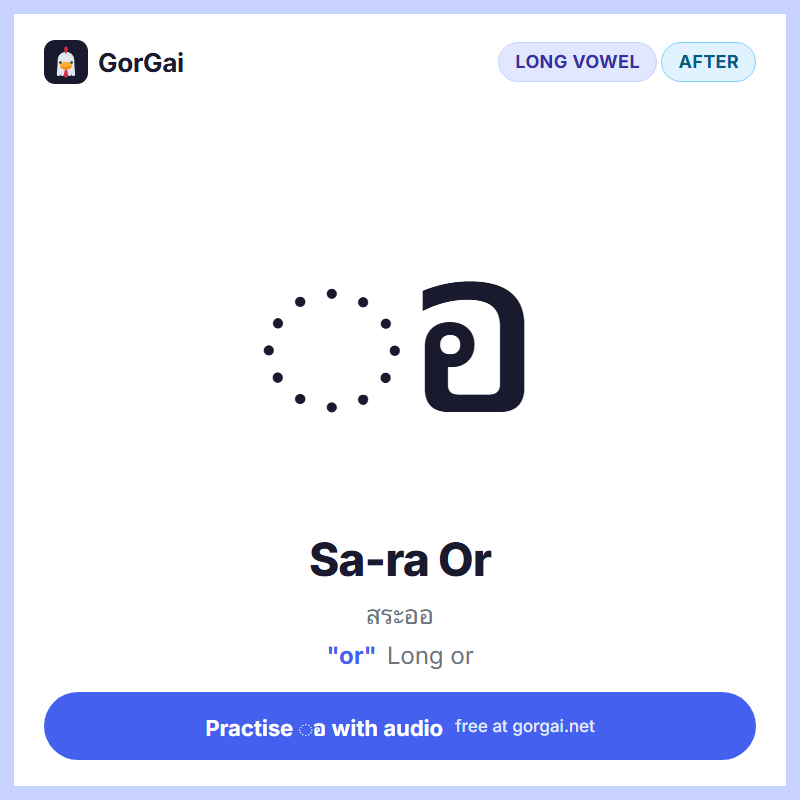
◌อ
สระออ
Sa-ra Or
"or"
long
after
#14
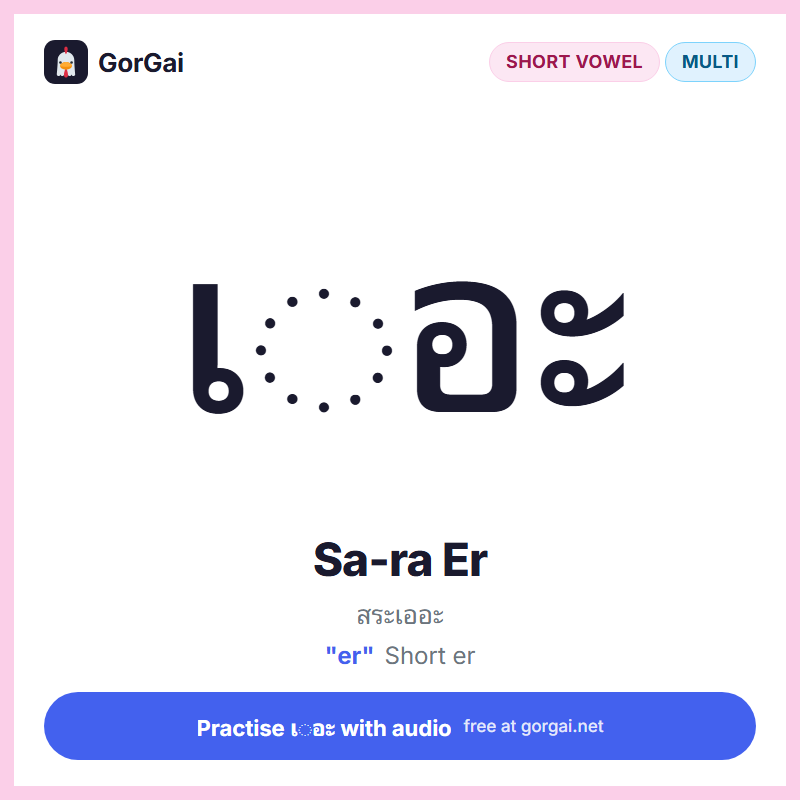
เ◌อะ
สระเออะ
Sa-ra Er
"er"
short
multi
#33
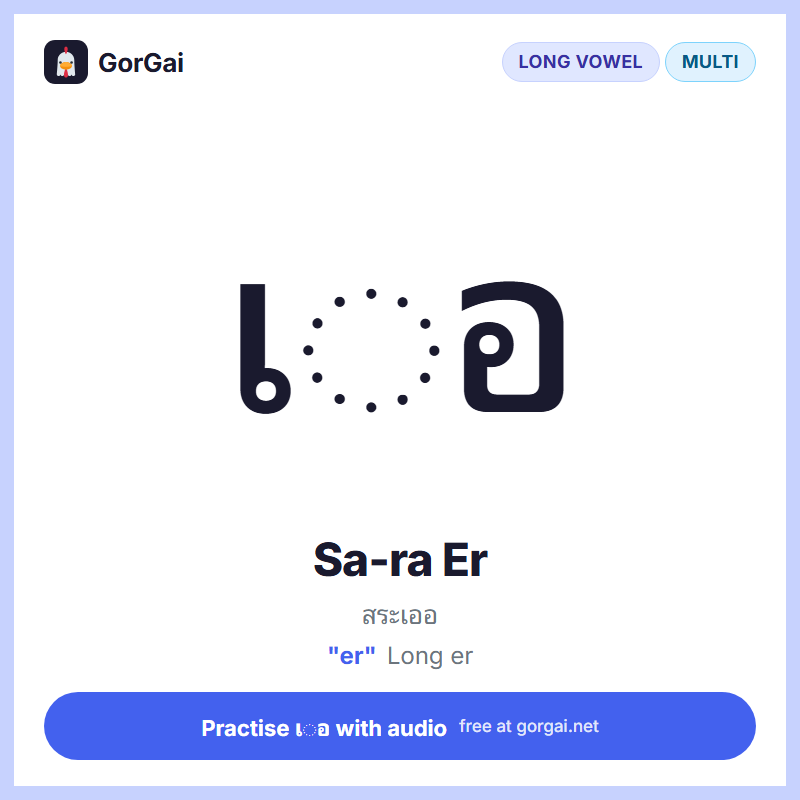
เ◌อ
สระเออ
Sa-ra Er
"er"
long
multi
#19
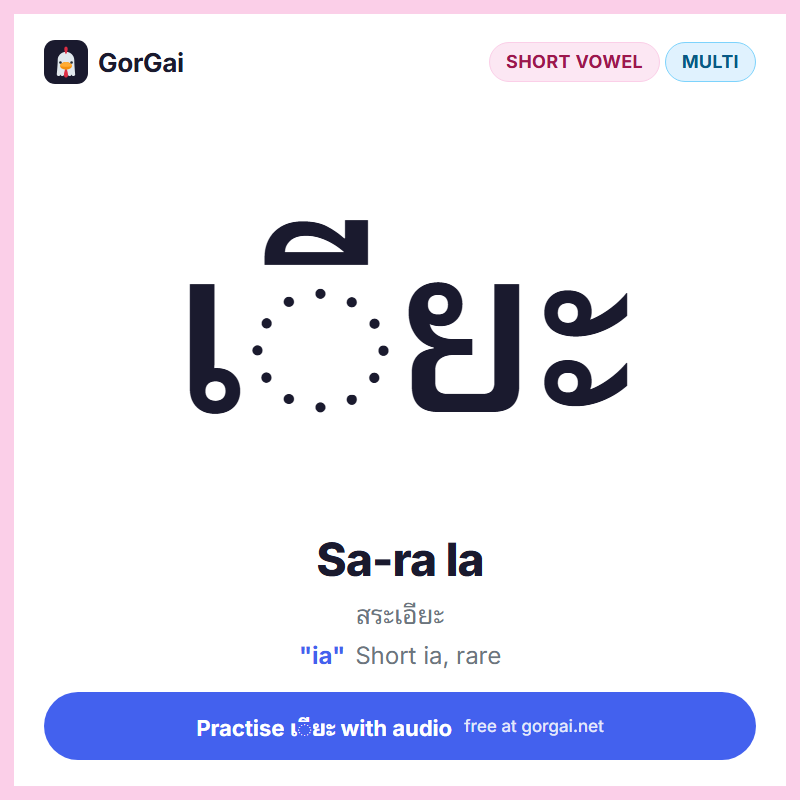
เ◌ียะ
สระเอียะ
Sa-ra Ia
"ia"
short
multi
#35 (rare)
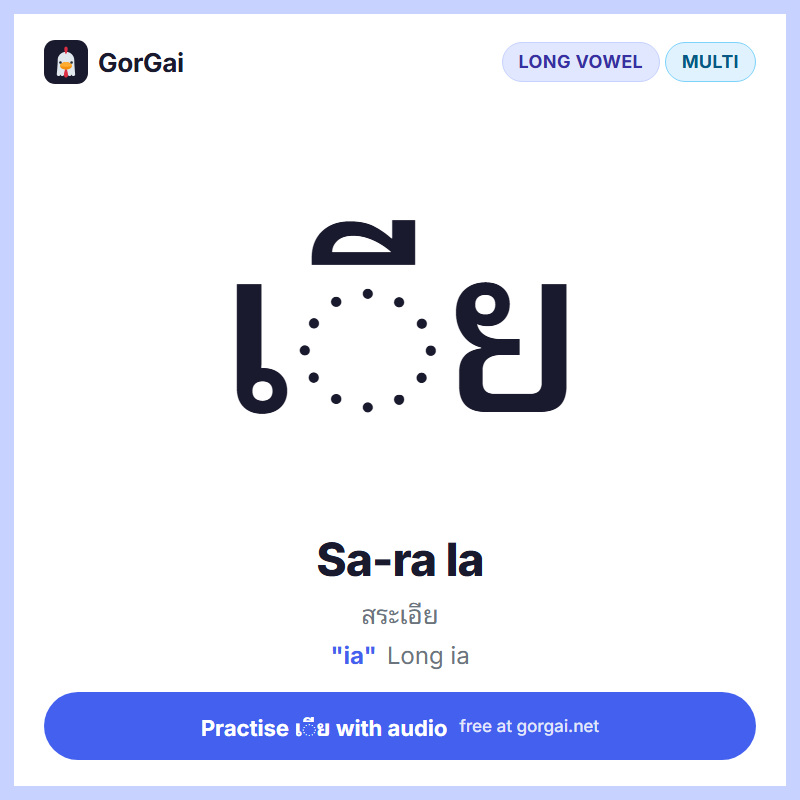
เ◌ีย
สระเอีย
Sa-ra Ia
"ia"
long
multi
#15
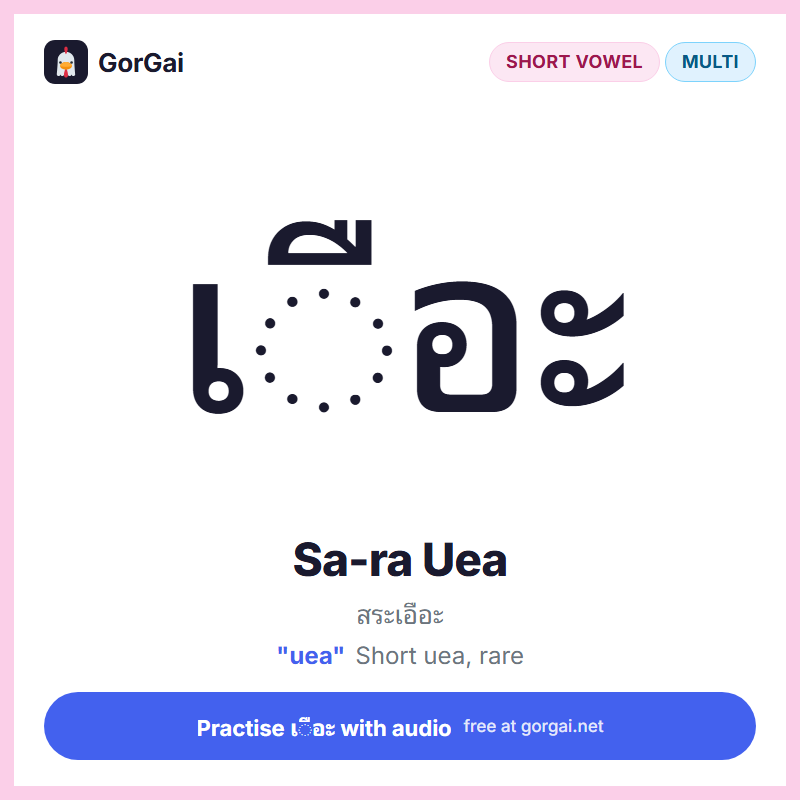
เ◌ือะ
สระเอือะ
Sa-ra Uea
"uea"
short
multi
#36 (rare)
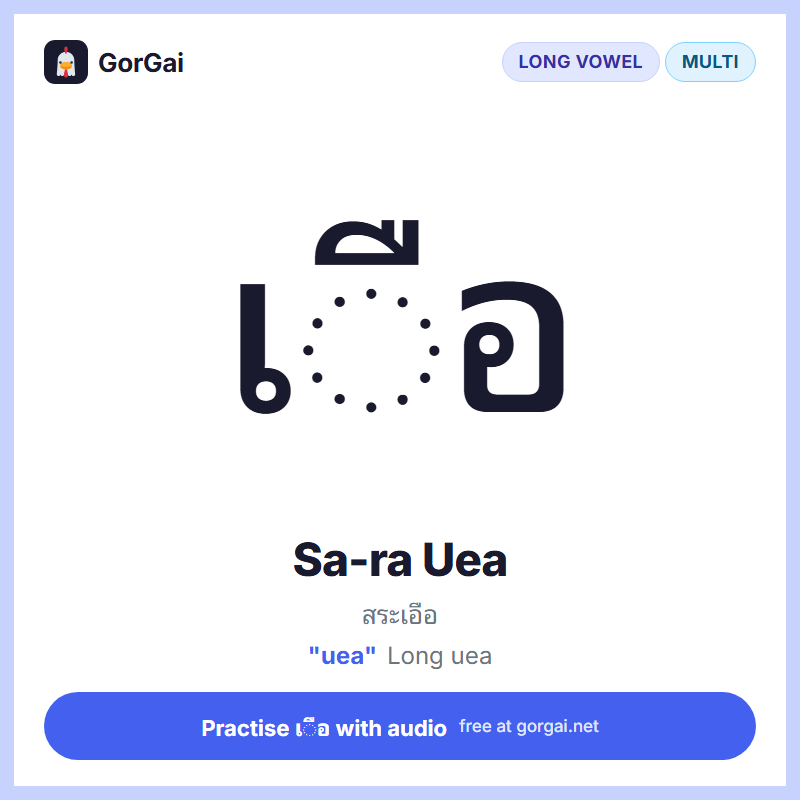
เ◌ือ
สระเอือ
Sa-ra Uea
"uea"
long
multi
#16
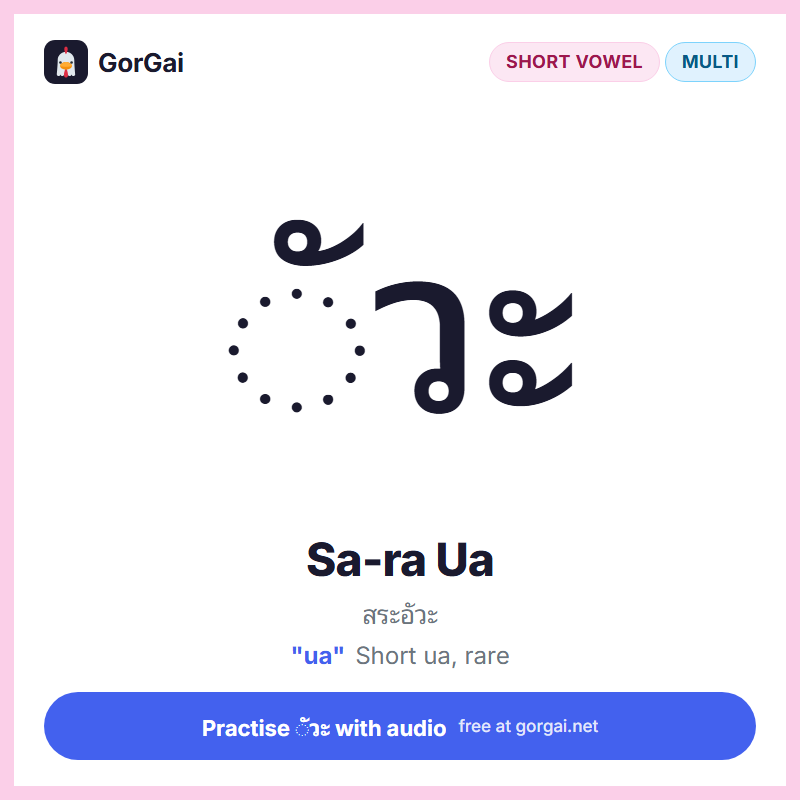
◌ัวะ
สระอัวะ
Sa-ra Ua
"ua"
short
multi
#34 (rare)
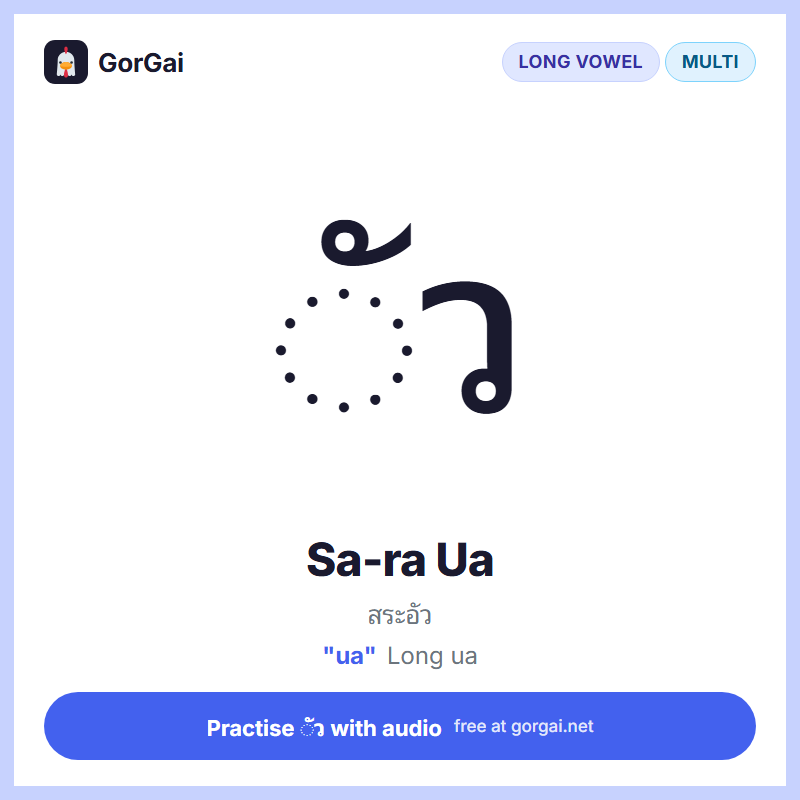
◌ัว
สระอัว
Sa-ra Ua
"ua"
long
multi
#22
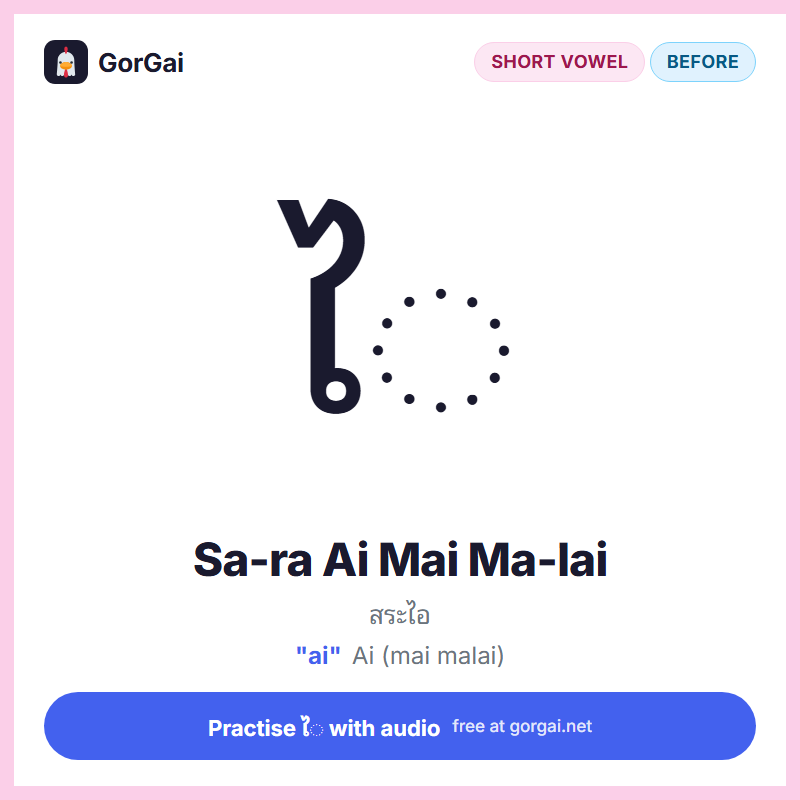
ไ◌
สระไอ
Sa-ra Ai Mai Ma-lai
"ai"
short
before
#8
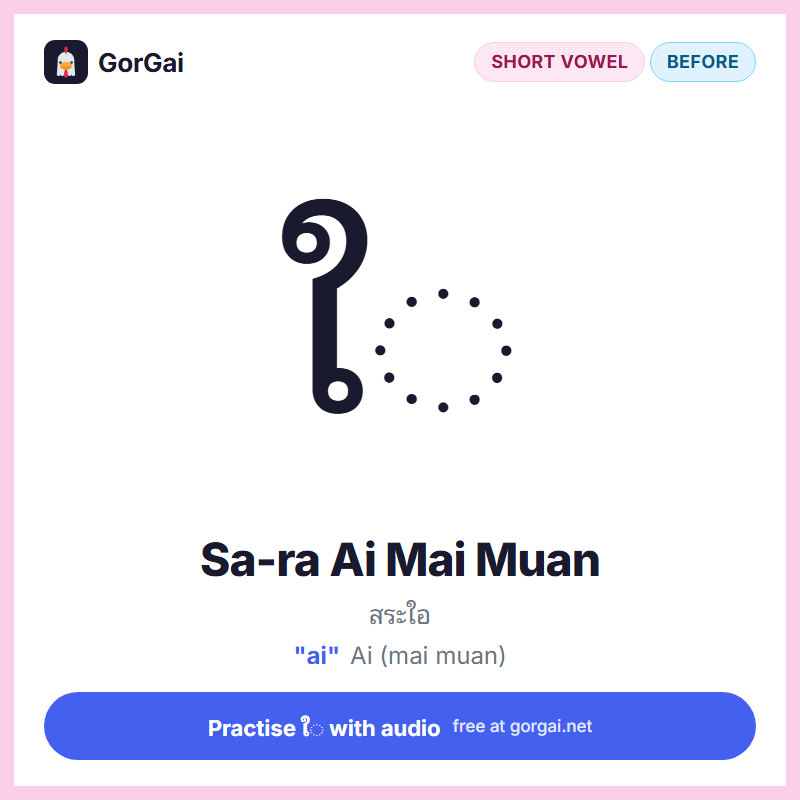
ใ◌
สระใอ
Sa-ra Ai Mai Muan
"ai"
short
before
#9
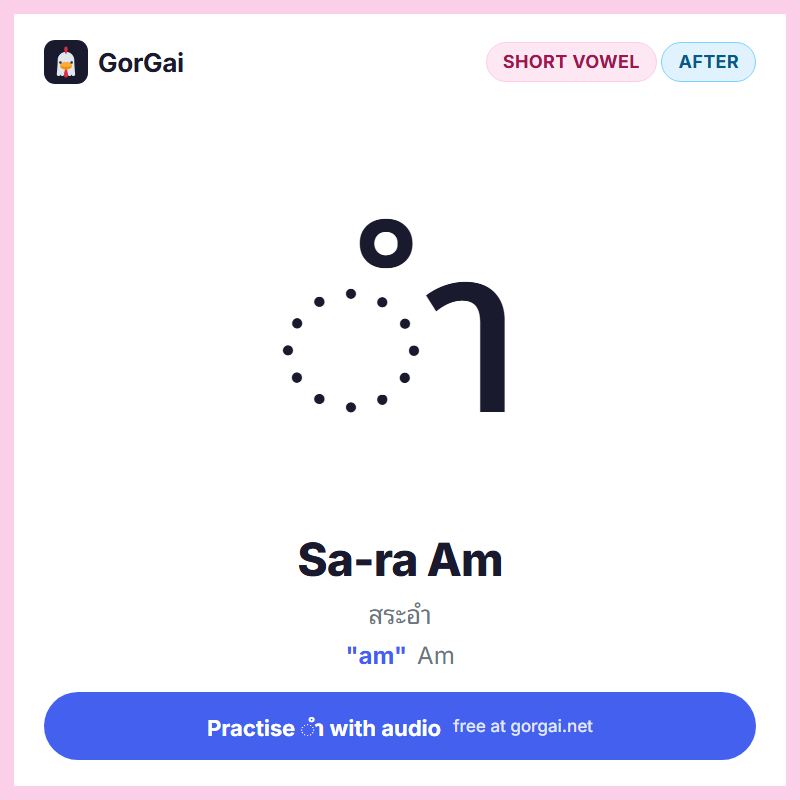
◌ำ
สระอำ
Sa-ra Am
"am"
short
after
#12
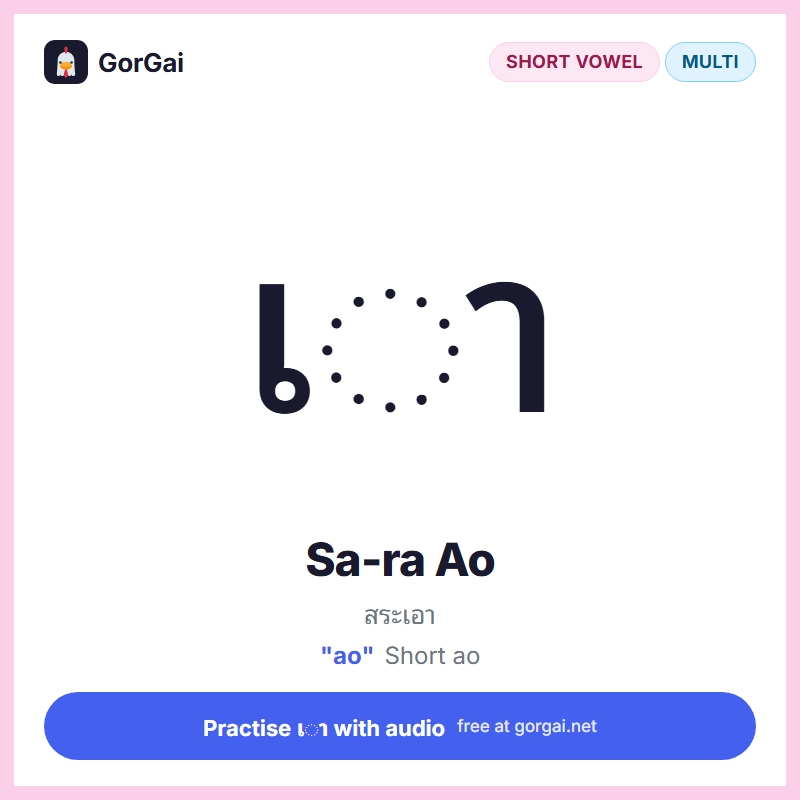
เ◌า
สระเอา
Sa-ra Ao
"ao"
short
multi
#3
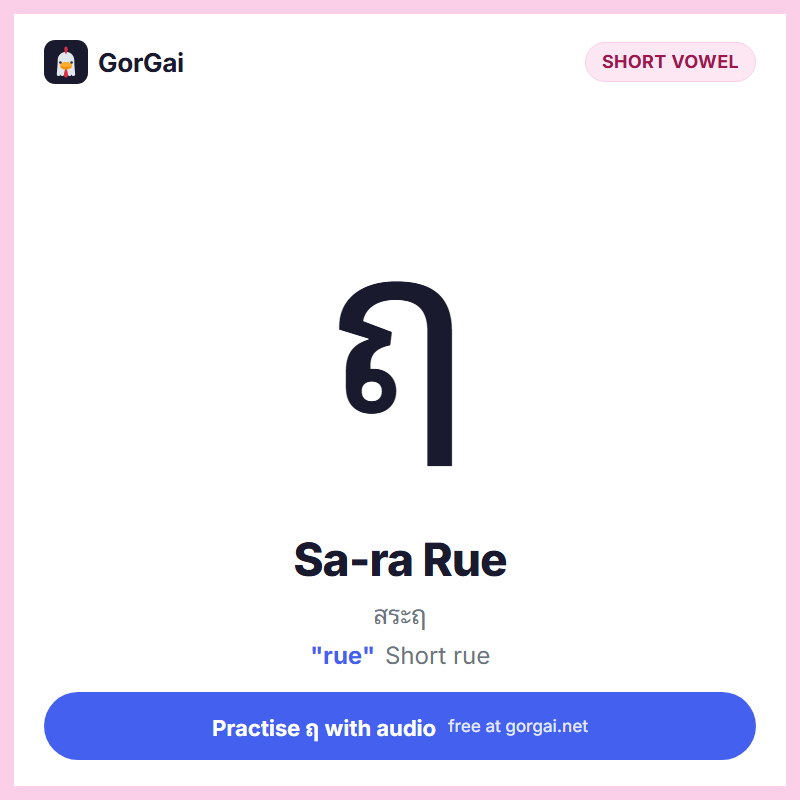
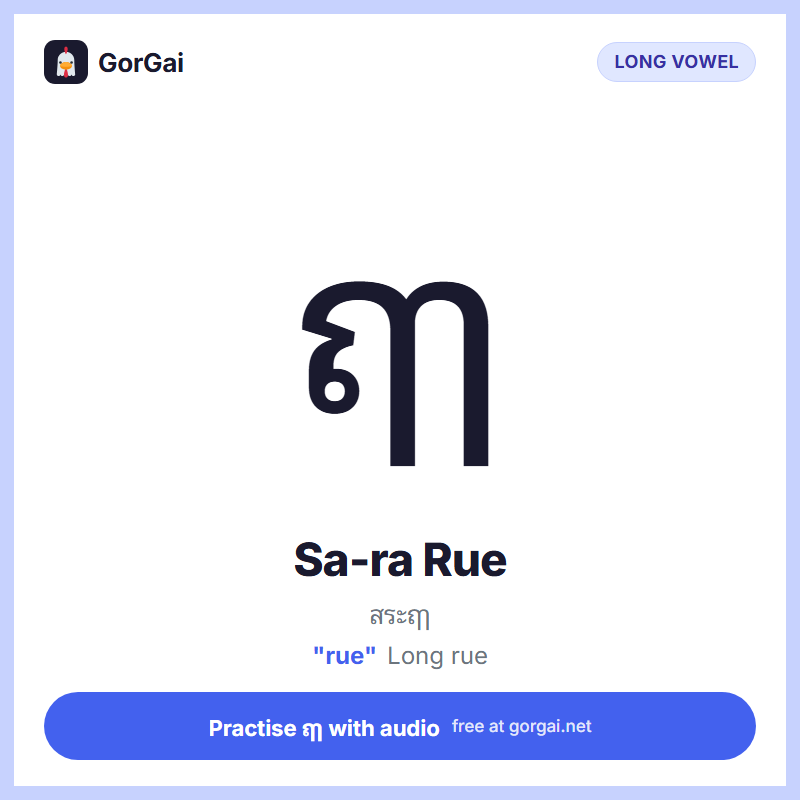
ฤ
สระฤ
Sa-ra Rue
"rue"
short
standalone
#27
ฤๅ
สระฤๅ
Sa-ra Rue
"rue"
long
standalone
#30
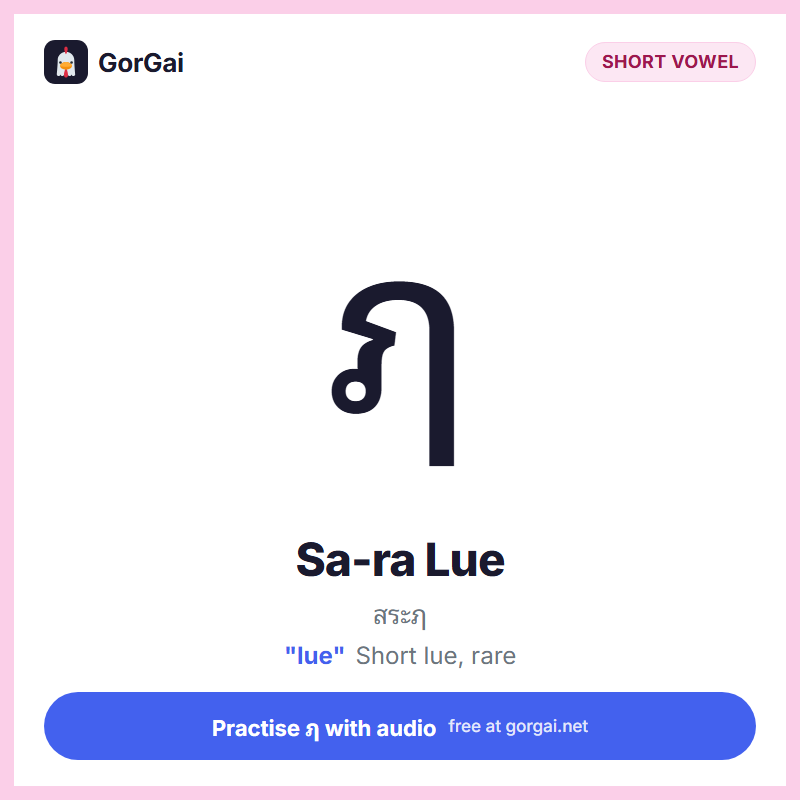
ฦ
สระฦ
Sa-ra Lue
"lue"
short
standalone
#31 (rare)
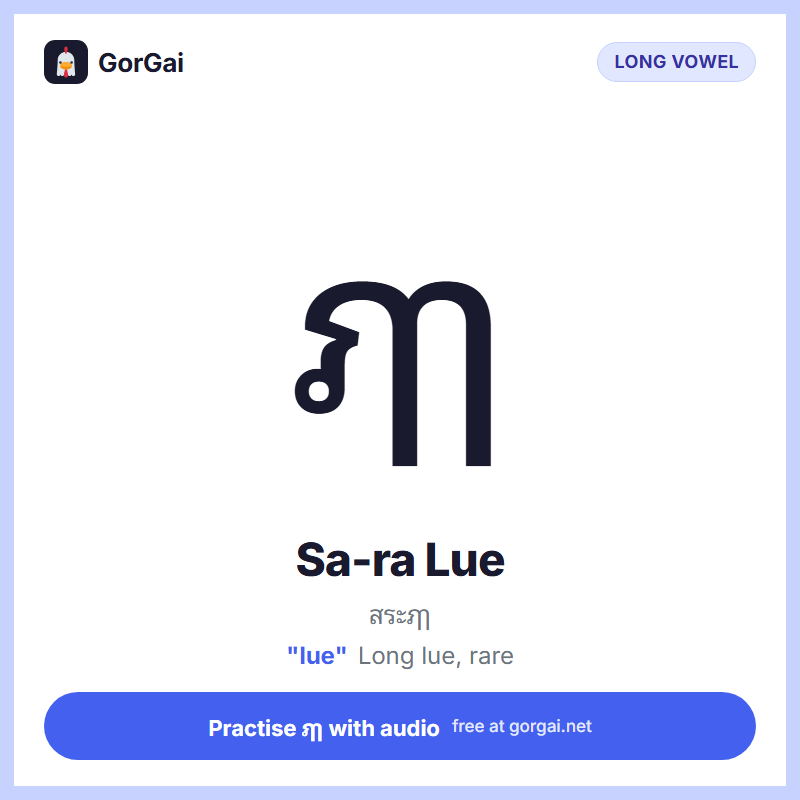
ฦๅ
สระฦๅ
Sa-ra Lue
"lue"
long
standalone
#32 (rare)
The 4 extra written forms
Not new vowels. These are what four of the vowels above look like when a final consonant follows, and they are on the chart because you cannot read เด็ก (child) or กัน (together) without them.
Form
Name
Romanized
Stands for
Rank
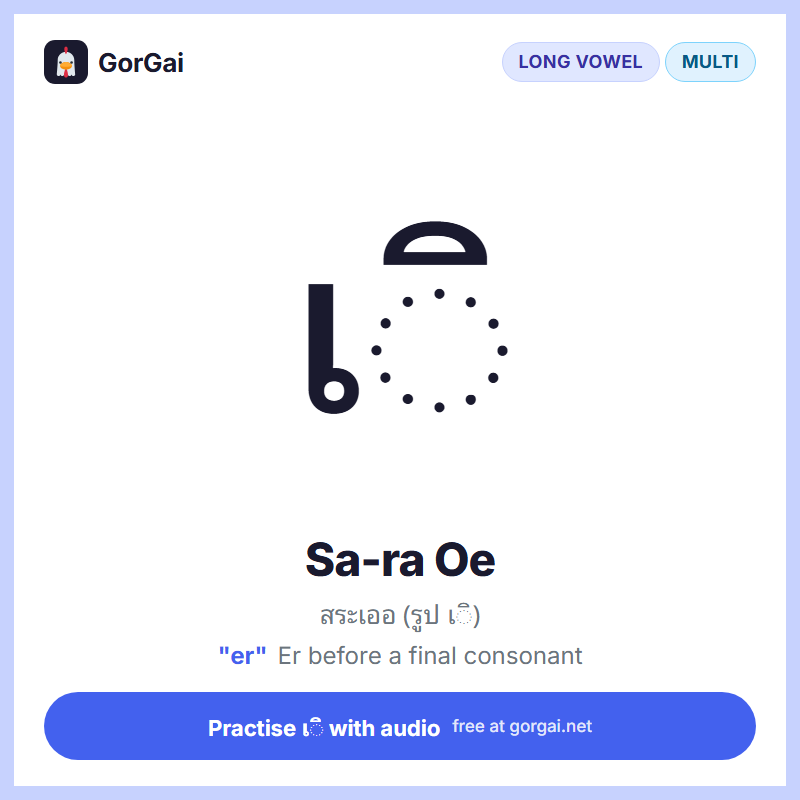
เ◌ิ
สระเออ (รูป เ◌ิ)
Sa-ra Oe
Er before a final consonant
#20
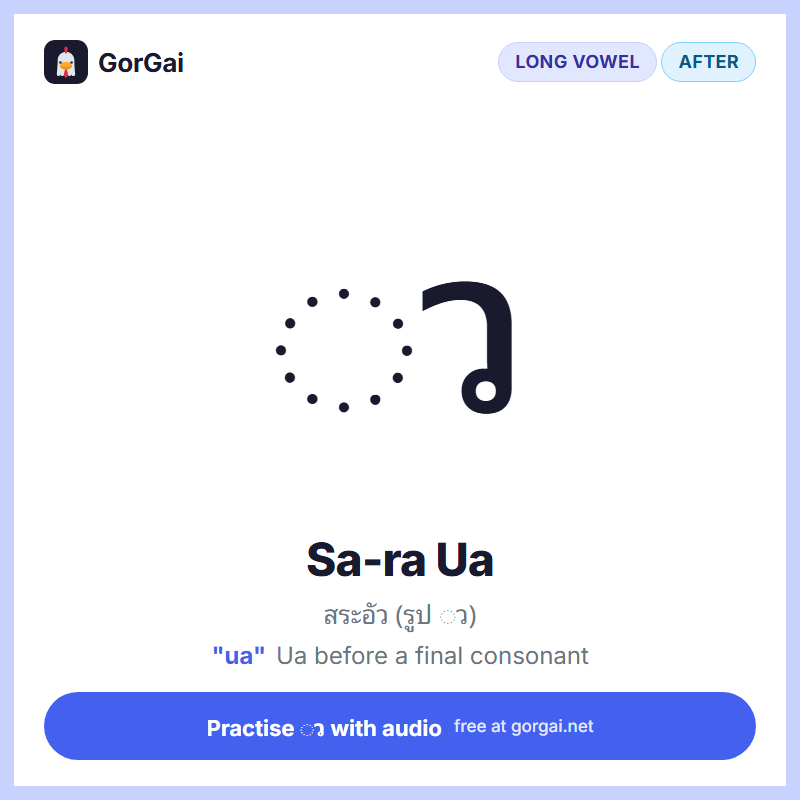
◌ว
สระอัว (รูป ◌ว)
Sa-ra Ua
Ua before a final consonant
#26
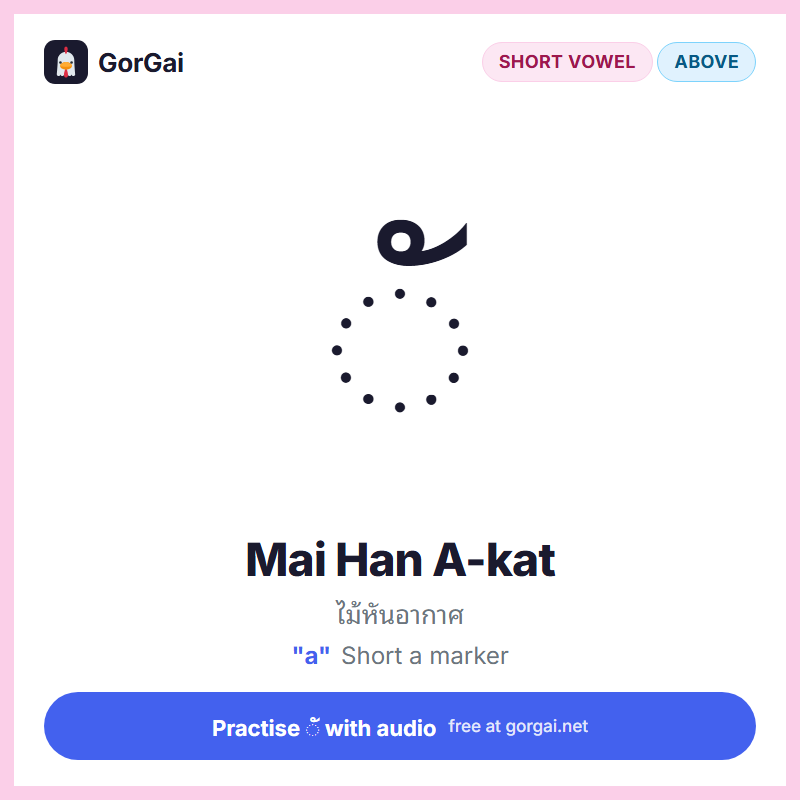
◌ั
ไม้หันอากาศ
Mai Han A-kat
Short a marker
#28
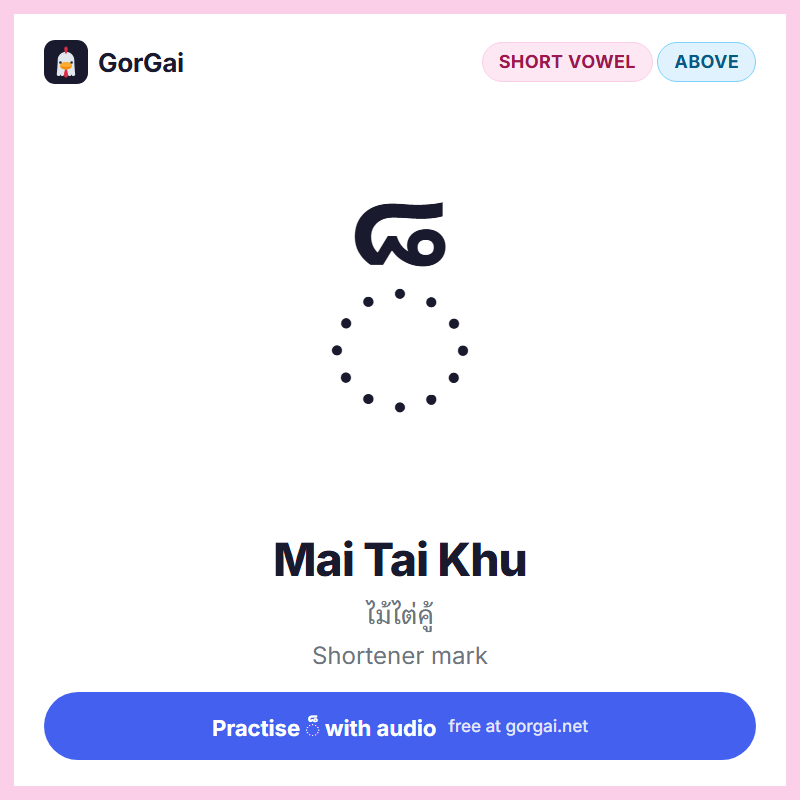
◌็
ไม้ไต่คู้
Mai Tai Khu
Shortener mark
#29
Where the vowel sits, and why the consonant still comes first
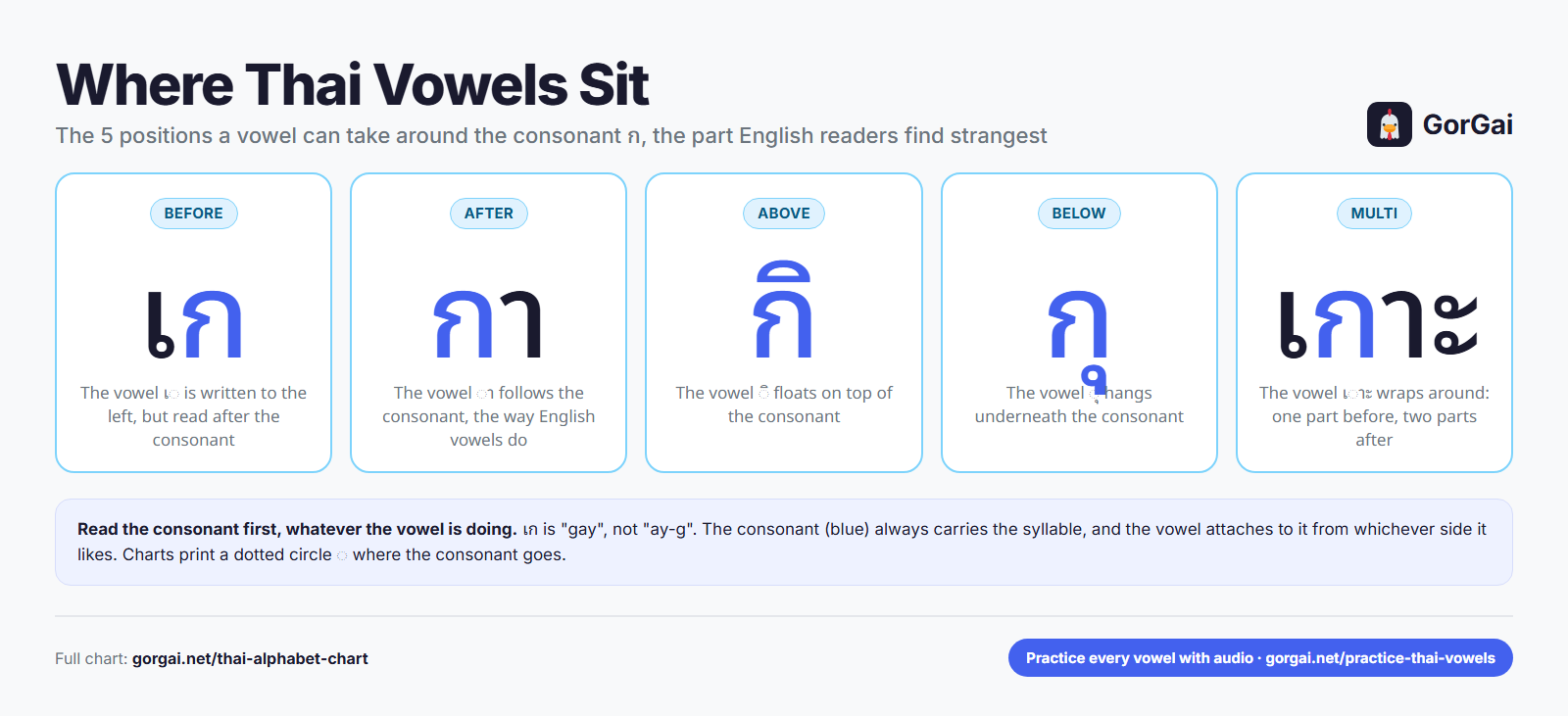
The five positions, all shown on ก. The consonant is blue because it is always read first.
Thai vowels are marks that attach to a consonant rather than letters in a row, so they can go after it (กา), above it (กิ), below it (กุ), before it (เก) or around it (เกาะ). The rule that makes this readable is simple and absolute: find the consonant, read it, then read whatever vowel is attached, wherever it is written. เก is "gay". The เ on the left is not read first even though it is written first.
Two consonants in a row with a "before" vowel in front, as in เปลี่ยน (to change), still follow the rule: the vowel belongs to the consonant cluster ปล, so you read "plian". The vowel practice mode drills each position separately, which is the fastest way to stop stumbling on the "before" vowels.
Short or long changes the word
Vowel length in Thai is not an accent or a matter of emphasis. It is part of the spelling and part of the meaning, and it also changes which tone rules a syllable follows. These pairs differ only in the length of the vowel:
Short
Say
Means
Long
Say
Means
กะ
ga
to estimate
กา
gaa
crow
ติ
ti
to criticise
ตี
tee
to hit
ดุ
du
fierce
ดู
doo
to look
เขะ
khe
(rare)
เข
khay
cross-eyed
ยัน
yan
to confirm
ยาน
yaan
vehicle
ขัด
khat
to scrub
ขาด
khaat
torn, missing
The habit to build: when you hear a Thai word, listen for how long the vowel is held before you worry about the tone. A long vowel is roughly twice the length of a short one, and Thai speakers hear the difference as clearly as English speakers hear "ship" and "sheep".
Vowels that change shape before a final consonant
This is the rule that separates people who can read a chart from people who can read a menu. Several vowels are written one way in an open syllable (nothing after the vowel) and another way when a consonant follows. The sound does not change; the spelling does.
Open
Before a final
Example
Say
Means
What happens
เ◌ะ
เ◌็◌
เด็ก
dek
child
the ะ turns into ◌็ on top
แ◌ะ
แ◌็◌
แข็ง
khaeng
hard
same trick for แ
โ◌ะ
(nothing)
คน
khon
person
the vowel disappears entirely
◌ะ
◌ั◌
กัน
gan
together
short a becomes ◌ั on top
◌ัว
◌ว◌
สวน
suan
garden
the ◌ั drops off
เ◌อ
เ◌ิ◌
เดิน
doen
to walk
the อ becomes ◌ิ on top
เ◌าะ
◌็อ◌
ล็อก
lok
to lock
mostly in loanwords
The hidden vowels: sounds with nothing written
Two vowels are sometimes not written at all, and they are the usual reason a word refuses to sound out.
The unwritten short "o". When a syllable is consonant plus consonant with nothing between them, read a short "o": คน (person) is "khon", ถนน is "tha-non", จน (poor) is "jon". This is the โ◌ะ vowel with its mark dropped.
The unwritten short "a". Between the first consonant and the rest of a longer word, an unwritten "a" is read: ถนน (road) is "tha-non", สบาย (comfortable) is "sa-baai", ขนม (snack) is "kha-nom". Thai speakers say it lightly, almost swallowed.
You will not get these from a chart. You get them from words, which is why the word reading practice breaks each word into syllables you can tap and hear, hidden vowels included.
Download the Thai vowels chart (free PDF and PNG)
One A4 page with all 32 vowels, the 4 extra written forms and all 8 tone and special marks, each with its sound, its length and where it sits around the consonant. No email address, no watermark. Prints on US Letter with "fit to page" ticked.
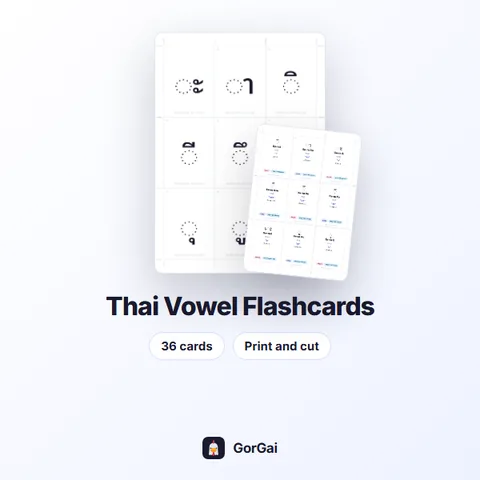
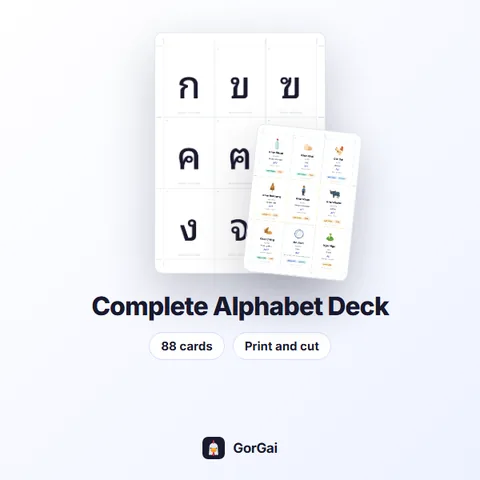
Everything above is free. If you would rather have the alphabet as cards you can cut out and shuffle, these are laid out for that: nine to an A4 sheet at playing card size, double sided so the answer prints behind its own letter, with no logo and no advert on the card.
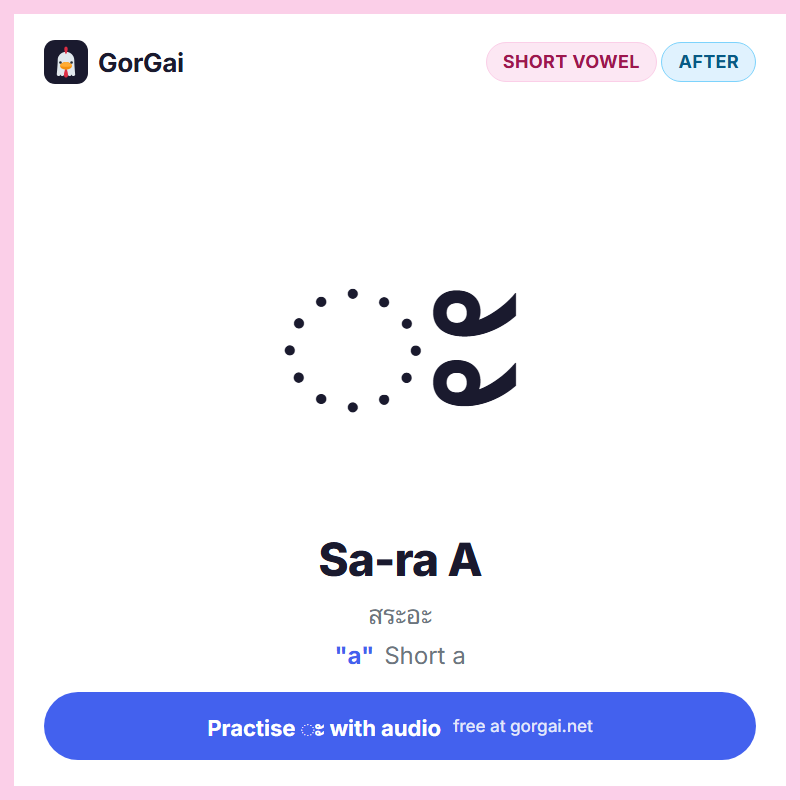
One square card per vowel form, showing the vowel around the dotted consonant, its name, its sound, and whether it is short or long and where it sits. Tap a card for the full-size image.
Thai has 32 vowel forms in the traditional count. Depending on how you count, there are 9 basic vowel sounds each with a short and a long version, 3 diphthongs, and a handful of special forms like ◌ำ, ไ◌, ใ◌ and เ◌า that bundle a vowel with a final sound. The chart on this page shows all 32, plus 4 extra written forms you meet in real words.
Why are Thai vowels written in different places?
Thai vowels are marks that attach to a consonant, not letters that sit in a line. A vowel can be written after the consonant, above it, below it, before it, or as several pieces around it. Whatever the position, you always read the consonant first: เก is "gay", not "ay-g". The dotted circle ◌ on charts shows where the consonant goes.
Does vowel length really change the meaning?
Yes, completely. กะ (short a) means to estimate and กา (long a) means crow. ติ means to criticise and ตี means to hit. Vowel length is not an accent; it is part of the word, and it also changes which tone rules apply to the syllable.
Which vowel is written but not pronounced, or pronounced but not written?
Both happen. The short "o" of โ◌ะ is not written at all when a final consonant follows: คน (person) is read "khon" with no vowel mark on the page. And between two consonants with nothing written, Thai reads a short "a": ถนน (road) is "tha-non". Learners call these the hidden vowels, and they are the usual reason a word will not sound out.
What is the difference between ไ◌ and ใ◌?
They sound the same, "ai". ใ◌ (mai muan) is used in only 20 words, which Thai children learn as a rhyme, and ไ◌ (mai malai) is used everywhere else. The 20 words are listed on the full alphabet chart page.
What are the 4 extra vowel forms on the chart?
They are not new vowels. They are how four existing vowels are written when a final consonant follows: ◌ั for short a (กัน), ◌็ as a shortener (เด็ก), เ◌ิ for เ◌อ (เดิน) and ◌ว for ◌ัว (สวน). Most charts leave them out, and then learners cannot read เด็ก, one of the most common words in the language.
About this chart
Part of the GorGai Thai alphabet chart, which also covers the 44 consonants, the tone marks, and how to read a syllable. Vowel names and forms follow Thailand's Royal Institute standards; frequency ranks come from the ThaiStat corpus at Chulalongkorn University. Free to use and share with a credit, CC BY 4.0. Last updated 2026-09-06.
🐔Enjoying GorGai? Install it for one-tap practice, offline and all!
What Learners Say
”Straight from the learnersCollected through Testimonial, not written by usUnedited
A note when something new lands, and nothing else. No spam, promise!
Thanks! Check your inbox to confirm.
🐔
pls whitelist us :(
We promise our ads will never get in the way of your learning.
An ad was meant to go here. Ads are what keep GorGai free, and not one of them is allowed inside the practice area, so nothing ever pops up while you are tracing.