The three modes
Every section of GorGai works the same way, so it is worth understanding the modes once. The switcher above the practice area splits them into Practice mode, which draws the letter for you, and Test mode, which hides it.
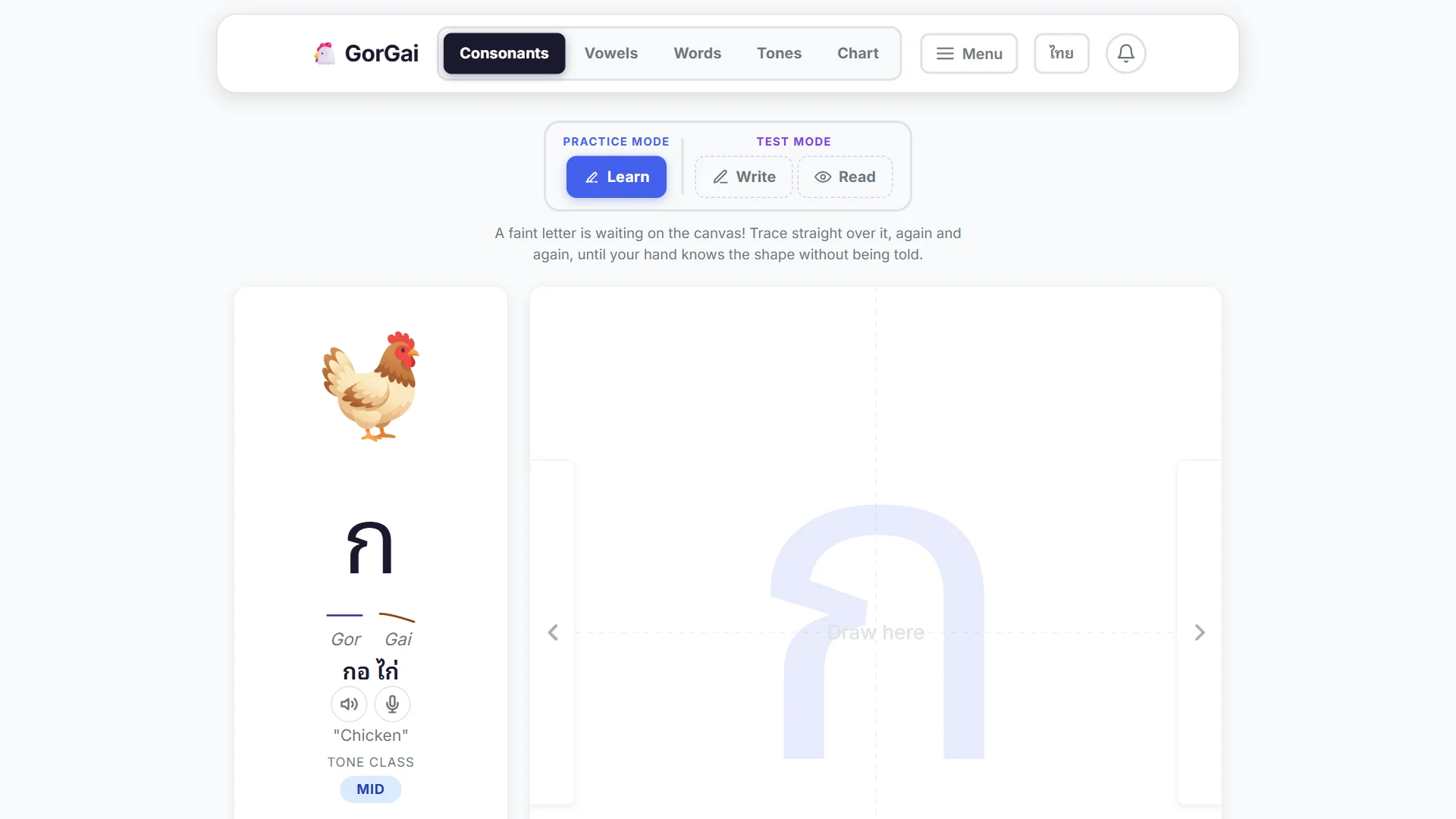
Learn: Trace it until your hand knows the shape
A faint guide character sits on the canvas and you draw straight over it, with a finger, a stylus or a mouse. This is the stage where you do not know the letter yet, and it is the only stage a printed worksheet can really help with. Beside the canvas you get the mnemonic (ก is gor gai, chicken), the romanisation, the tone class, and audio so you hear it while you draw it.
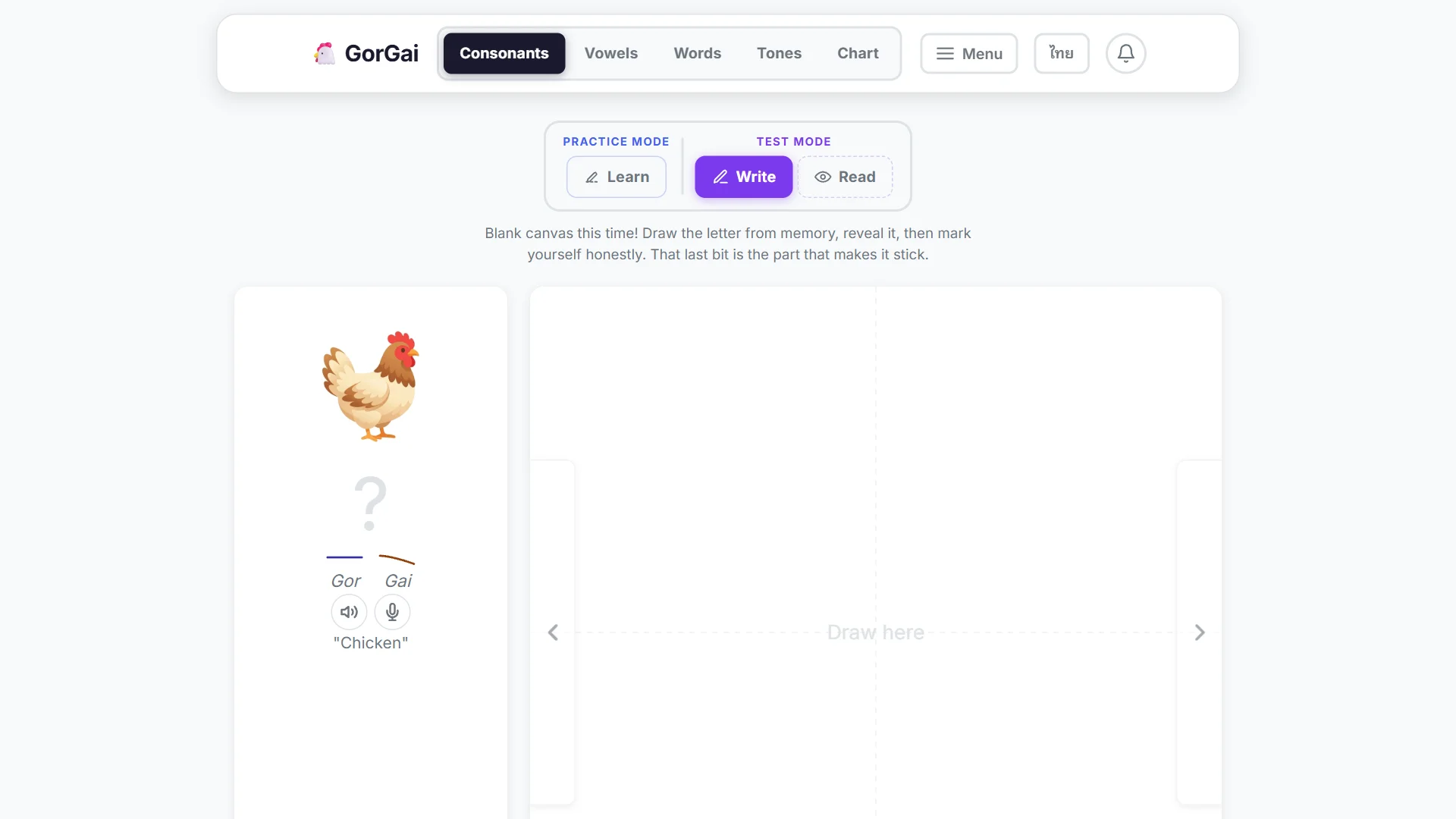
Write: Blank canvas, from memory, then mark yourself
The guide disappears and so does the letter. You get the emoji hint, the romanised name and a question mark where the character should be. You draw it from memory, reveal the answer, and mark yourself right or wrong. That last part is the one that makes it stick: being wrong and seeing exactly how is what builds the memory, and it is the thing a printed sheet can never do.
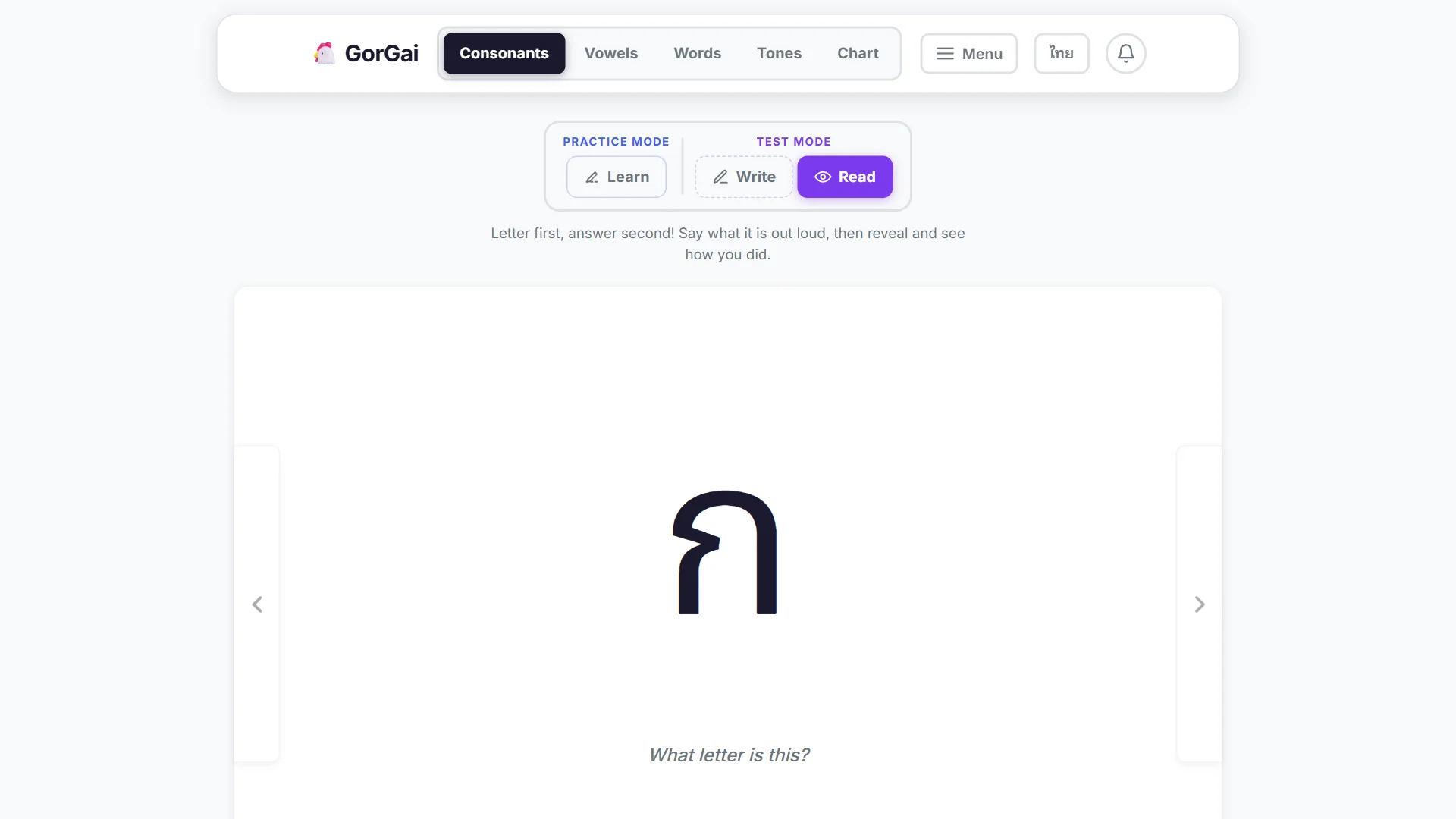
Read: See it cold and name it
The reverse test. You are shown the character with nothing else, you try to recall its name and sound, then you reveal the name, the tone class and the mnemonic to check. Writing and reading are genuinely different skills. It is very possible to draw a letter perfectly and still not recognise it on a sign, and this is the mode that fixes that.
Review mode, if you have ever used Anki
Write and Read both have a Review button next to the shuffle icon, with a number on it. That number is how many letters are waiting for you right now. Turn it on and GorGai stops running through the alphabet in order and starts running a proper spaced repetition schedule instead: the letters you keep missing come back in minutes, the ones you have nailed drop out of your way for days, then weeks.
It is the same algorithm Anki uses, on Anki's default settings, so the four buttons will look familiar. Again, Hard, Good, Easy, each one showing exactly when that letter will come back. Press 1 to 4 on a keyboard if you prefer. Everything you have already marked Got it or Wrong counts, so if you have been practising for a while the schedule starts from what you have shown it, not from zero.
When there is genuinely nothing left due, it says so and tells you when the next letter is back. There is a Practise anyway button right there, because being told to come back in six hours is a rubbish thing to hear when you sat down to study. 😊
The puff of air
One warning about the romanisation, because it catches everybody. Thai splits k, t, p and ch into two letters each: one said with a puff of air, one without. English does this too, you have just never had to think about it. Say "pin" and "spin" with a hand in front of your mouth and you will feel the difference.
The trouble is what the romanisation does with that. ผ and พ get written "ph", which is not an f: Phor Phan starts like "pan", not like "fan". ท and ถ get written "th", which is never the th of "think", a sound Thai simply does not have. And ก gets written "gor", which is not really a g at all.
So every consonant card now shows the sound properly, tells you which half of the pair it is, and points at an English word you already say correctly. There is a Sound row in the practice set filters too, so you can drill just the aspirated letters, just the unaspirated ones, or all 22 of the paired ones together.
What you can practise
All three modes work on each of these, so you can trace a vowel, write it blind, or read it cold in exactly the same way you would a consonant.
Consonants 44 letters
Where everyone starts. All 44 consonants, each with its gor gai style mnemonic and its tone class colour coded, because the class of the first consonant is one of the four things that decides the tone of a whole syllable later on.
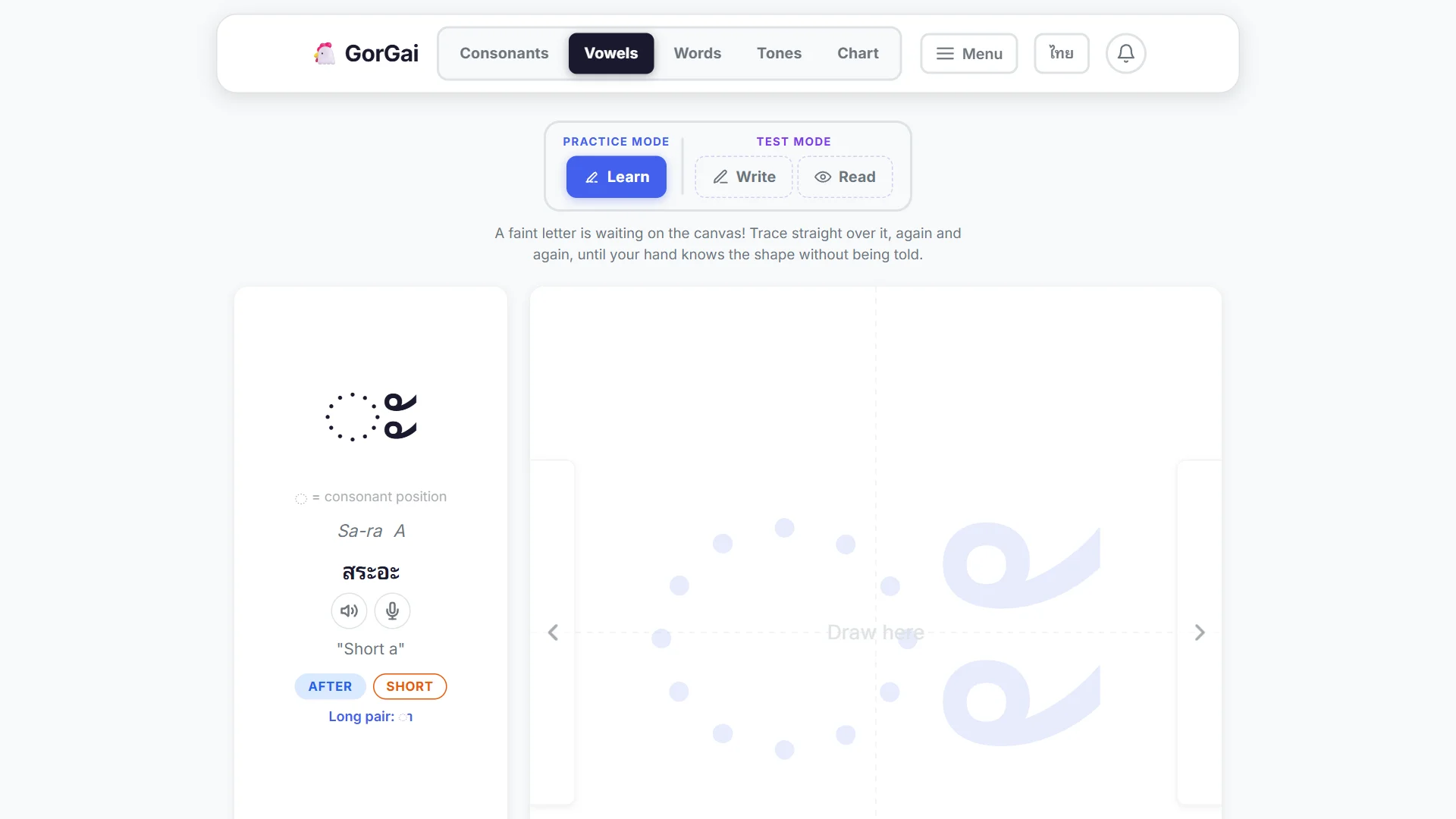
Vowels 32 forms
Thai vowels do not politely follow the consonant the way Latin ones do. A vowel can sit after it, before it, above it, below it, or wrap around it in more than one position at once, and that placement is most of the difficulty. Every form is tagged by position and paired short against long, including the awkward ones like ฤ and อำ.
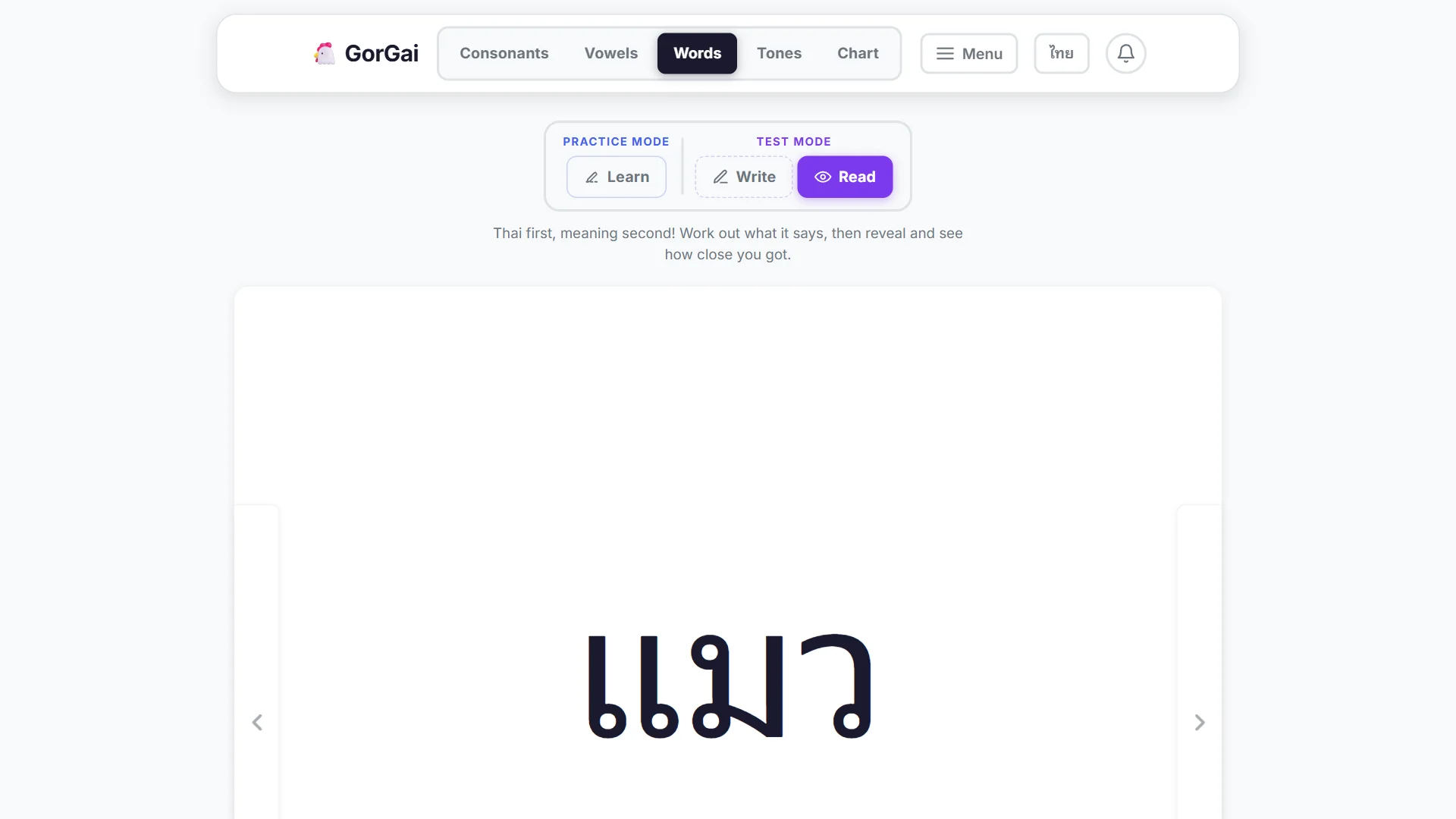
Words 89 words
Letters in isolation only get you so far. Here you work with whole words across eight everyday categories: animals, food, greetings, numbers, colours, body parts, places and daily life. Tap any syllable to hear it and see every character explained, including compound vowels that wrap around a consonant. In Read mode you get the Thai first and work out the meaning yourself.
Two reference pages
Not everything is practice. These two are for looking things up, and the tone rules page in particular is worth reading once the letters are automatic.
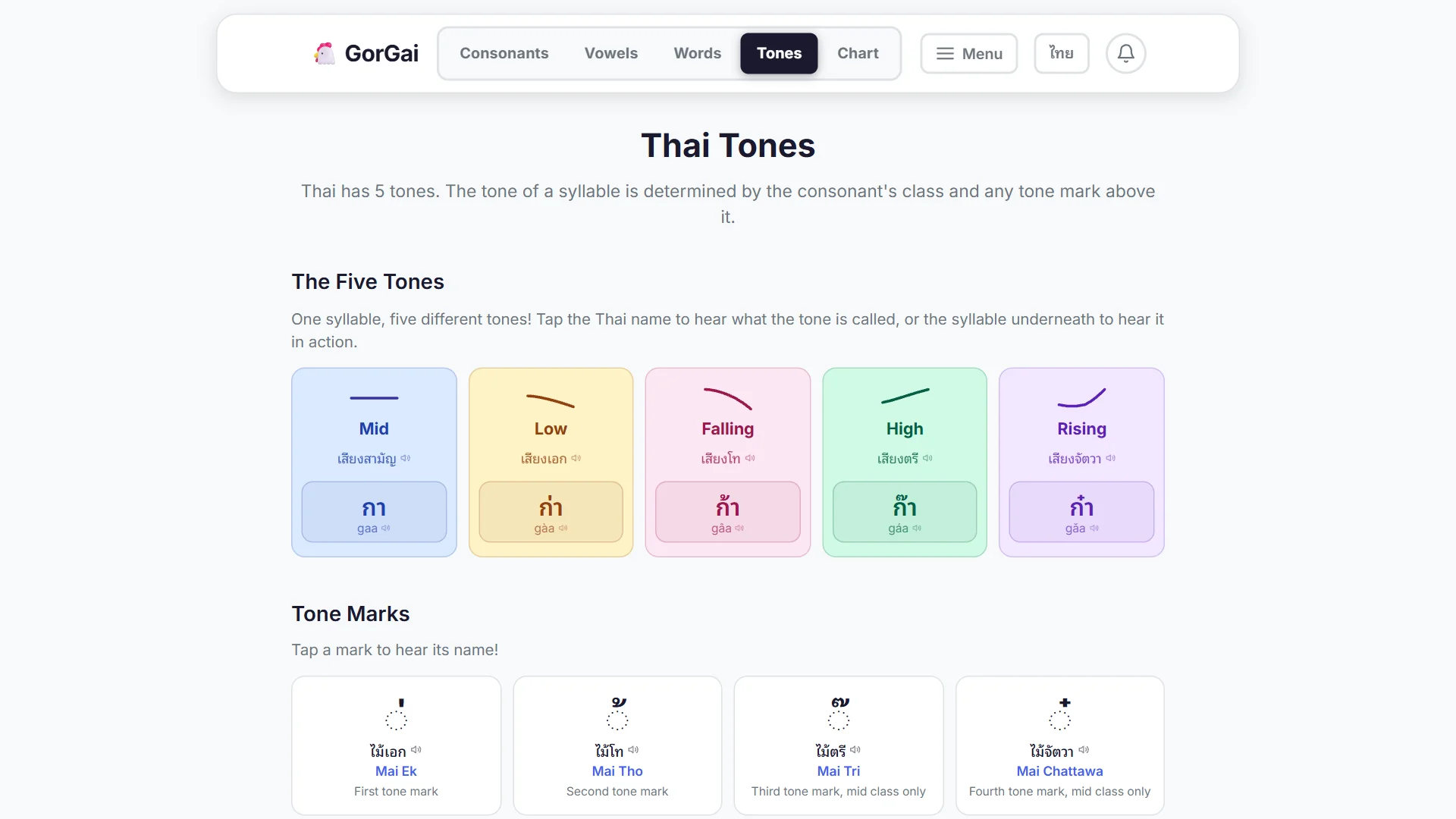
Tone rules
Five tones, and the tone of any written syllable follows from four things: the consonant class, the vowel length, whether the syllable is live or dead, and any tone mark. Those rules take an afternoon to understand. There is a quiz here once they do.
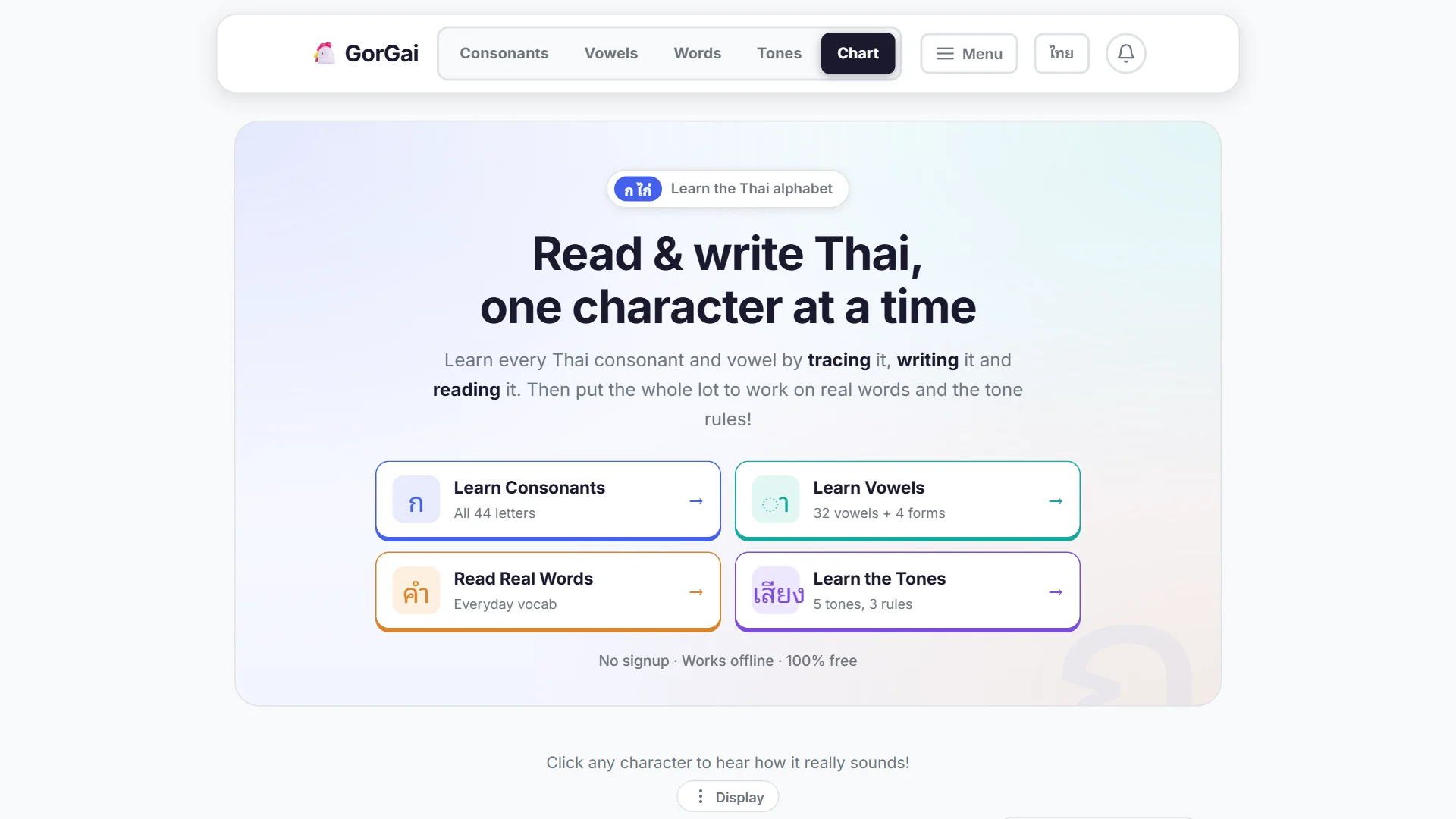
The full alphabet chart
Every consonant and vowel on one page, sorted by tone class, with audio on each. Useful when you want to see the whole system at once instead of one card at a time.
Away from the screen
A screen is better at sound, stroke order and deciding what you are due to see today. Paper is better at being on a wall while you do something else. Both are worth having, and the paper half costs nothing: the printable Thai alphabet chart PDF puts all 44 consonants on one A4 page and all 32 vowels plus the marks on the next, with no email and no watermark on it. Teachers can print a class set.
If you would rather cut them up than pin them up, the same 88 letters come as Thai alphabet flashcards, nine to a sheet at playing card size. The charts, the PDFs and every flashcard image on the site stay free either way.
How to actually use it
Fifteen minutes a day beats two hours on a Sunday, and it is not close. Recognising letters is a memory task, and memory responds far better to frequent short exposure than to one long session. Two hours once a week is also, in my experience, the schedule people abandon first.
- Recognise before you write. Run Read mode on the consonants until the shapes are familiar, then start writing them from memory. Trying to do both at once is slower.
- Narrow the set to what you keep getting wrong. You can filter the practice set down to specific letters, so once eight of them are the problem, practise those eight instead of cycling through all 44.
- Leave the tone rules until the letters are automatic. The rules depend on knowing consonant classes, and consonant classes are just another property of letters you already need to know.
- Move to words earlier than feels comfortable. Reading a real word forces you to handle vowels that sit before or around a consonant, which is the thing single letters never teach.
Do I need an account?
No. GorGai has no account, no login and no signup. Your progress is saved in your own browser using local storage, which means it is instant and private to your device, and nobody else ever sees it. The trade-off is that progress does not follow you between devices or survive clearing your browser data.
Is GorGai free?
Yes, and it stays free. There is no premium tier, no trial and nothing to unlock. Ads cover the hosting, and they are deliberately kept out of the practice area itself so nothing sits between you and the canvas. The one thing on the site with a price on it is the printable flashcard packs, and every letter in them is already here for nothing in another form.
How long does it take to learn the Thai alphabet?
Most people recognise all 44 Thai consonants within one to two weeks of daily practice and write them from memory within two to four weeks. Vowel forms and simple words follow in the second month, and basic sentences around the third. That is for reading, which is a much shorter project than speaking Thai fluently.