← Interactive Thai alphabet chart Thai Alphabet Flashcards
All 44 consonants, all 32 vowels and the 8 marks, as cards. Free square images to save
to your phone or drop into Anki, and print-and-cut decks if you want them on paper. Letter
on the front, everything you need on the back.
Start here, and pay nothing
The charts and the printable PDFs are free, with no email address and no watermark. If a
wall chart is what you came for, take it and go. Nothing below is needed to learn the
alphabet.
Plus five chart images, and a free square flashcard image for every letter: all 44 consonants and all 36 vowel forms, each with the
sound and the class on it. Save them, put them on a slide, or import them into Anki.
Everything free is also listed on the printable chart page.
And if you want the cut-out deck
Four packs, all instant downloads. Nine cards to an A4 sheet at 63 by 88mm, which is
playing card size, laid out for double-sided printing so each answer lands behind its own
letter. Cut marks sit in the margins so no printed line ends up on the finished card.
Most popular Thai Consonant Flashcards
All 44 consonants, print and cut
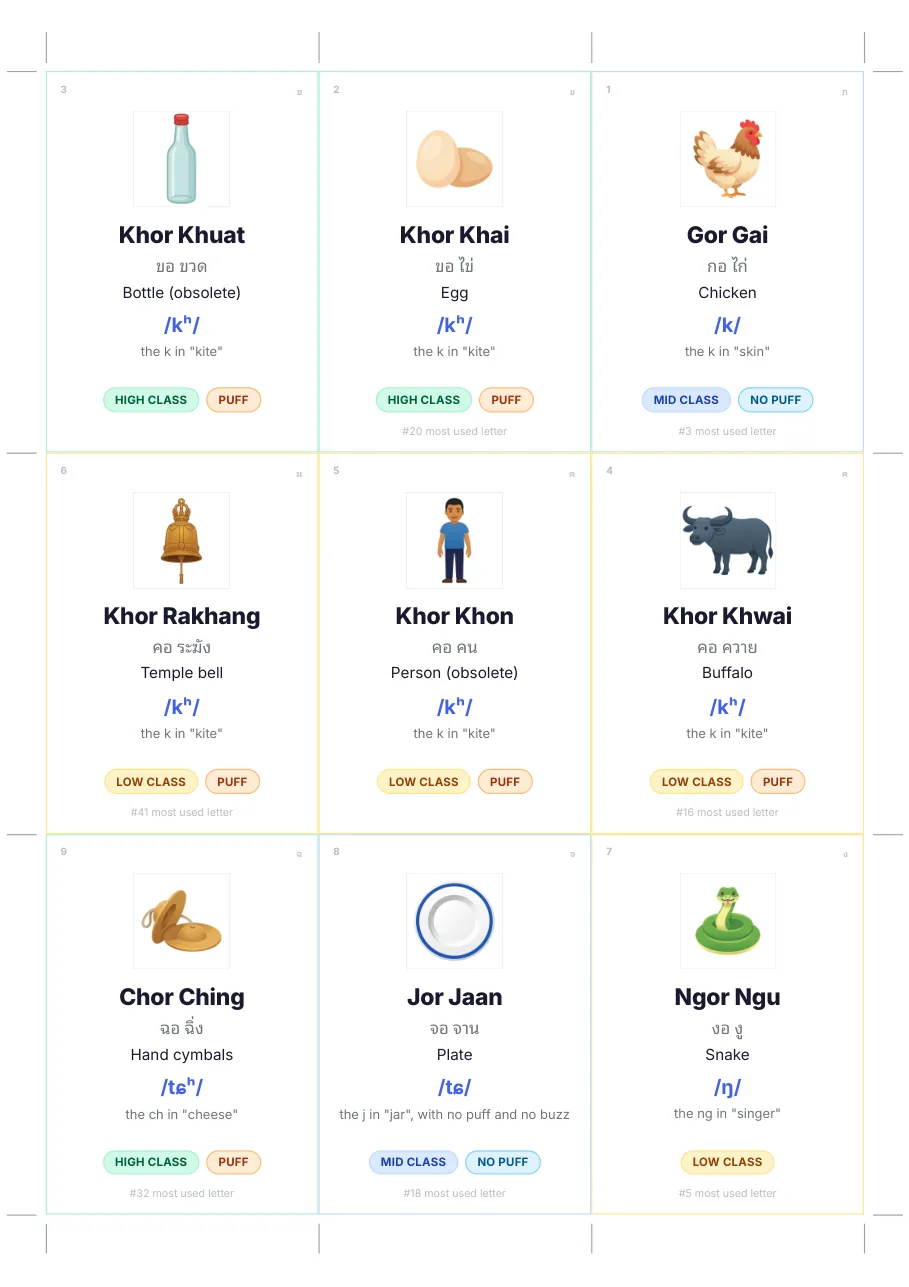
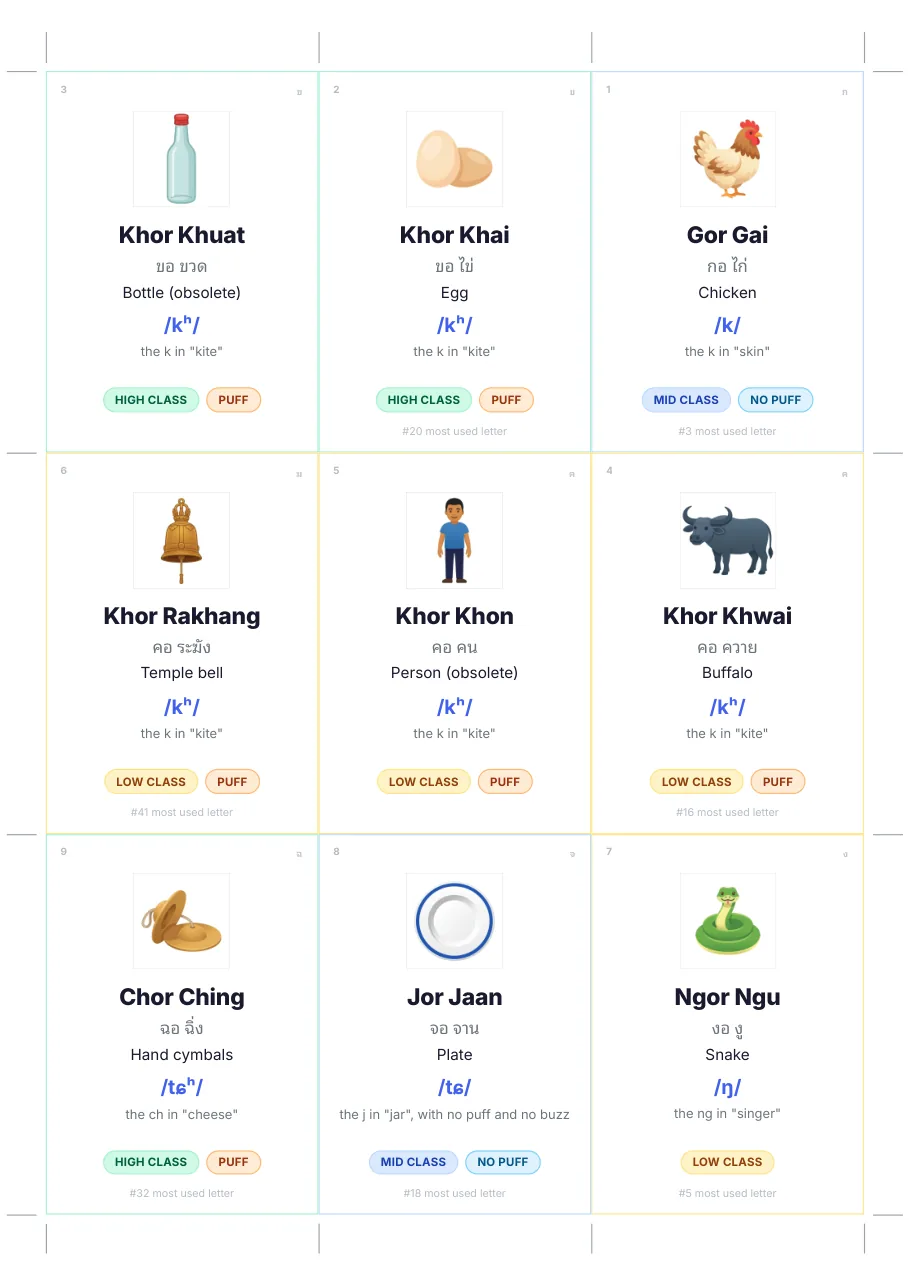
The letter on the front, everything you need on the back: the picture word, the traditional name, the real sound in IPA, whether it takes a puff of air, and the tone class. Nine cards to an A4 sheet at playing card size, laid out for double-sided printing so each answer lands behind its own letter.
- 44 double-sided cards, 63 x 88mm, ready to print and cut
- Cut marks in the margins, so no printed line ends up on the card
- Backs colour coded by tone class, and numbered so a dropped deck sorts itself
- The same 44 cards as square PNGs for Anki or a slideshow
- No logo, no advert, no gorgai.net on the card
Who it is for: Anyone who learns better on paper than on a screen, and anyone building an Anki deck who wants the artwork done.
Thai Vowel Flashcards
All 32 vowels plus the 4 written forms
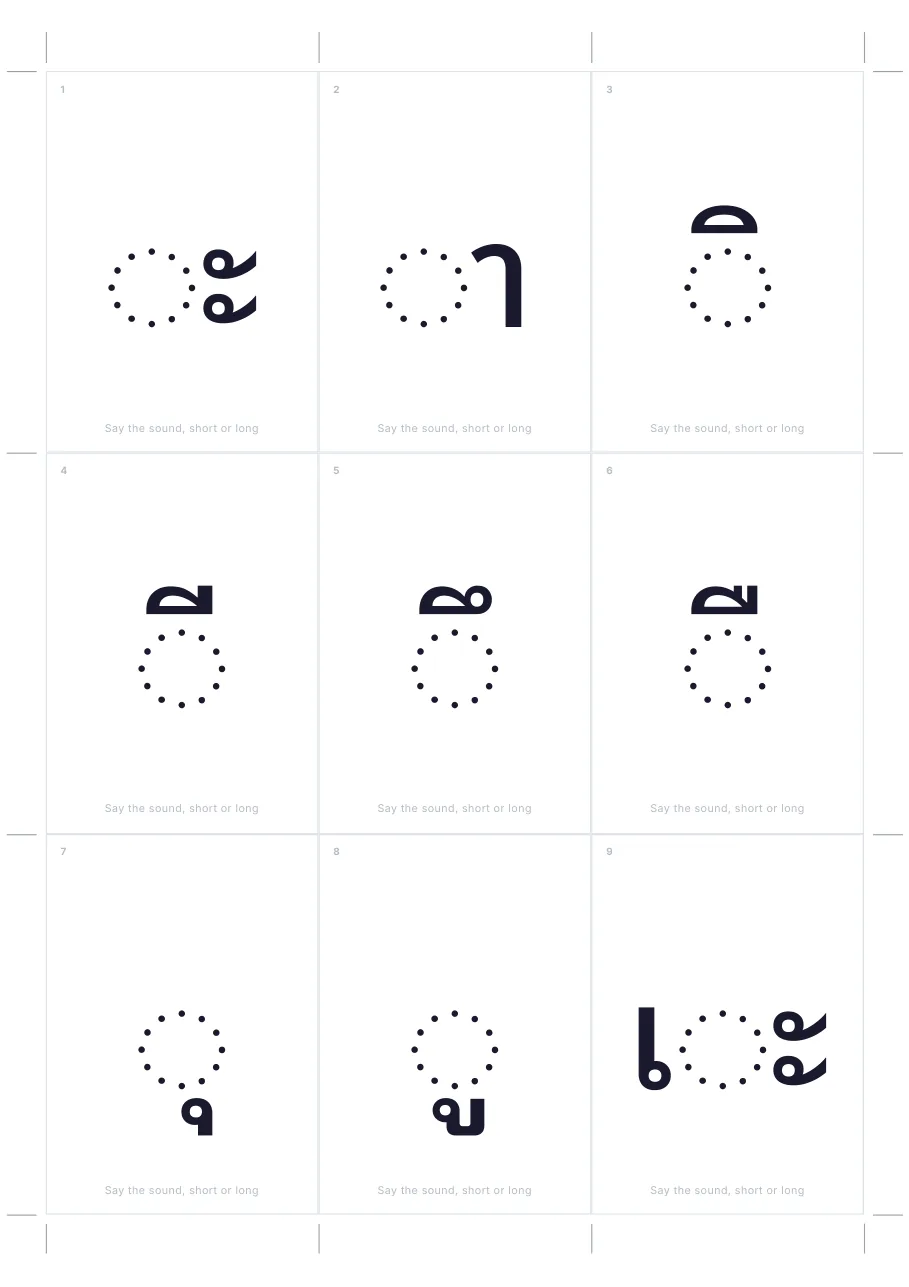
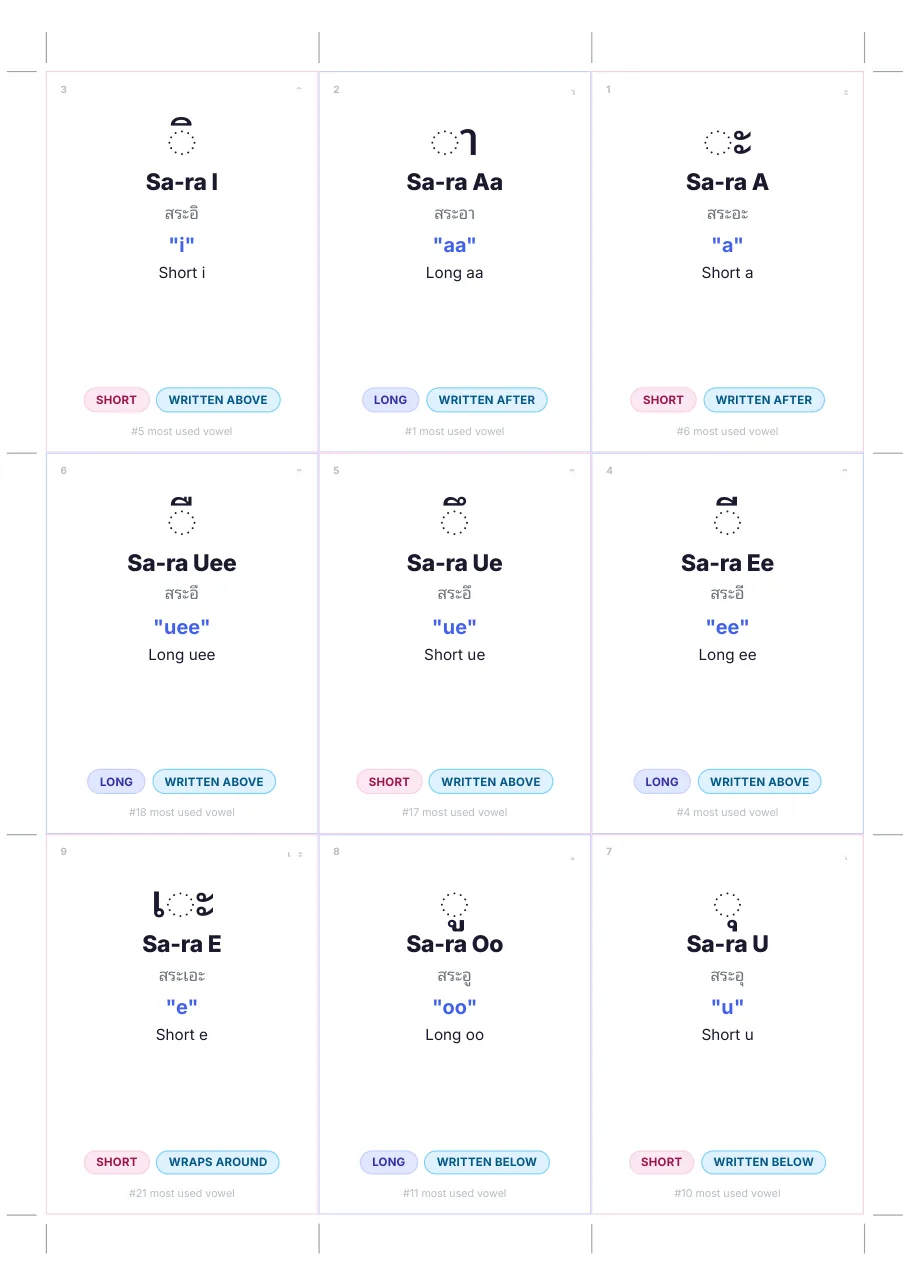
The vowels are the part that trips English readers up, because they can sit before, after, above, below or all the way around the consonant. Each card shows the vowel with its dotted circle on the front, then the sound, the length and the position on the back.
- 36 double-sided cards, 63 x 88mm, ready to print and cut
- The 4 extra forms that appear before a final consonant, which most charts skip
- Short and long colour coded so you can deal the pairs against each other
- The same 36 cards as square PNGs
- No logo, no advert, no gorgai.net on the card
Who it is for: Learners who know most of the consonants and keep guessing at the vowels.
Best value Complete Alphabet Deck
Consonants, vowels and the marks
Everything above, plus the eight tone and special marks that almost no alphabet pack bothers with, including the one that silences a letter. Four PDFs so you can print a section at a time, and all 88 cards as PNGs.
- 88 double-sided cards: 44 consonants, 36 vowels, 8 marks
- Four print files: the whole deck, and each section on its own
- All 88 cards as square PNGs for Anki, slides or a phone lock screen
- No logo, no advert, no gorgai.net on the card
Who it is for: Anyone going through the whole writing system rather than picking at one part of it.
Teacher Pack
The deck, the posters, and a licence to print for a class
The complete deck plus the five wall charts at print resolution, big enough for A2. It also carries the two half-branded card sets: one with the GorGai logo but no call to action for handouts where you want to credit the source, and one with the call to action but no logo. Print as many sets as your classes need.
- Everything in the complete deck
- 5 posters at print resolution: consonants, vowels, tone marks, vowel positions, consonant classes
- Card sets in three brandings: clean, logo only, and link only
- Licence to print unlimited copies for your own students
Who it is for: Thai teachers, tutors, homeschoolers and anyone printing a set for more than one person.
Buying opens Gumroad in a new tab. They handle the payment, the tax and the emailing, so
no card details ever touch this site. Files arrive within a minute. Not what you expected? Email hello@gorgai.net and you get your money back.
What is actually on a card
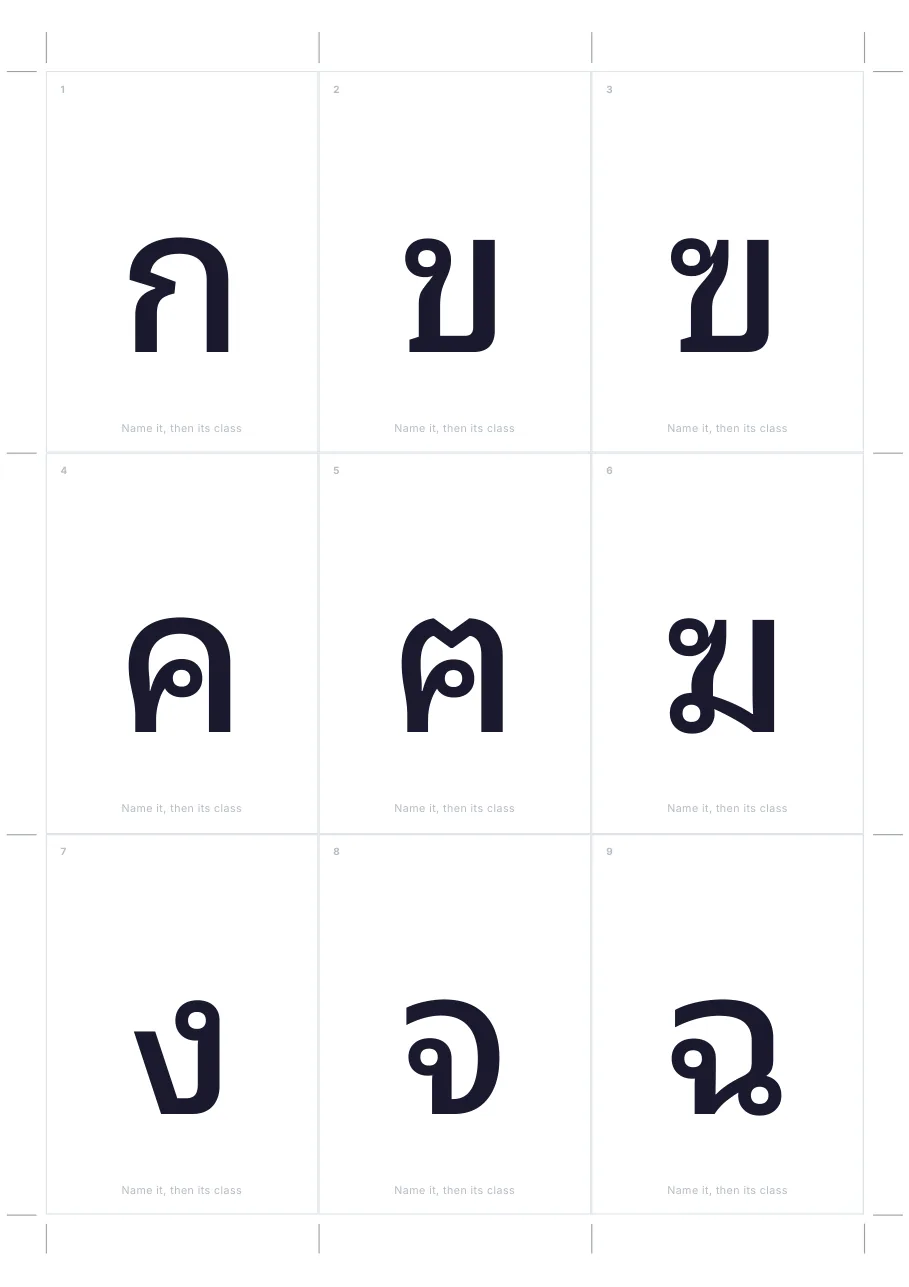
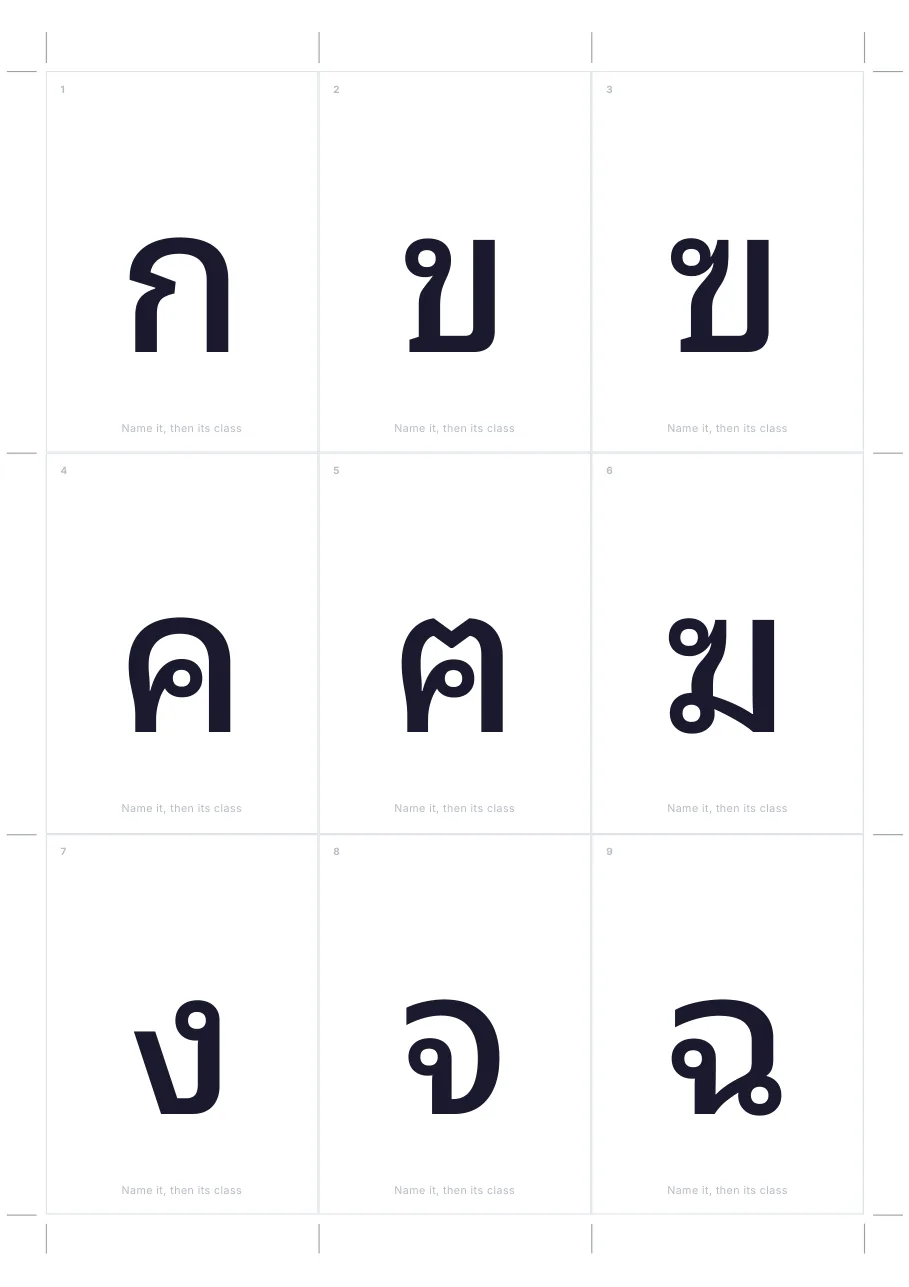
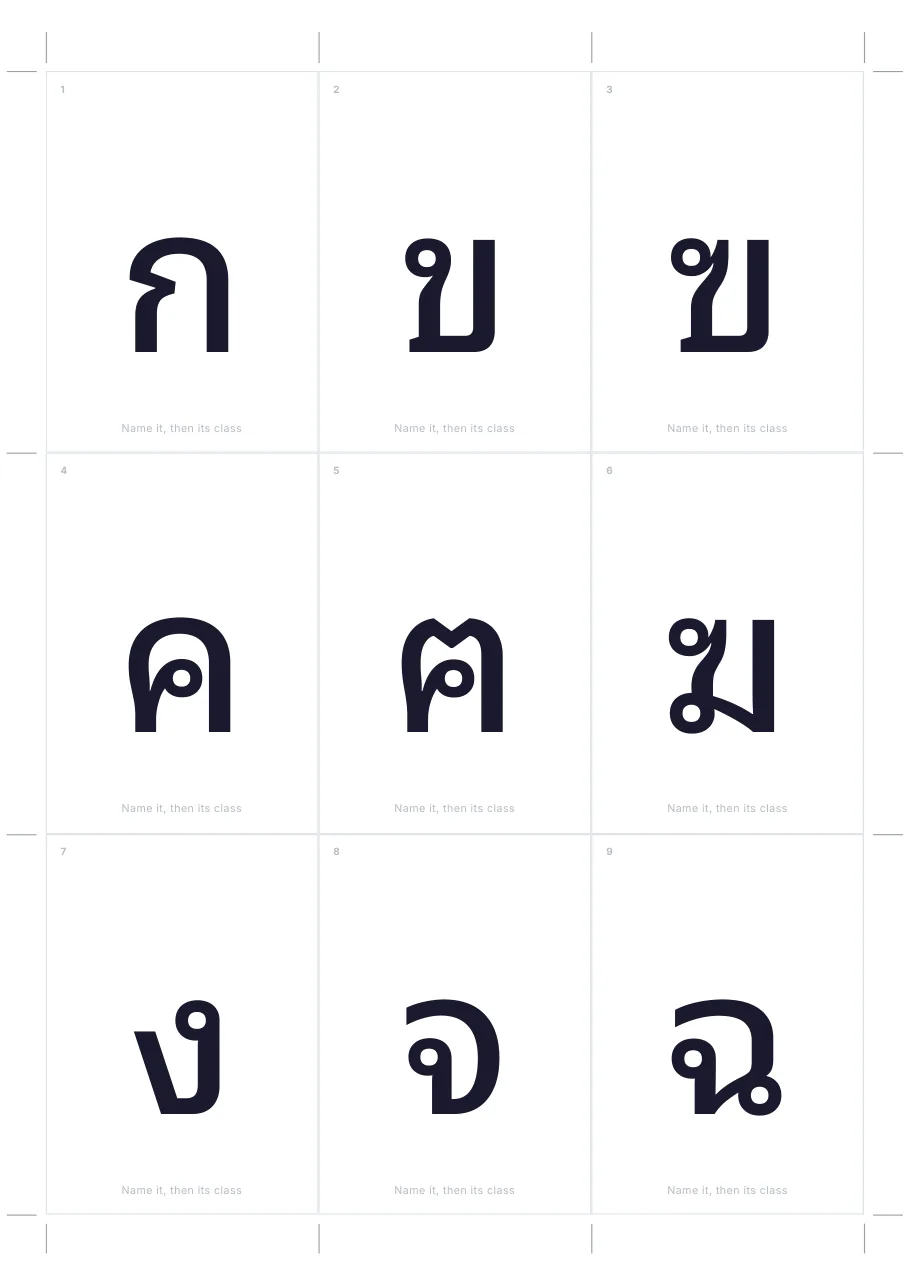
The front is the letter and nothing else, at about 46mm tall, so it reads from across a
table. There is a small number in the corner, which is alphabet order, and one line of
prompt telling you what to try and recall before you flip it.
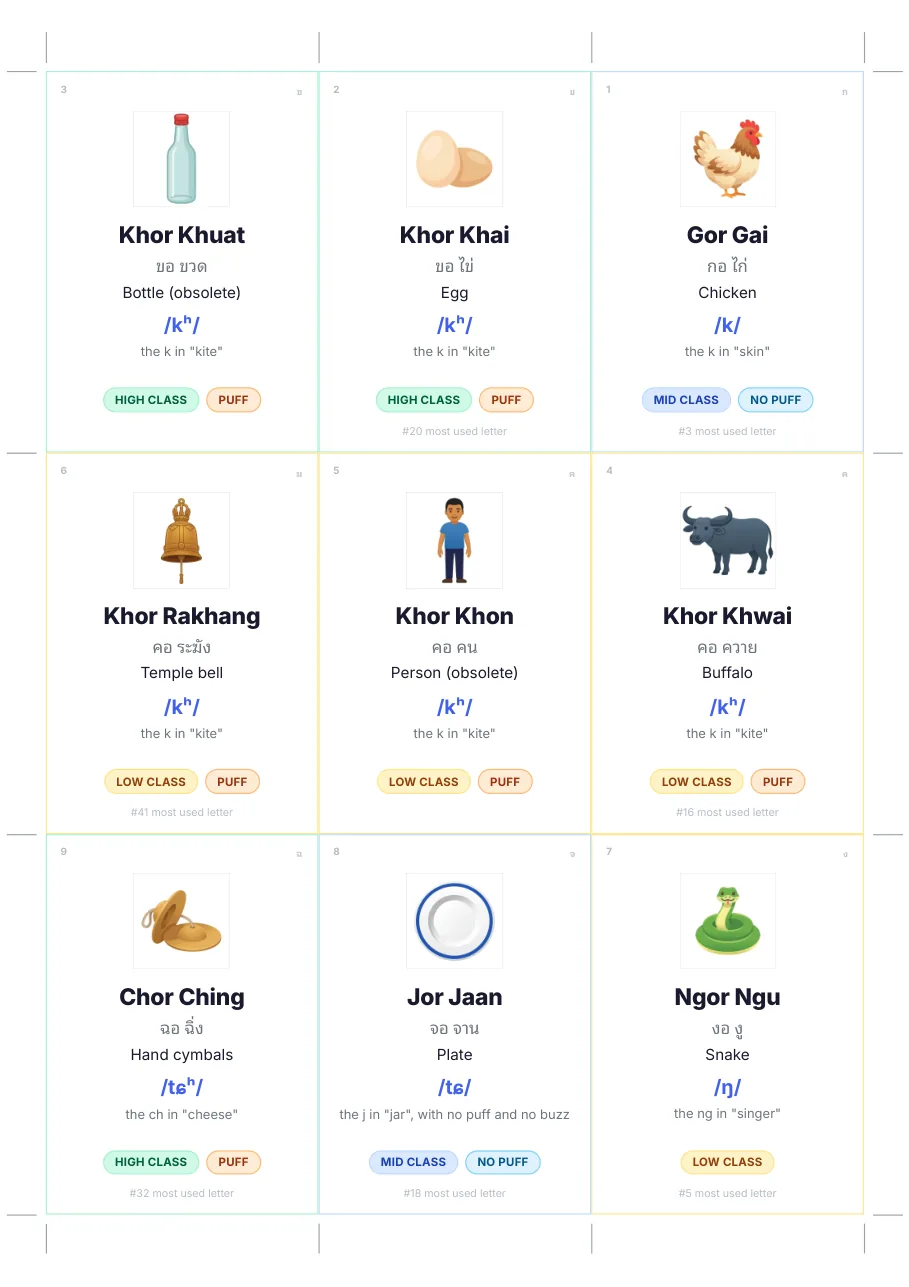
The back of a consonant card carries five things:
- The picture word, drawn rather than photographed, the same one Thai children learn: ก ไก่ the chicken, ข ไข่ the egg.
- The traditional name in Thai script and in English letters.
- The real sound in IPA, with a plain English example beside it. This is the part romanized names get wrong: ก is not a g, it is the k in "skin", and the "th" in Thor Thahan is never the th in "think".
- A puff or no puff marker. Thai splits k, t, p and ch into an aspirated and an unaspirated half, and English speakers reach for the wrong one constantly. Hold a hand in front of your mouth: on a puff card you should feel air.
- The tone class, in colour and as a word, plus how common the letter actually is in written Thai.
Vowel cards carry the sound, the name, whether it is short or long, and where the vowel
sits around the consonant. Mark cards say what the mark does to the letter underneath it.
Why paper, when there is a free app right here
Because they do different jobs. The site is better at the sound, the stroke order and the
scheduling: it can play you a native recording, animate the strokes and decide what you
are due to see today. What it cannot do is sit on a kitchen table while four people take
turns, or get shuffled, or go in a pocket on a flight with no wifi.
Physical cards also make you commit. On a screen the answer is one tap away and it is very
easy to half-remember, tap, and tell yourself you knew it. With a card in your hand you
say the answer out loud first, because turning it over takes effort. That gap is where the
learning happens, and it is the whole argument for cardboard.
How to print them properly
- Double sided, flip on long edge. This is the setting that matters. The backs are laid out mirrored to suit it, so with any other flip setting every card ends up with somebody else's answer.
- Scale 100%, not "shrink to fit". Shrinking moves the cut marks and the cards stop being card sized.
- Card stock if you have it. 200gsm survives a year of shuffling. Ordinary paper is fine and is what most people use.
- Cut with a ruler. Line it up with the small marks in the margins. A guillotine is faster if you have one, and a class set is worth borrowing one for.
Every pack opens with a cover sheet repeating all of this, so you do not have to come back
here to find it.
Three ways people use them
- The growing pile. Start with ten cards, not eighty. Add three a day. Anything you get wrong goes back on top of the pile rather than at the bottom, so it comes round again in a minute rather than tomorrow.
- Sort by class. The backs are colour coded, so you can fan the deck face-down and split it into mid, high and low without reading a word. Drill one class at a time; the class is the fact that decides the tone of every syllable the letter starts, so it is the one worth over-learning.
- Two players. One holds the card, the other says the name, the sound and the class. Swap when you miss one. This is the version that works with a Thai partner or a child, and it is the version people actually stick with.
If you want the same idea with a scheduler doing the choosing, the site's read mode runs Anki's algorithm on Anki's defaults and
costs nothing.
Using these as an Anki deck
Every card is a square PNG as well as a print sheet, which is the format Anki wants. There
is no .apkg to import and no add-on to install: you make the deck once and it is yours to
edit, which is better than inheriting somebody else's field layout.
- Get the images. The free set is on the chart page, one file per letter, with the GorGai mark on it. The paid packs carry the same 88 cards clean.
- Drop them in your media folder. In Anki, Tools then Check Media shows you where that is. Copy the PNGs in.
- Make a two-field note type, Front and Back. Put
<img src="thai-consonant-gor-gai.png"> on the back and the bare letter on the front, so you are recalling the answer rather than recognising the picture. - Or skip Anki entirely. The site already runs Anki's algorithm on Anki's defaults, free, with audio: read mode schedules every letter for you and needs no setup at all.
Worth saying plainly: if all you want is spaced repetition on the Thai alphabet, the site
does it and costs nothing. The images are for people who already live in Anki and want
their Thai cards in the same place as everything else.
Questions about Thai alphabet flashcards
What is the difference between these and the free flashcards?
The free ones are square images, one per letter, with the GorGai logo and a link on them. They are made for a screen: save them to your phone, drop them into Anki, put one on a slide. These are made for paper. Each card is 63 by 88mm, the size of a playing card, printed nine to an A4 sheet with the answer laid out on the reverse so a double-sided print comes out right. There is no logo and no link on the card, because a card you cut out and keep in a pocket for a year should not be carrying an advert.
How do I get the files after paying?
Gumroad emails them to you within a minute of the payment going through, along with a link you can come back to whenever you need it. Nothing is shipped, nothing arrives in the post, and there is no account to make on this site.
Do I need a colour printer?
No. Colour is nicer because the tone classes and the vowel lengths are colour coded on the backs, but every card also prints the class and the length as a word. On a black and white printer you lose the shortcut, not the information.
What paper should I use?
200gsm card if you have it, because it survives being shuffled. Ordinary printer paper works and is what most people use; glue two sheets back to back or slip the cards into sleeves if you want them stiffer. The cover sheet inside every pack has the print settings written out.
Will it print on US Letter?
Yes, with "fit to page" ticked in the print dialog. The cards come out about 4% smaller than 63 by 88mm, which is fine unless you are set on sleeving them, in which case print at 100% on A4.
Can I use these with my students?
The single packs cover you, your family and your own printing. The Teacher Pack adds a licence to print as many sets as your classes need, plus the five wall charts at a size that holds up on A2. Reselling the files or passing them on as your own is the only thing that is off the table.
Why sell anything, when the rest of the site is free?
The chart, the audio, the three practice modes, the printable PDFs and every flashcard image are free and stay free. Ads pay for the hosting, badly. These packs are the same alphabet in a format that took a long weekend to lay out properly, and a few of them a month means the free half never has to get worse.
What if it is not what I expected?
Email hello@gorgai.net and you get your money back. Digital files cannot be sent back, so there is nothing to return.
Where the content comes from
The letters, names, classes and picture words follow the Gor Gai curriculum taught in Thai
schools and the Royal Institute's romanization; the IPA follows the standard description of
Thai initial consonants; the frequency ranks come from the ThaiStat corpus at Chulalongkorn
University. Every card is generated from the same data that drives the interactive chart, so a card cannot say one thing while
the site says another. Last updated 2026-09-06.