
Thai Alphabet Chart: All 44 Consonants and 32 Vowels, with Audio and a Printable PDF
This Thai alphabet chart shows every one of the 44 Thai consonants (พยัญชนะไทย) and all 32 vowel forms (สระไทย) in one place, with a picture for each letter, its traditional Gor Gai name, the real sound in IPA, its tone class and native audio. Scroll up and click any character to hear it. Scroll down for the printable version, the letters grouped by class, and the parts most charts leave out: which letters to learn first, what happens at the end of a word, and how to actually read a syllable.
Unlike a static poster, the chart at the top is interactive. Tap a letter to hear it, switch between alphabetical and most-used order, and hide the romanization when you want to test yourself. When you need paper instead, the same chart is below as a free PDF.
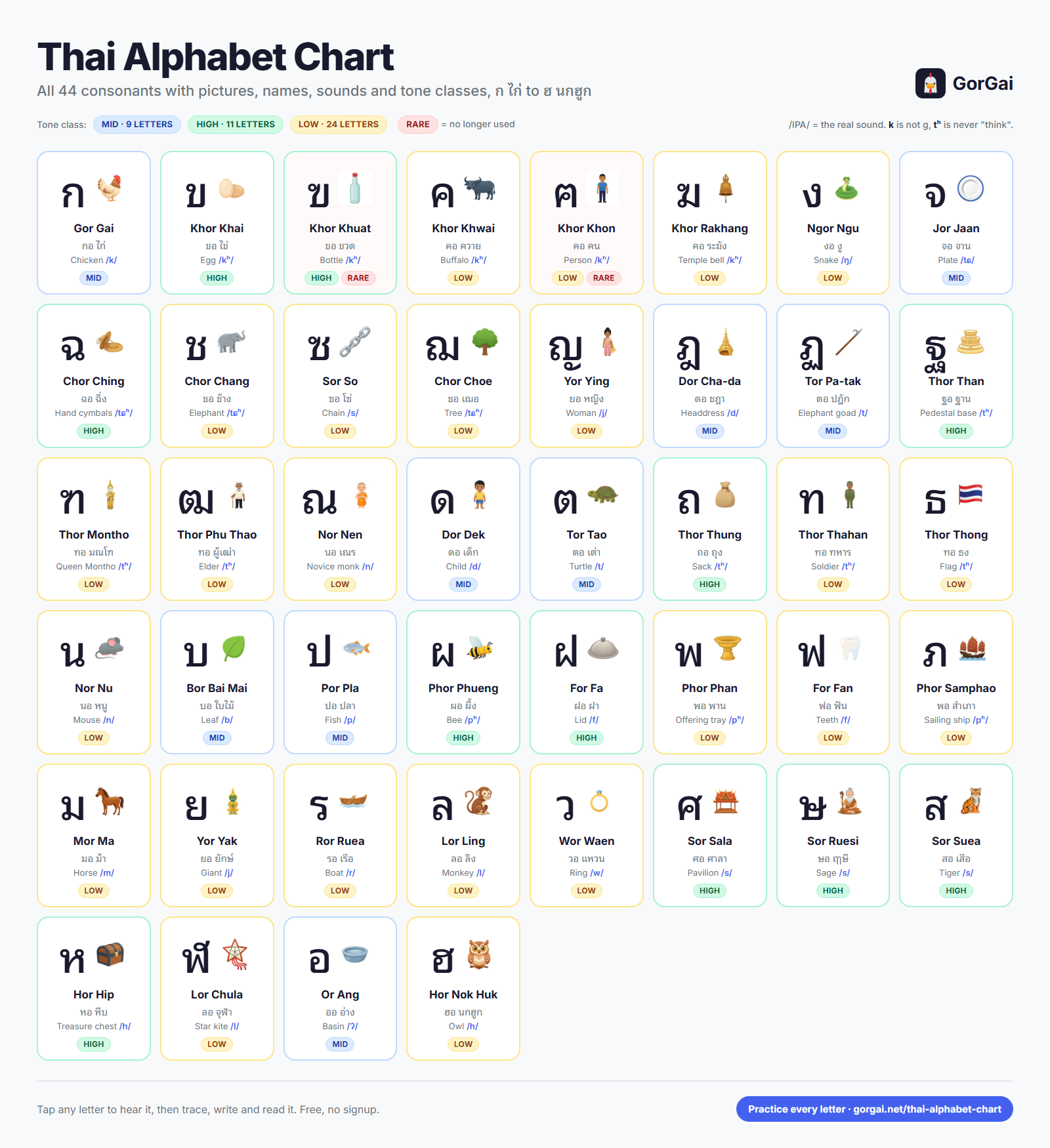
Download the printable Thai alphabet chart (free PDF and PNG)
Three PDFs, no email address, no watermark. Take the whole alphabet on two A4 pages, or just the half you are working on. They all print fine on US Letter too, just tick "fit to page".
Just the consonants, or just the vowels
Most people work on one half at a time, and a two-page file with the wrong half on it is a page you keep flipping past. So each half has its own one-page PDF, and its own chart page with a searchable table and a frequency rank for every letter.
Consonants onlyAll 44 letters on one A4 page
Every letter with its picture word, name, IPA sound and tone class. The one to pin up while you are still learning the alphabet.
Vowels onlyAll 32 vowels and the 8 marks, one A4 page
Sound, length and position for every vowel, plus the 4 extra written forms and all 8 tone and special marks.
The same charts as images
For a phone lock screen, a slide or a document rather than paper. All 1600 pixels wide, so the letters stay sharp on a screen.
Want one letter at a time instead? Every consonant and vowel is also a square flashcard image further down, with the sound and the class on it. Print tips, page previews and the FAQ about the files are on the printable Thai alphabet chart PDF page.
A few ways people use it: stuck on the fridge for a month, printed at 50% as a bookmark for a Thai textbook, or saved to the phone's photos so it is there in the queue at immigration. The PNGs are sized so the letters stay sharp on a phone screen.
Printable flashcard packs
Everything above is free. If you would rather have the alphabet as cards you can cut out and shuffle, these are laid out for that: nine to an A4 sheet at playing card size, double sided so the answer prints behind its own letter, with no logo and no advert on the card.
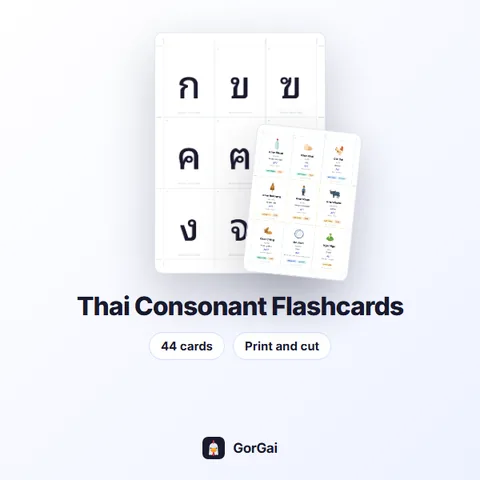
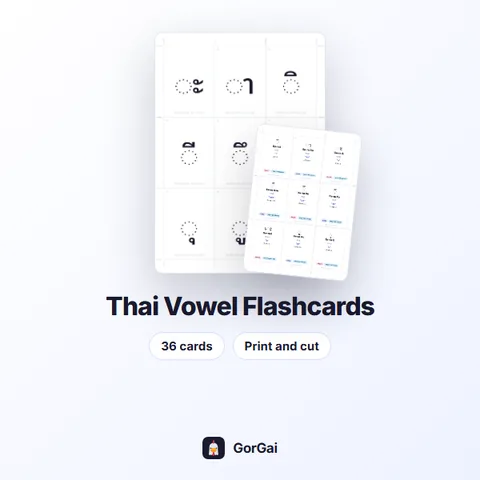
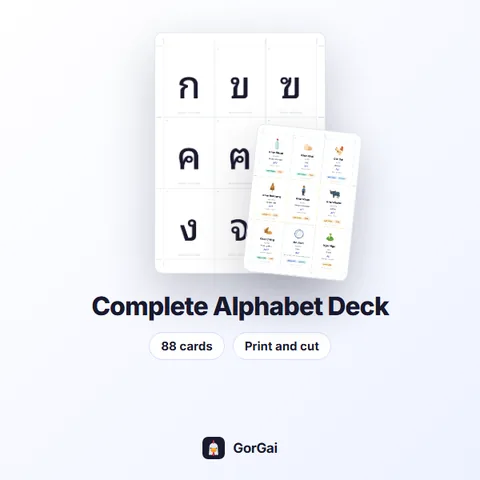

Teachers and bloggers: the charts are free to share and embed with a link back. Paste this into your page:
<a href="https://gorgai.net/thai-alphabet-chart/"><img src="https://gorgai.net/images/chart/thai-alphabet-chart.png" alt="Thai alphabet chart by GorGai" width="1600" height="1750"></a>
All 44 Thai consonants: the Gor Gai chart with tone classes
The Thai alphabet has 44 consonants, each identified by the Gor Gai (ก ไก่) picture word that Thai children learn in school. The picture words exist because so many letters share a sound: there are six ways to write "th", and "Thor Thahan" (soldier) is how a Thai speaker tells you which one. The consonants are divided into three tone classes: mid (อักษรกลาง), high (อักษรสูง), and low (อักษรต่ำ). The class decides the tone of every syllable the letter starts, which is why it is printed on every card.
📄 Take just the consonants: download all 44 on one A4 page, or open the Thai consonants chart for the same letters in a searchable table with frequency ranks. The vowels have their own one-page PDF too.
The same 44 letters in alphabetical order, with a frequency rank for each and the 21 sounds behind them, are on the Thai consonants chart. The Sound column here shows the IPA and, for the pairs English readers mix up, whether the letter is said with a puff of air. ก is "Gor" on paper but it is the unaspirated k in "skin", not a g. The h in "Khor" and "Thor" marks a puff, not a separate sound, and the "th" is never the th in "think".
Mid-Class Consonants (อักษรกลาง): 9 Letters
Mid-class consonants are the most versatile group. They can use all four tone marks and produce a mid tone by default in live syllables. These 9 letters are the foundation of the tone system. Learn them first.
| Letter | Name | Picture | Romanized | Sound | Meaning |
|---|---|---|---|---|---|
| ก | กอ ไก่ | 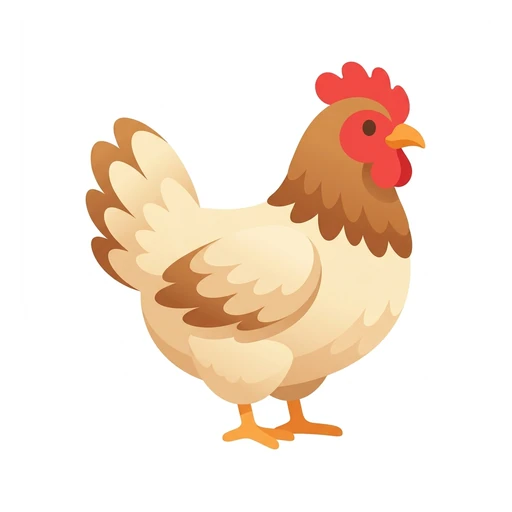 | Gor Gai | /k/no puff | Chicken |
| จ | จอ จาน |  | Jor Jaan | /tɕ/no puff | Plate |
| ฎ | ดอ ชฎา | 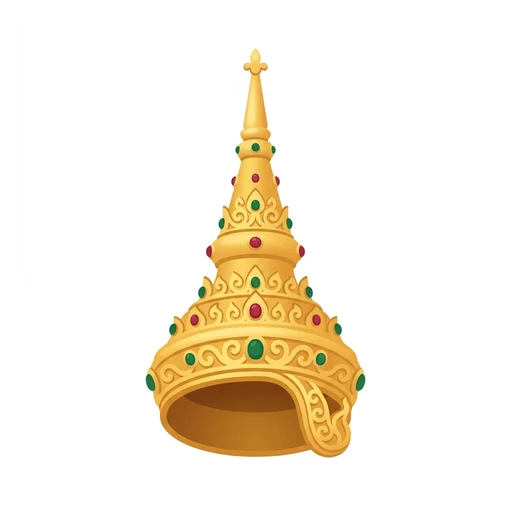 | Dor Cha-da | /d/ | Headdress |
| ฏ | ตอ ปฏัก |  | Tor Pa-tak | /t/no puff | Elephant goad |
| ด | ดอ เด็ก |  | Dor Dek | /d/ | Child |
| ต | ตอ เต่า |  | Tor Tao | /t/no puff | Turtle |
| บ | บอ ใบไม้ |  | Bor Bai Mai | /b/ | Leaf |
| ป | ปอ ปลา |  | Por Pla | /p/no puff | Fish |
| อ | ออ อ่าง |  | Or Ang | /ʔ/ | Basin |
Memory aid: the 9 mid-class consonants can be remembered with the Thai phrase ไก่ จิก เด็ก ตาย บน ปาก โอ่ง (a chicken pecked a child to death on the rim of a water jar). The first consonant of each word gives you ก จ ด ต บ ป อ, plus ฎ ฏ which pair with ด ต. You can also practice writing mid-class consonants using GorGai's tone class filter.
High-Class Consonants (อักษรสูง): 11 Letters
High-class consonants produce a rising tone by default in live syllables. They only use two tone marks: mai ek (่) and mai tho (้). Every one of them is either a puffed (aspirated) stop or a hissing fricative.
| Letter | Name | Picture | Romanized | Sound | Meaning |
|---|---|---|---|---|---|
| ข | ขอ ไข่ | 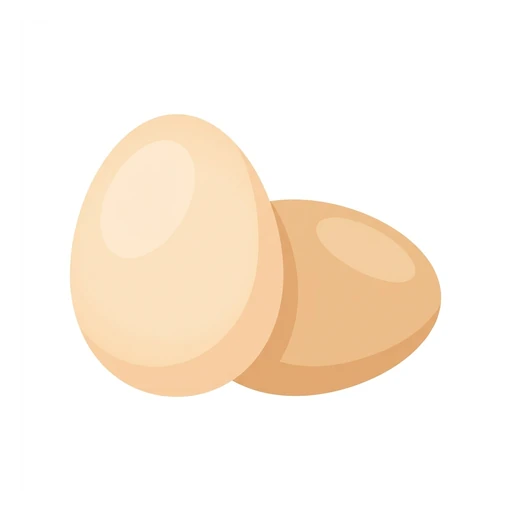 | Khor Khai | /kʰ/puff | Egg |
| ฃ | ขอ ขวด |  | Khor Khuat | /kʰ/puff | Bottle (obsolete) |
| ฉ | ฉอ ฉิ่ง |  | Chor Ching | /tɕʰ/puff | Hand cymbals |
| ฐ | ฐอ ฐาน |  | Thor Than | /tʰ/puff | Pedestal base |
| ถ | ถอ ถุง |  | Thor Thung | /tʰ/puff | Sack |
| ผ | ผอ ผึ้ง |  | Phor Phueng | /pʰ/puff | Bee |
| ฝ | ฝอ ฝา |  | For Fa | /f/ | Lid |
| ศ | ศอ ศาลา | 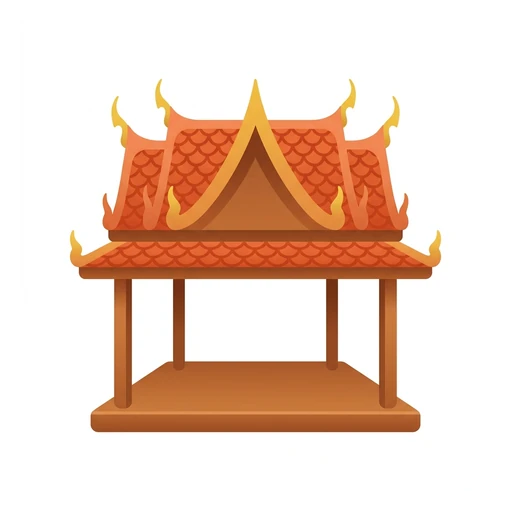 | Sor Sala | /s/ | Pavilion |
| ษ | ษอ ฤๅษี |  | Sor Ruesi | /s/ | Sage |
| ส | สอ เสือ |  | Sor Suea | /s/ | Tiger |
| ห | หอ หีบ |  | Hor Hip | /h/ | Treasure chest |
Memory aid: Thai learners use ผี ฝาก ถุง ข้าว สาร ให้ ฉัน ศึกษา เฐ่า: a ghost entrusted a sack of rice for me to study, old one. The mnemonic covers ผ ฝ ถ ข ส ห ฉ ศ (plus ฐ/ษ and obsolete ฃ). Try reading high-class consonants with GorGai's flashcard mode.
Low-Class Consonants (อักษรต่ำ): 24 Letters
Low-class consonants are the largest group, more than half the alphabet. They produce a mid tone by default in live syllables and only use mai ek (่) and mai tho (้). Many low-class consonants are paired with a high-class letter that shares the same sound (ค low and ข high are both "kh").
| Letter | Name | Picture | Romanized | Sound | Meaning |
|---|---|---|---|---|---|
| ค | คอ ควาย |  | Khor Khwai | /kʰ/puff | Buffalo |
| ฅ | คอ คน |  | Khor Khon | /kʰ/puff | Person (obsolete) |
| ฆ | คอ ระฆัง | 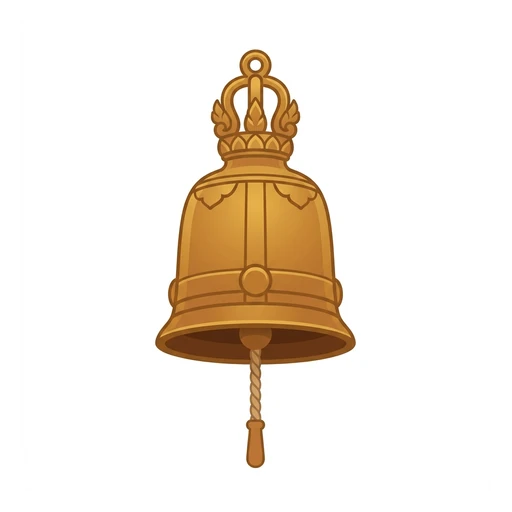 | Khor Rakhang | /kʰ/puff | Temple bell |
| ง | งอ งู |  | Ngor Ngu | /ŋ/ | Snake |
| ช | ชอ ช้าง |  | Chor Chang | /tɕʰ/puff | Elephant |
| ซ | ซอ โซ่ |  | Sor So | /s/ | Chain |
| ฌ | ชอ เฌอ |  | Chor Choe | /tɕʰ/puff | Tree |
| ญ | ยอ หญิง | 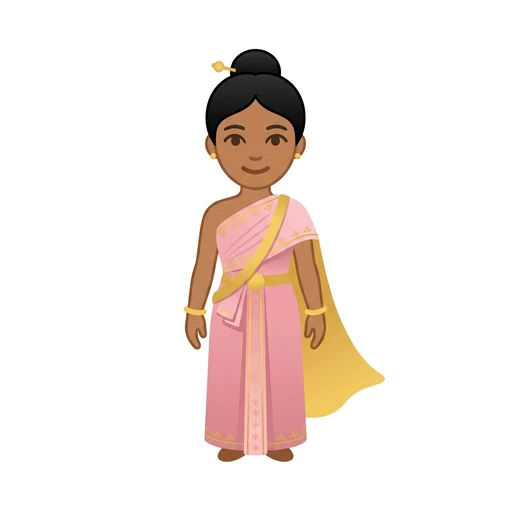 | Yor Ying | /j/ | Woman |
| ฑ | ทอ มณโฑ | 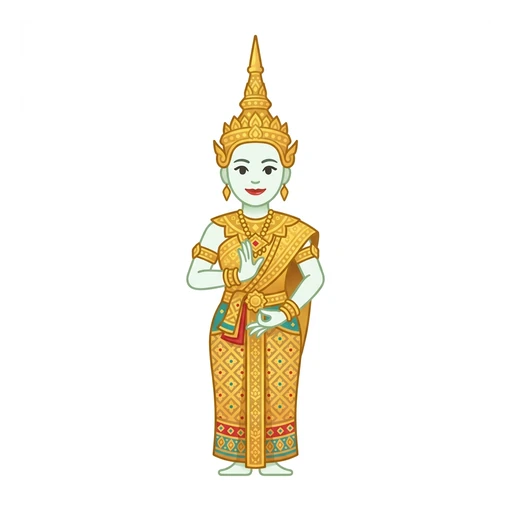 | Thor Montho | /tʰ/puff | Queen Montho |
| ฒ | ทอ ผู้เฒ่า | 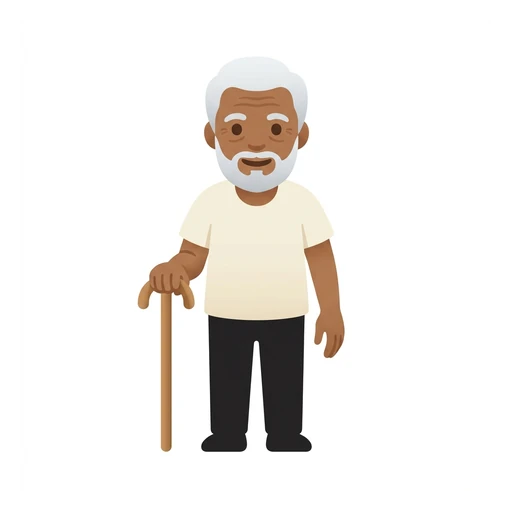 | Thor Phu Thao | /tʰ/puff | Elder |
| ณ | นอ เณร |  | Nor Nen | /n/ | Novice monk |
| ท | ทอ ทหาร |  | Thor Thahan | /tʰ/puff | Soldier |
| ธ | ทอ ธง |  | Thor Thong | /tʰ/puff | Flag |
| น | นอ หนู |  | Nor Nu | /n/ | Mouse |
| พ | พอ พาน |  | Phor Phan | /pʰ/puff | Offering tray |
| ฟ | ฟอ ฟัน |  | For Fan | /f/ | Teeth |
| ภ | พอ สำเภา |  | Phor Samphao | /pʰ/puff | Sailing ship |
| ม | มอ ม้า |  | Mor Ma | /m/ | Horse |
| ย | ยอ ยักษ์ |  | Yor Yak | /j/ | Giant |
| ร | รอ เรือ |  | Ror Ruea | /r/ | Boat |
| ล | ลอ ลิง |  | Lor Ling | /l/ | Monkey |
| ว | วอ แหวน |  | Wor Waen | /w/ | Ring |
| ฬ | ลอ จุฬา |  | Lor Chula | /l/ | Star kite |
| ฮ | ฮอ นกฮูก |  | Hor Nok Huk | /h/ | Owl |
Low-class consonants include 14 "paired" consonants (which have a high-class counterpart with the same sound) and 10 "unpaired" consonants (ง ณ น ม ย ญ ร ล ว ฬ) which have no high-class match. Unpaired low-class consonants use ห as a leading silent consonant (หน, หม, หย, and so on) to access high-class tones. Practice writing low-class consonants or test yourself with flashcard recognition.
Save any consonant as a card image
One card per letter, 800 by 800 pixels: the letter, its picture word, the traditional name, the real sound and the tone class. Save the ones you are working on to your phone, drop them into Anki or a slideshow, or print a few for the fridge. Tap a card to open the full-size PNG.
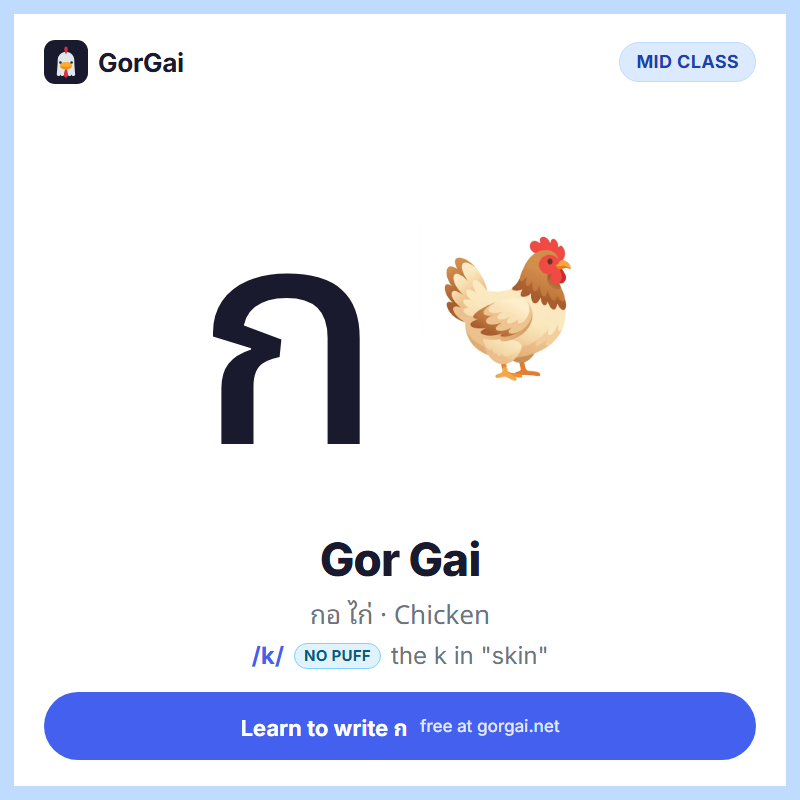
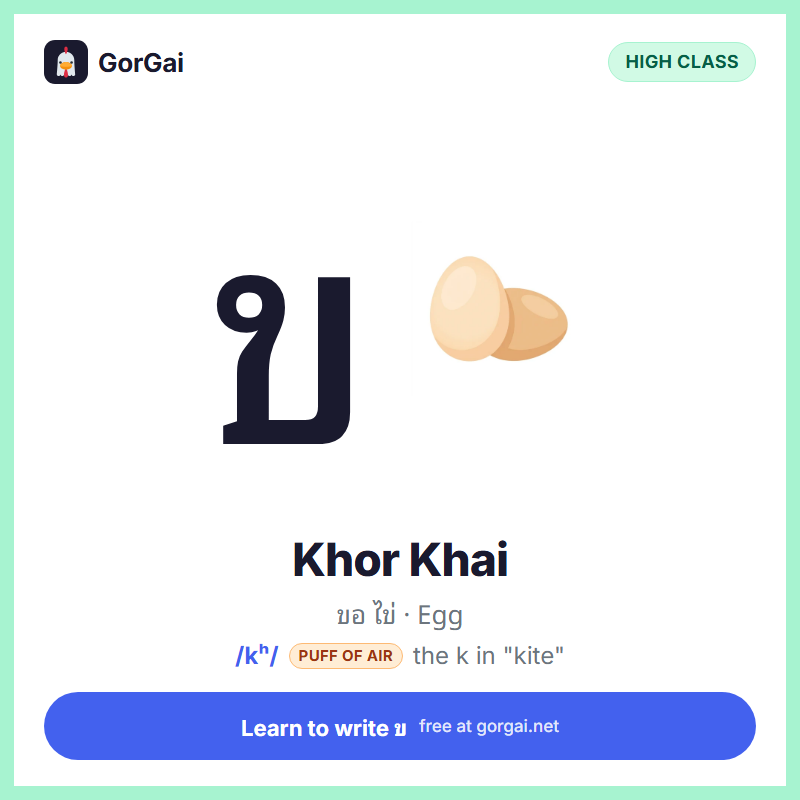
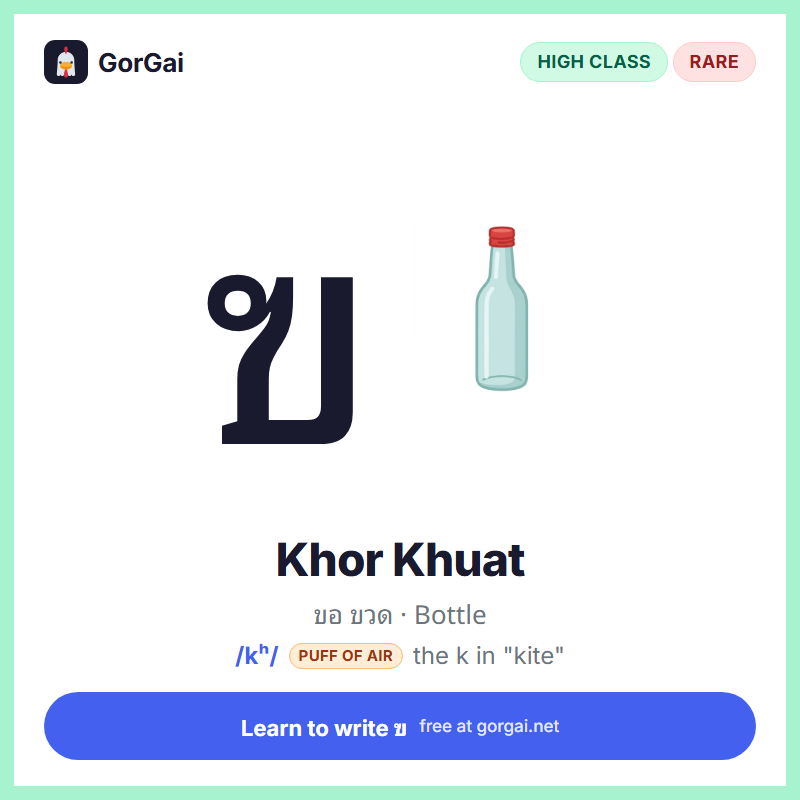
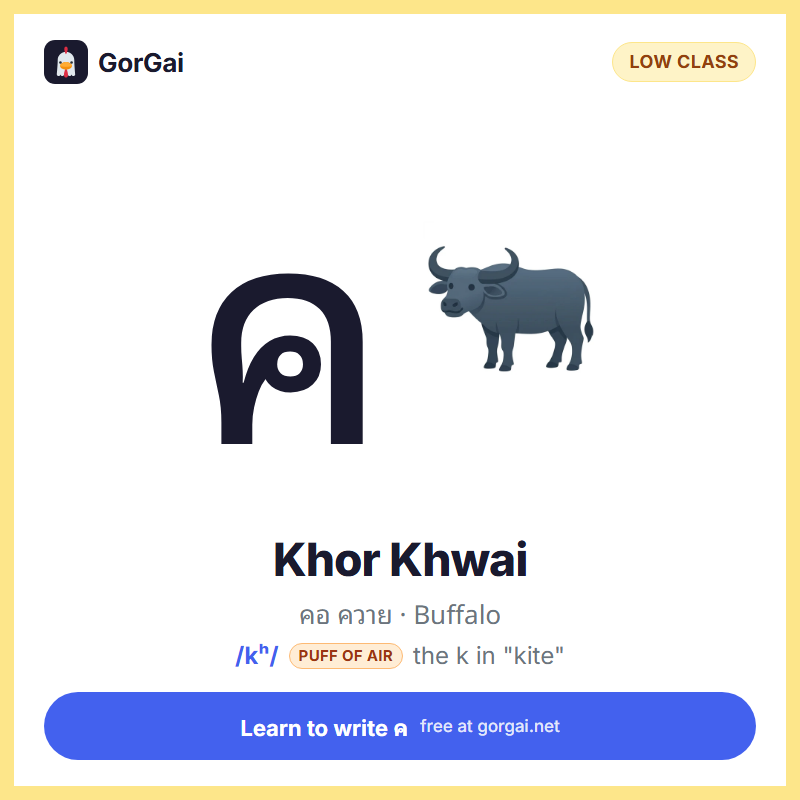
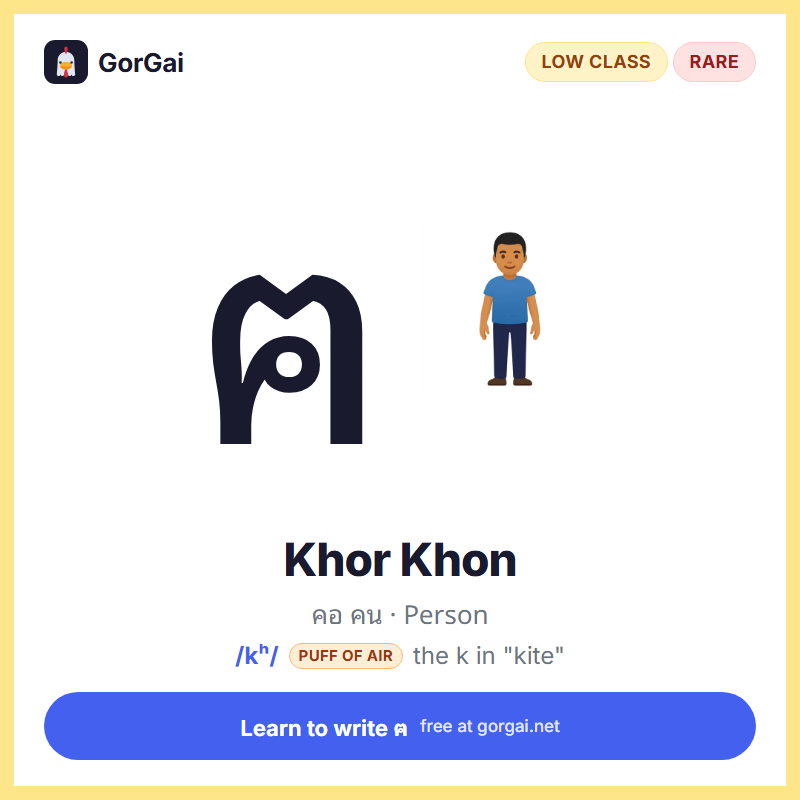
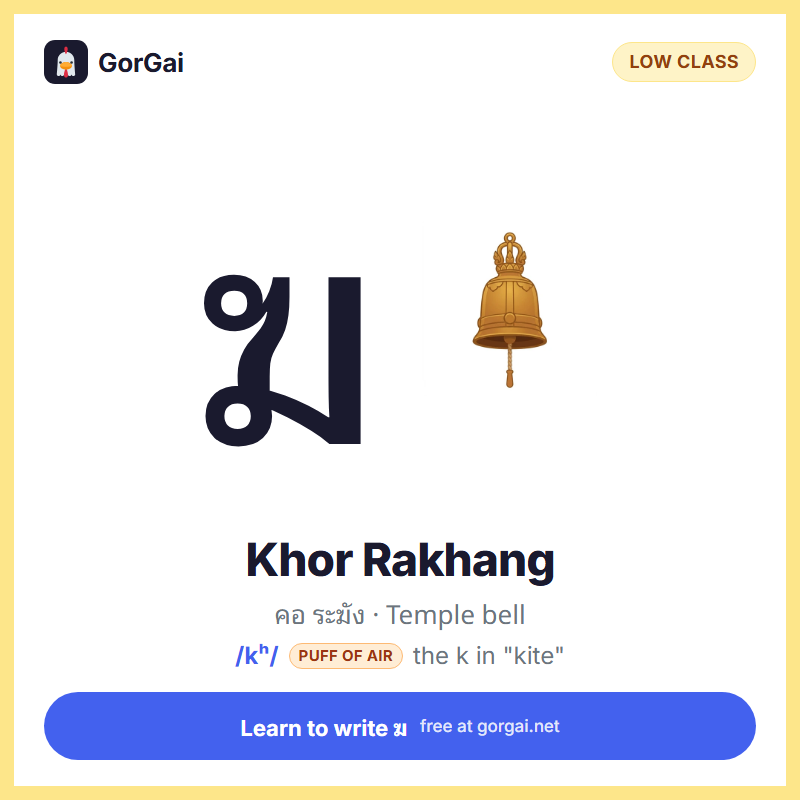

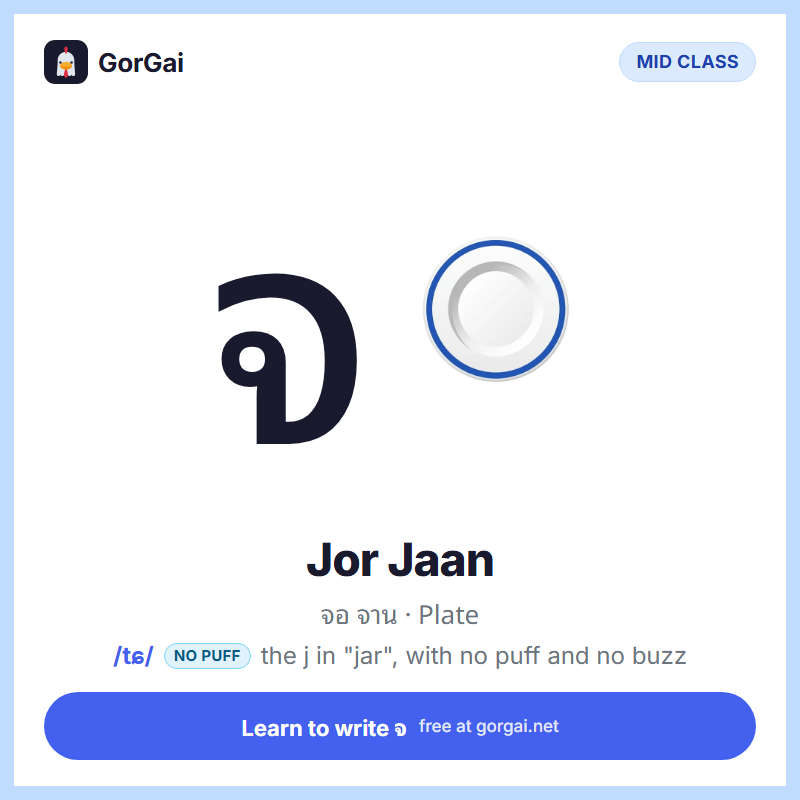

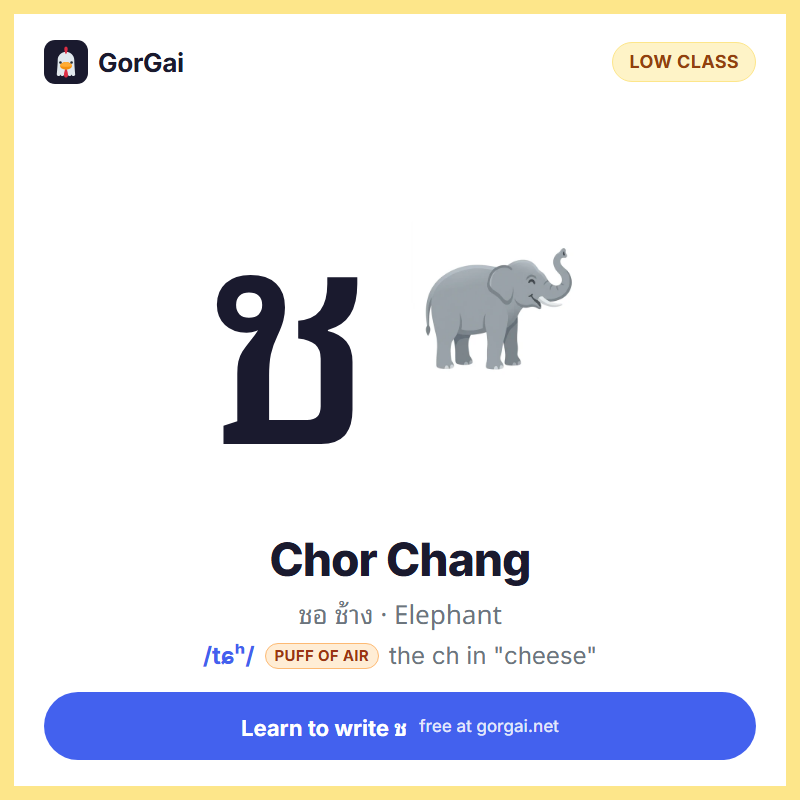
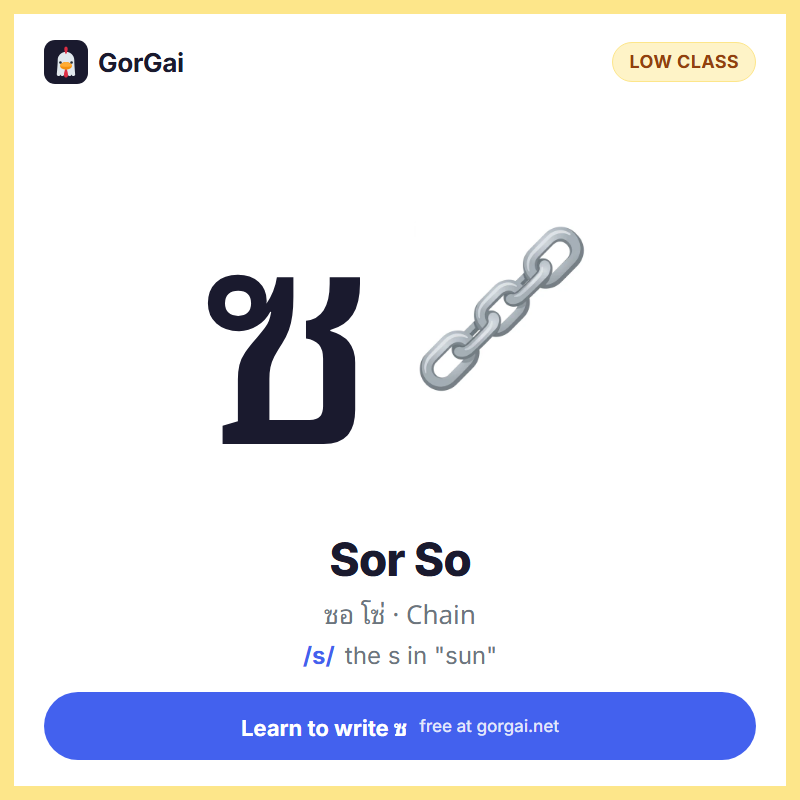
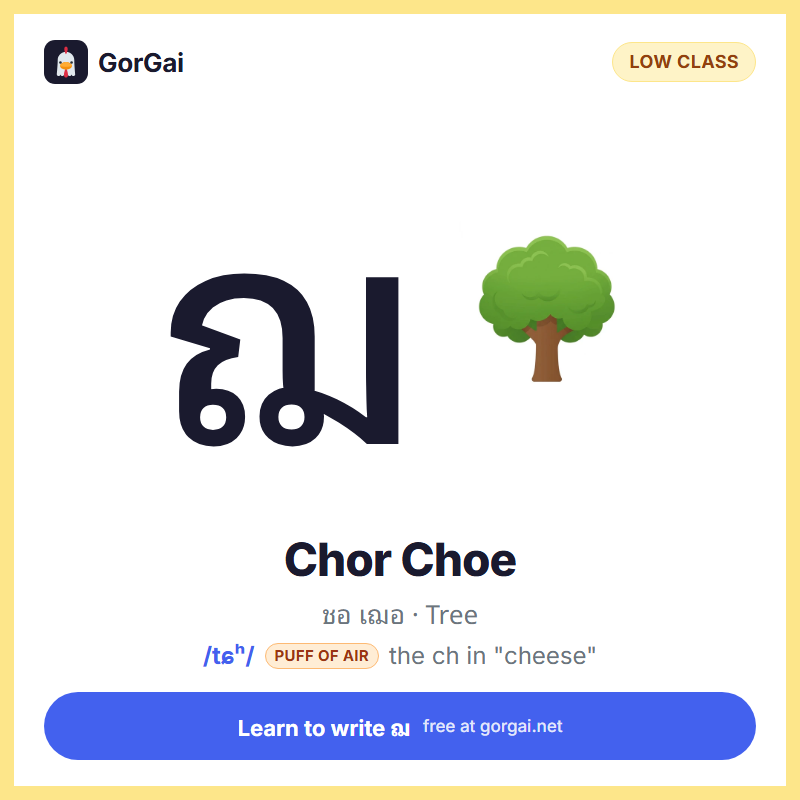
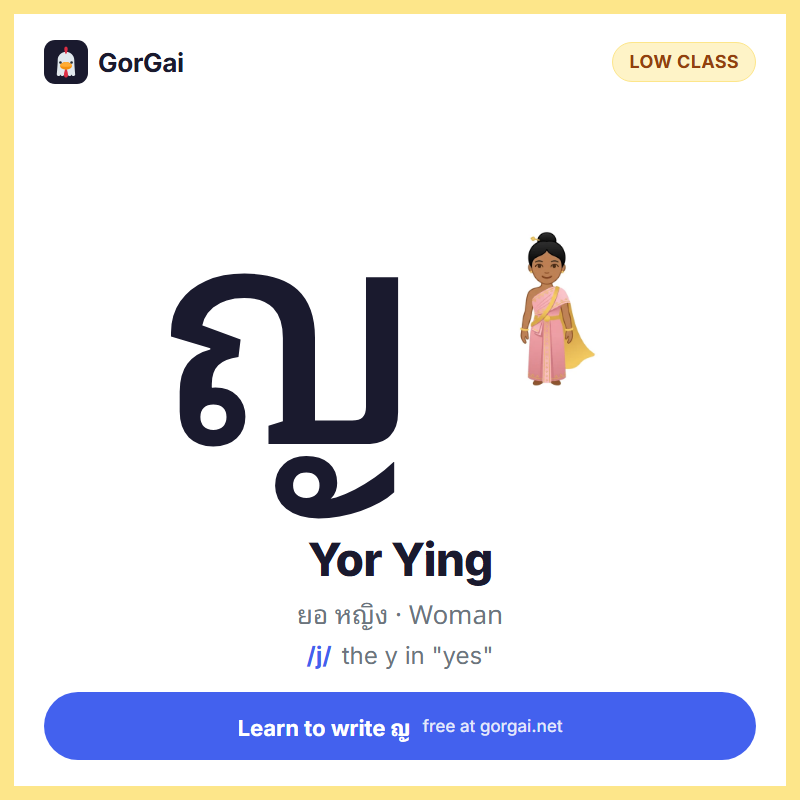
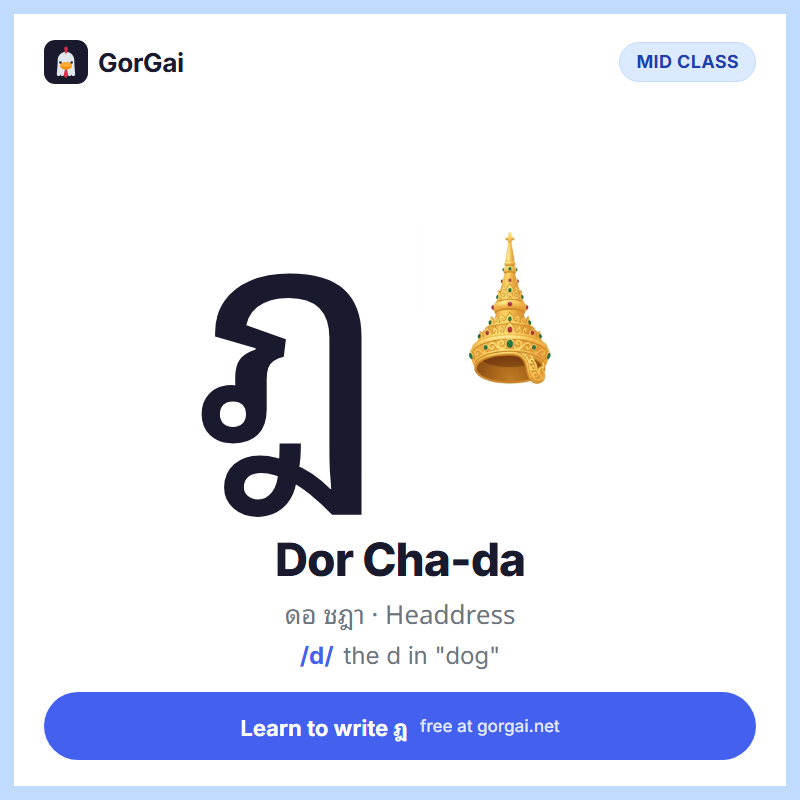
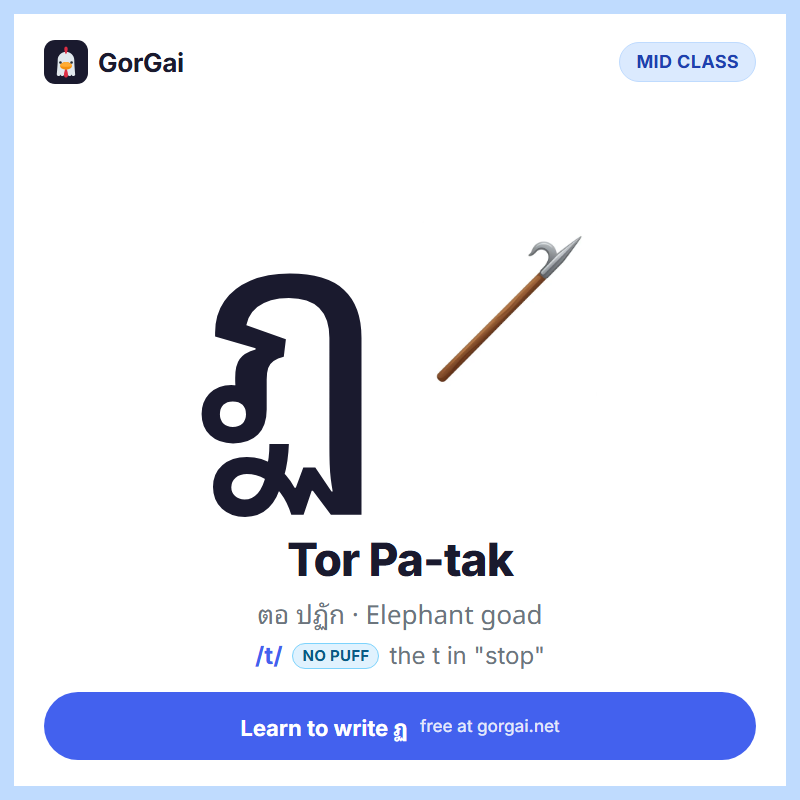
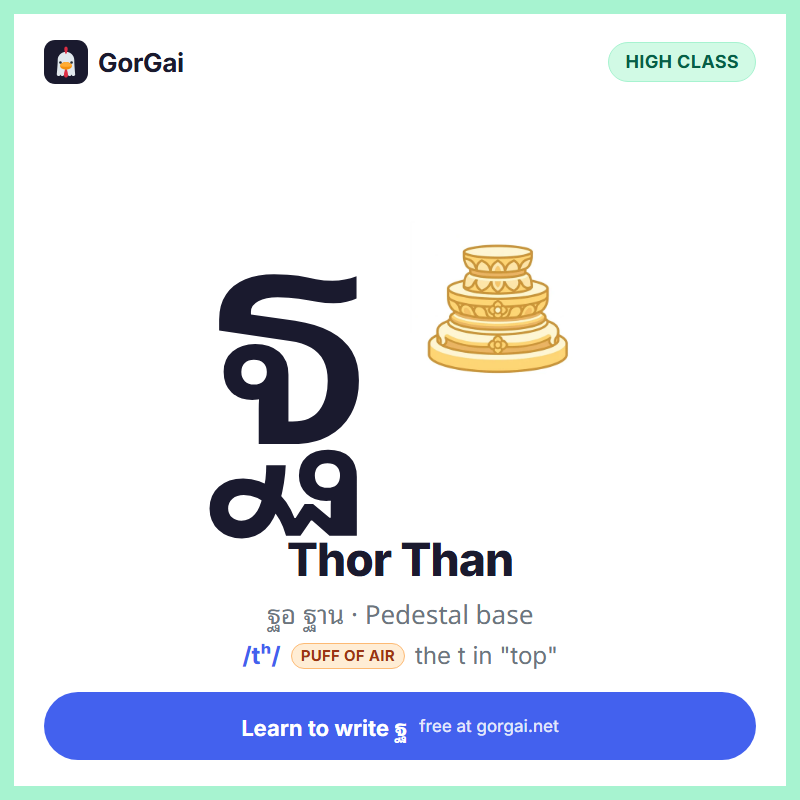
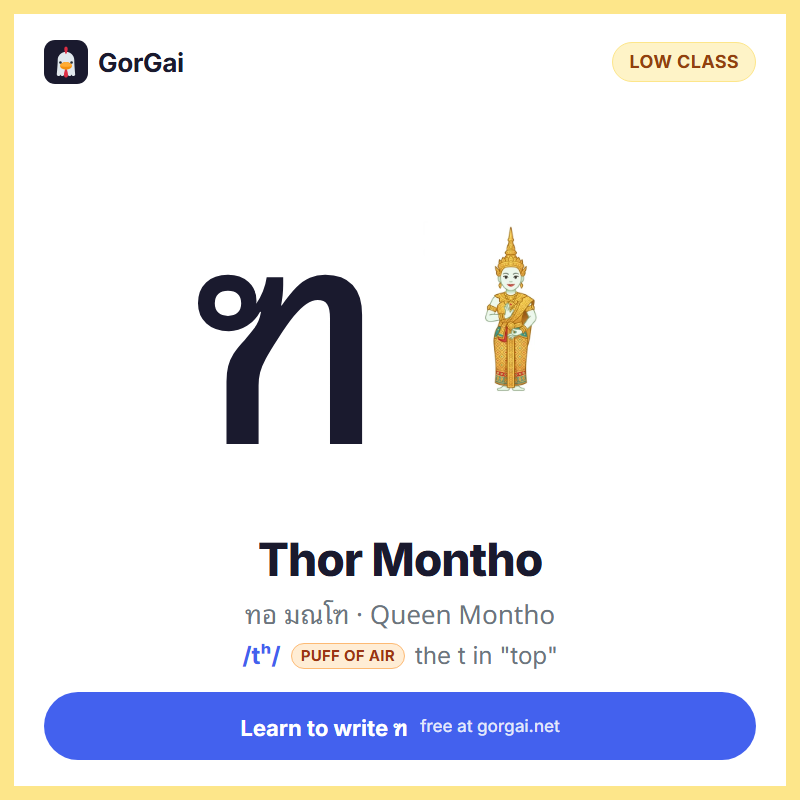

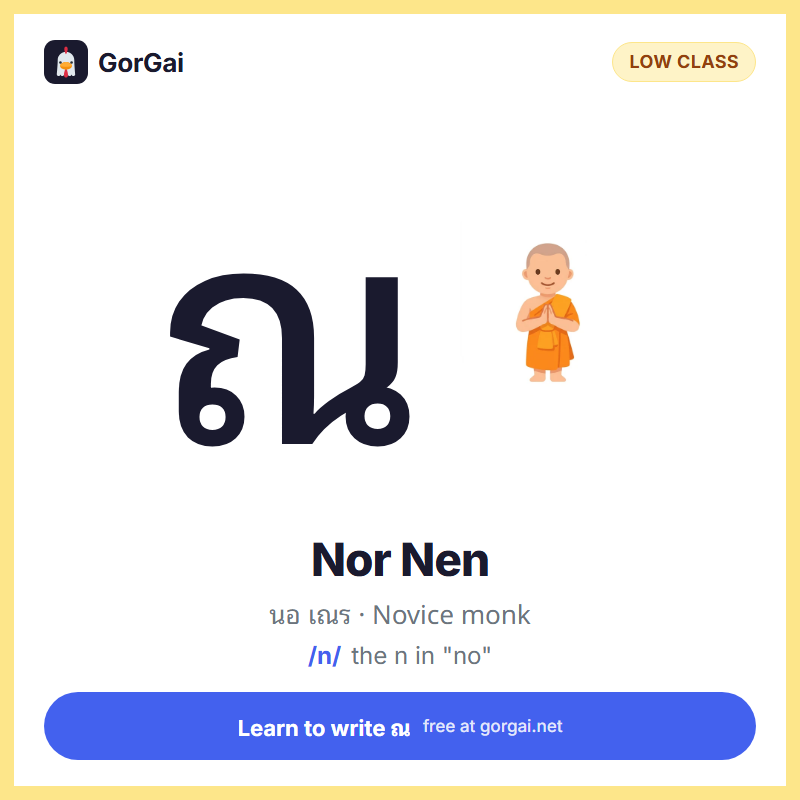
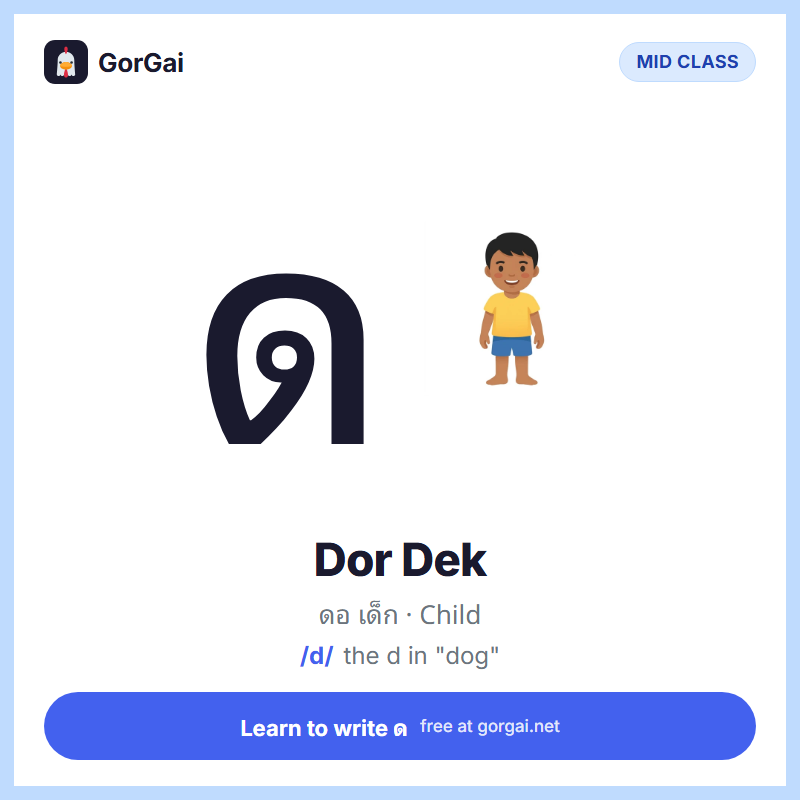

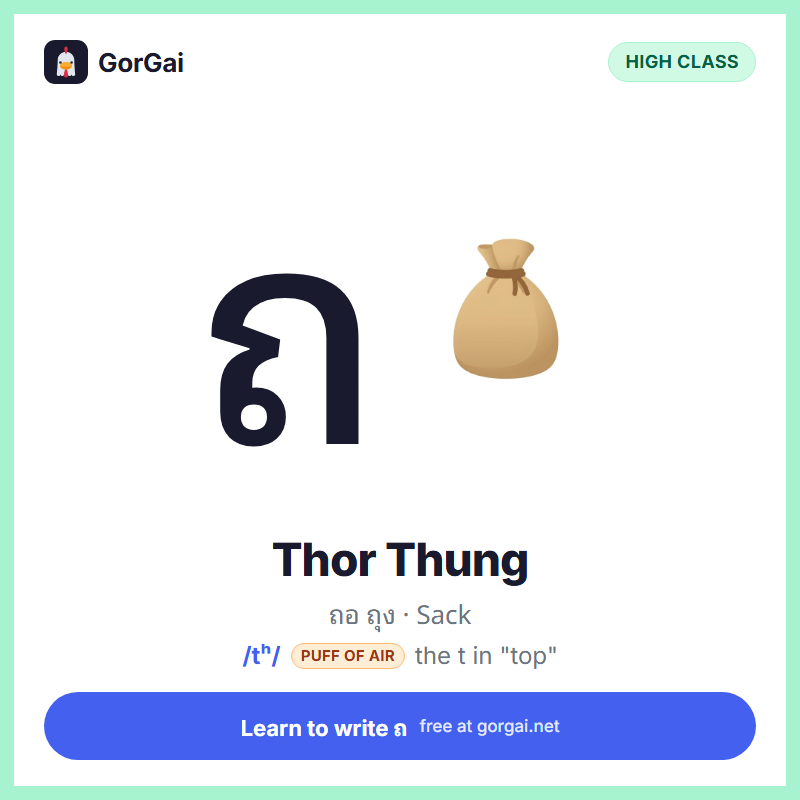
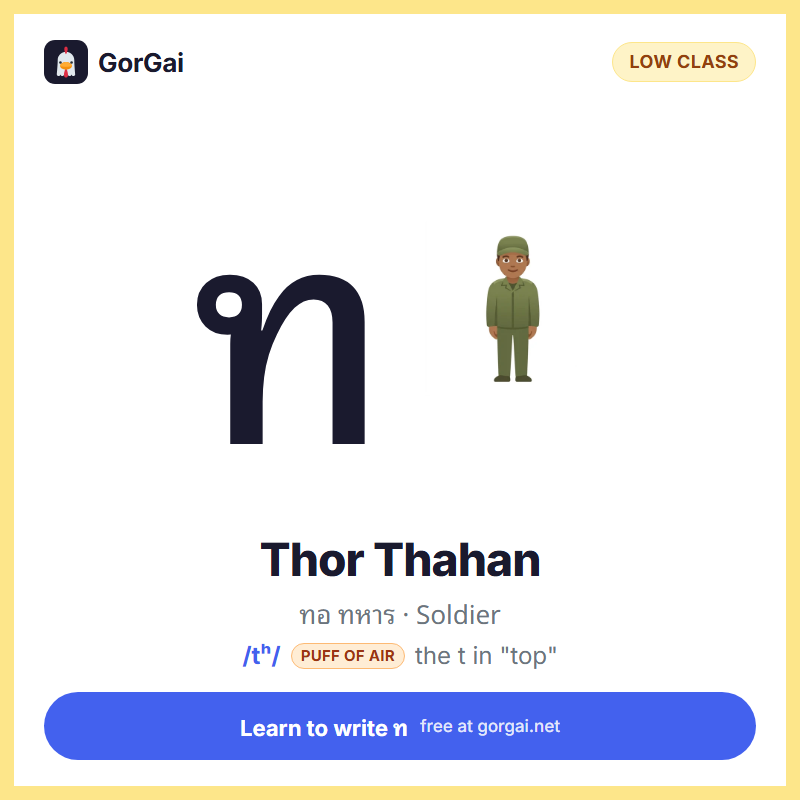
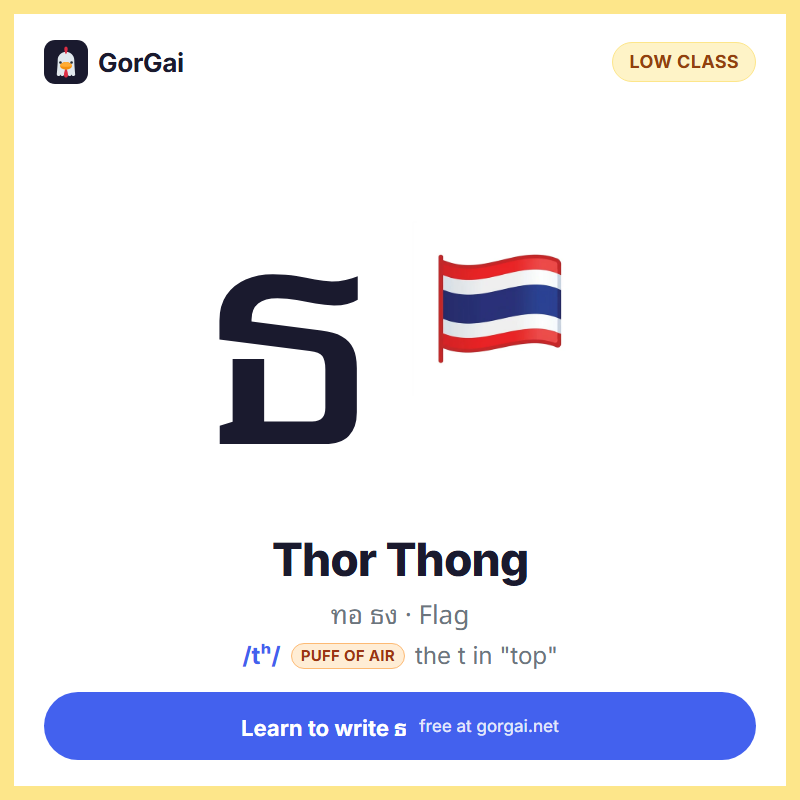
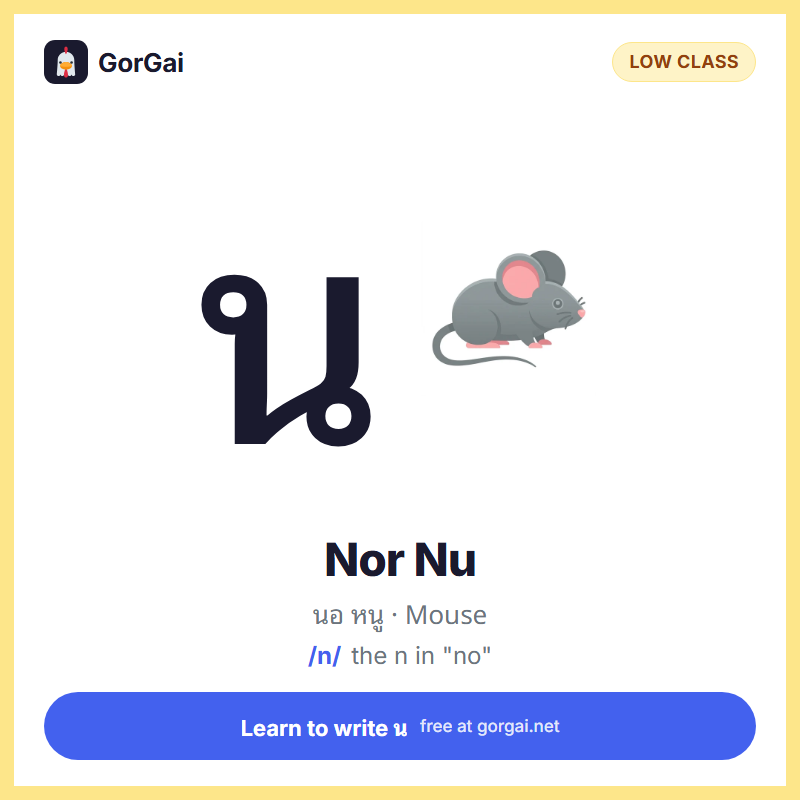
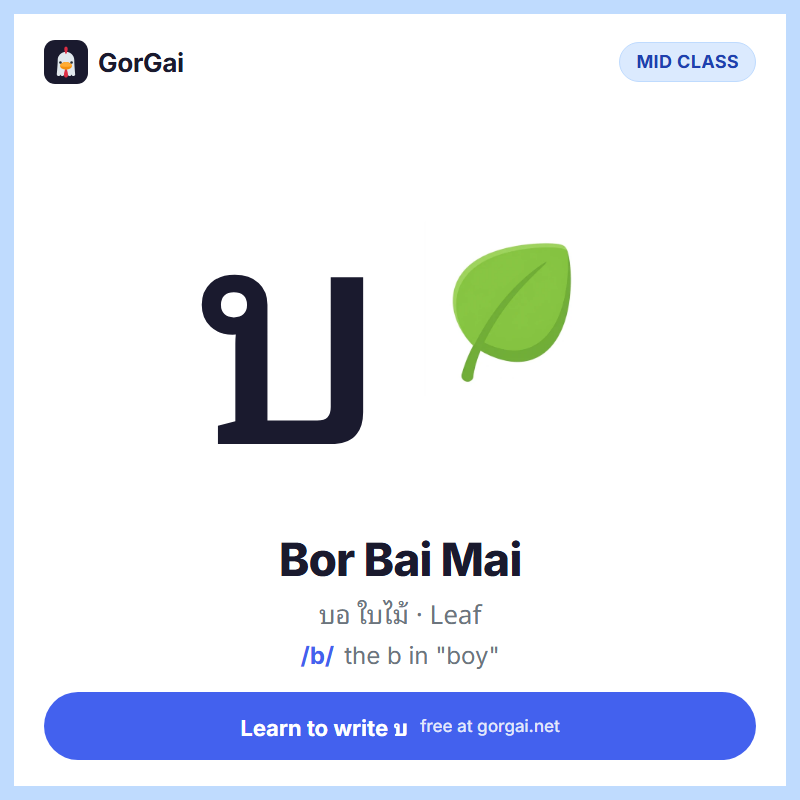
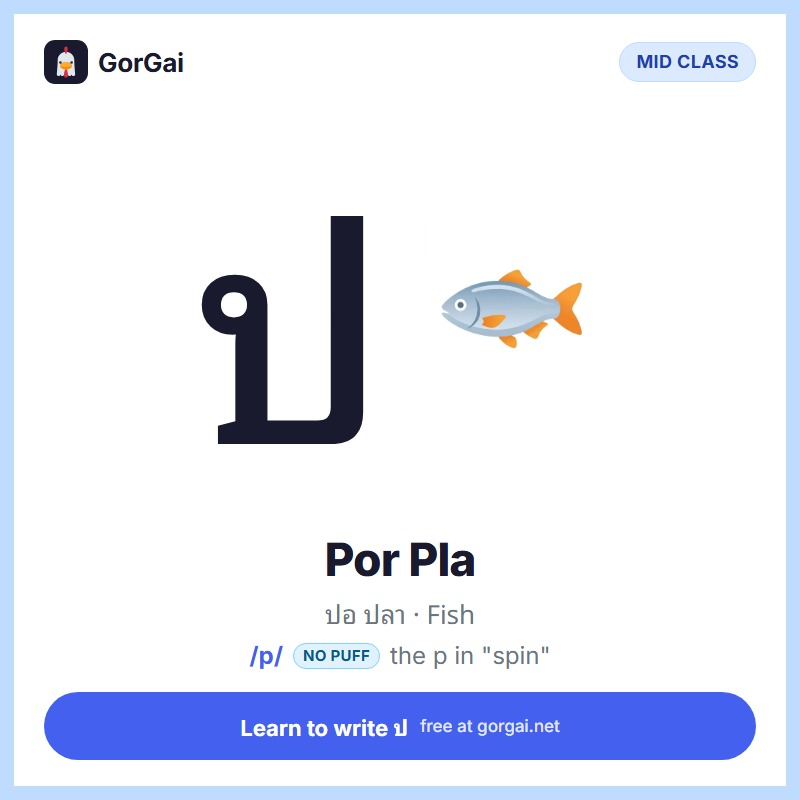

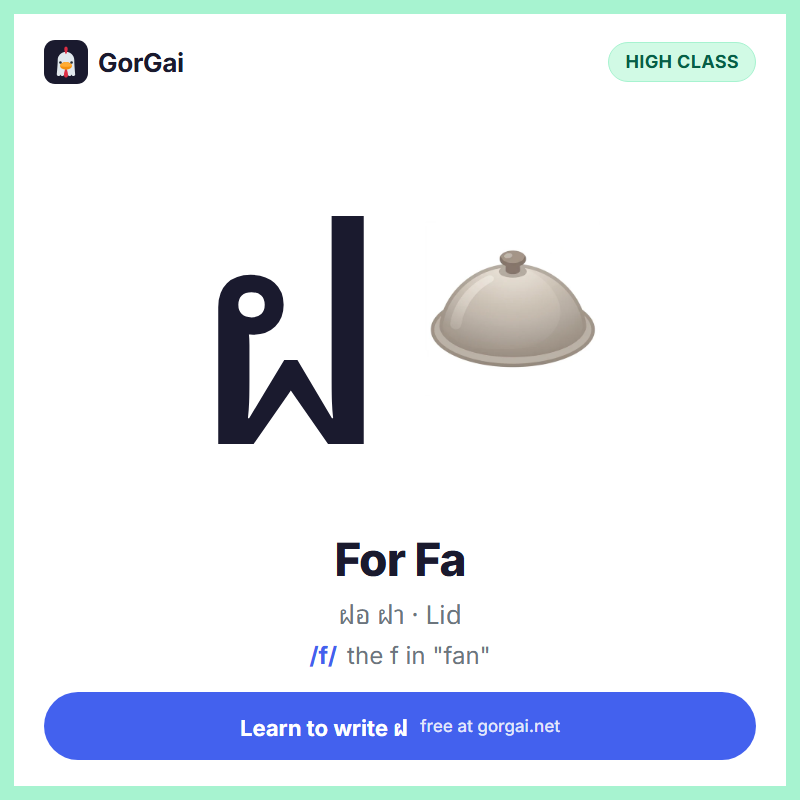
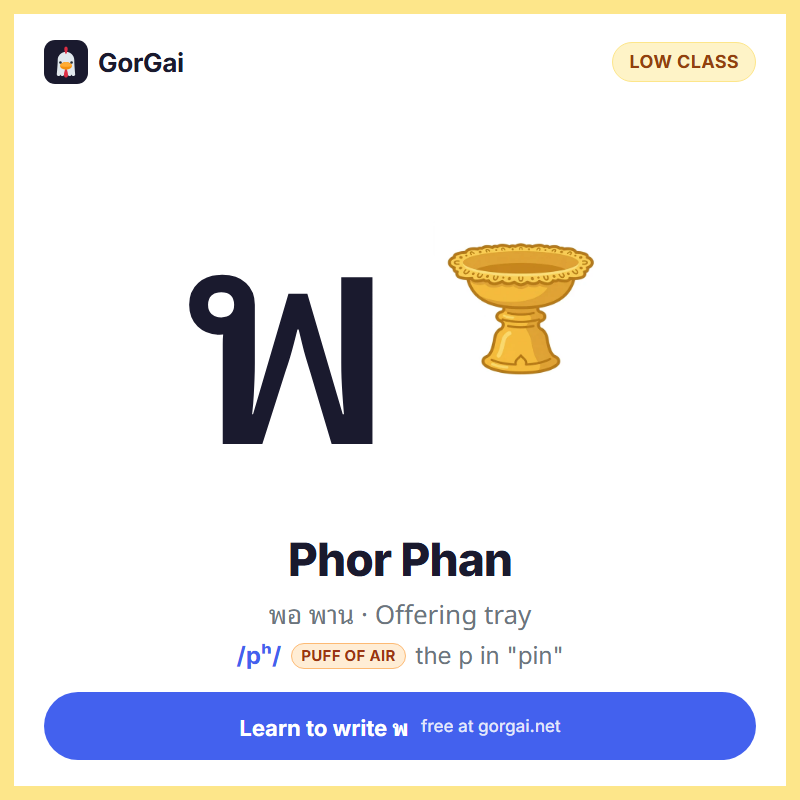
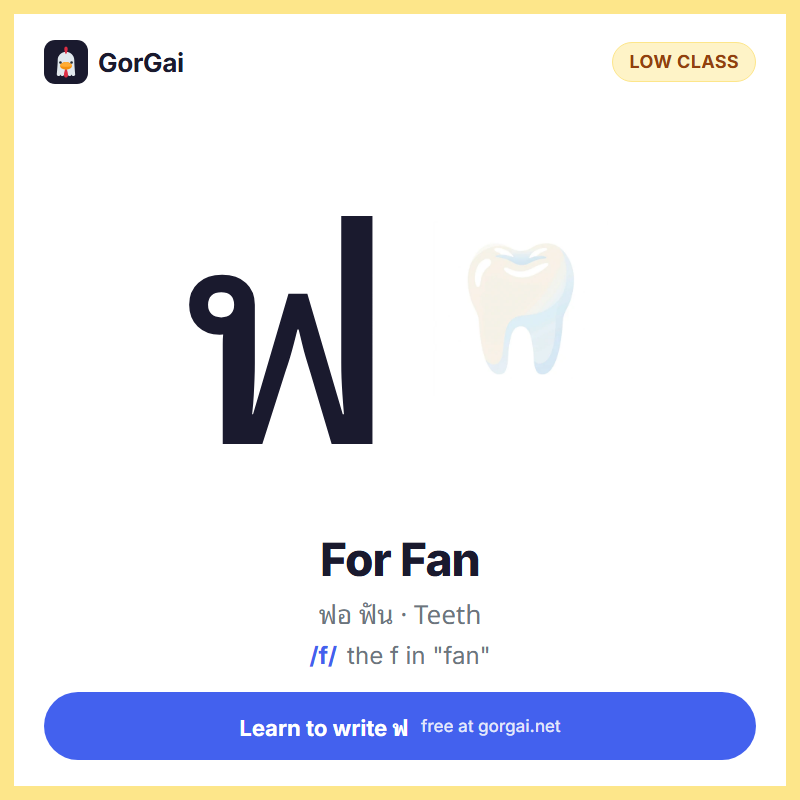
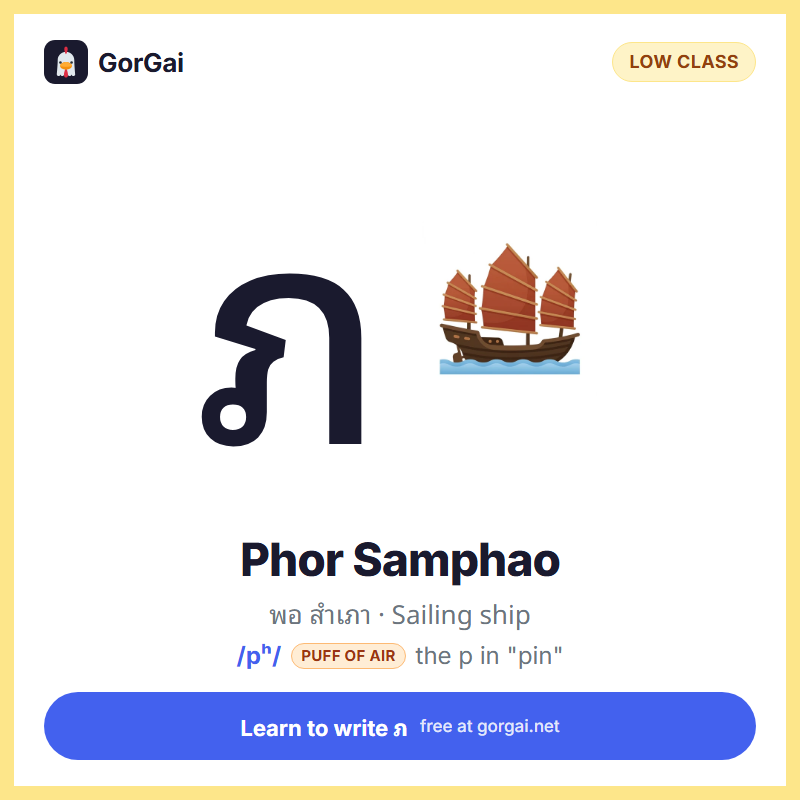
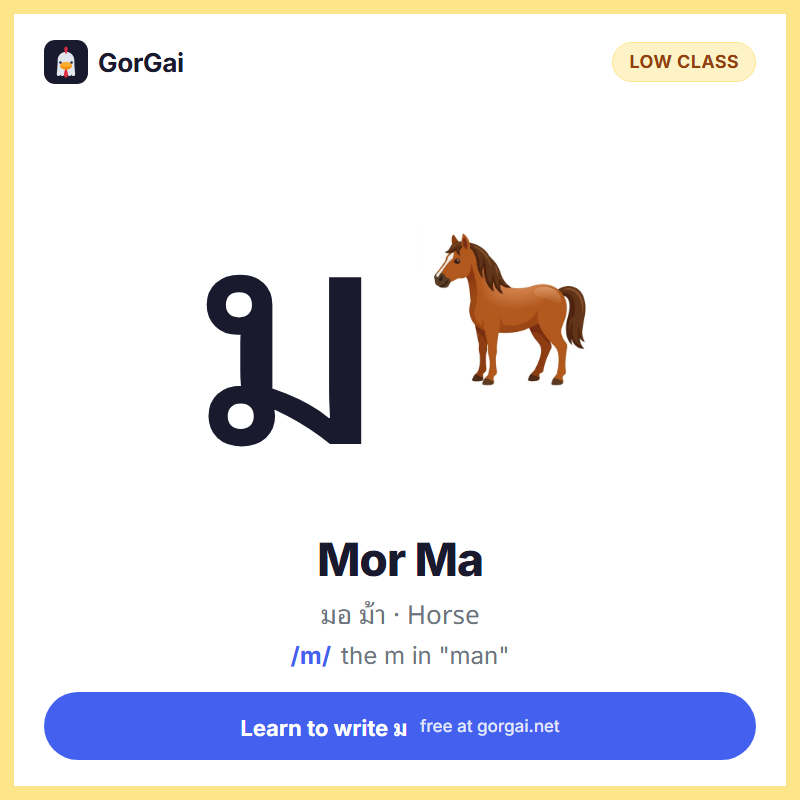
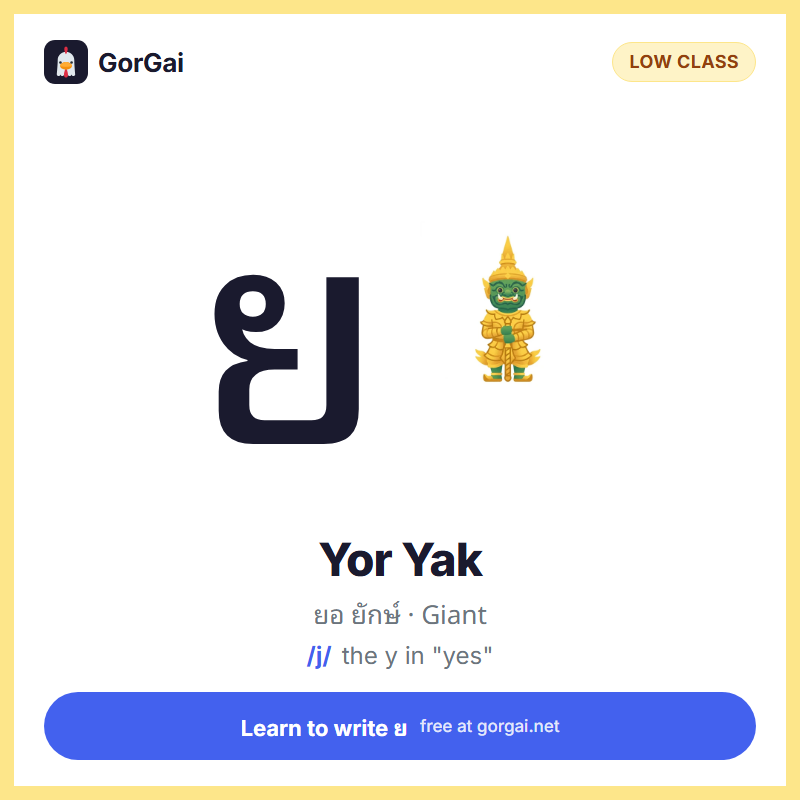
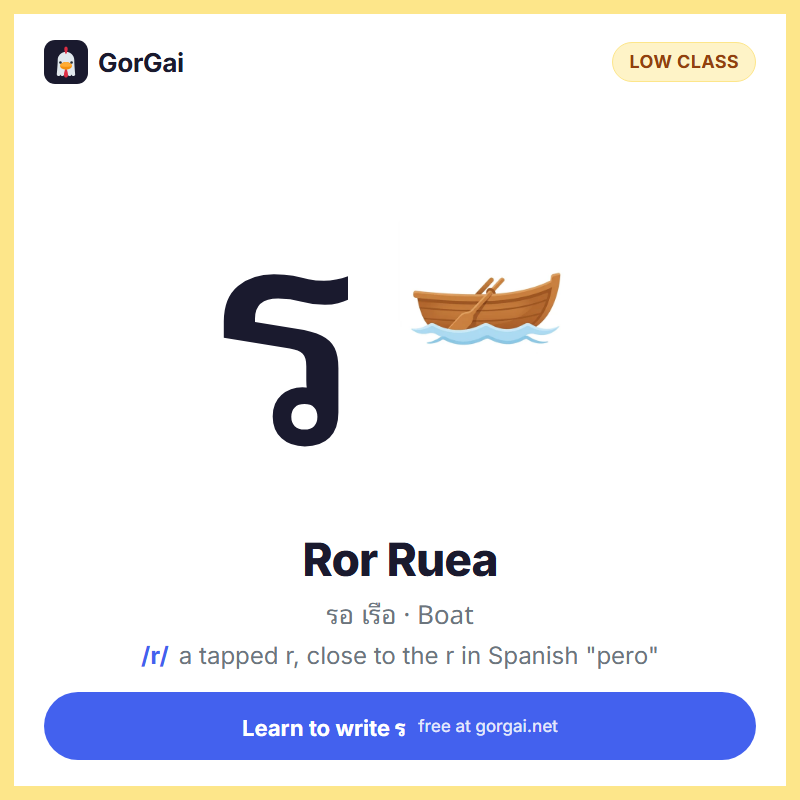
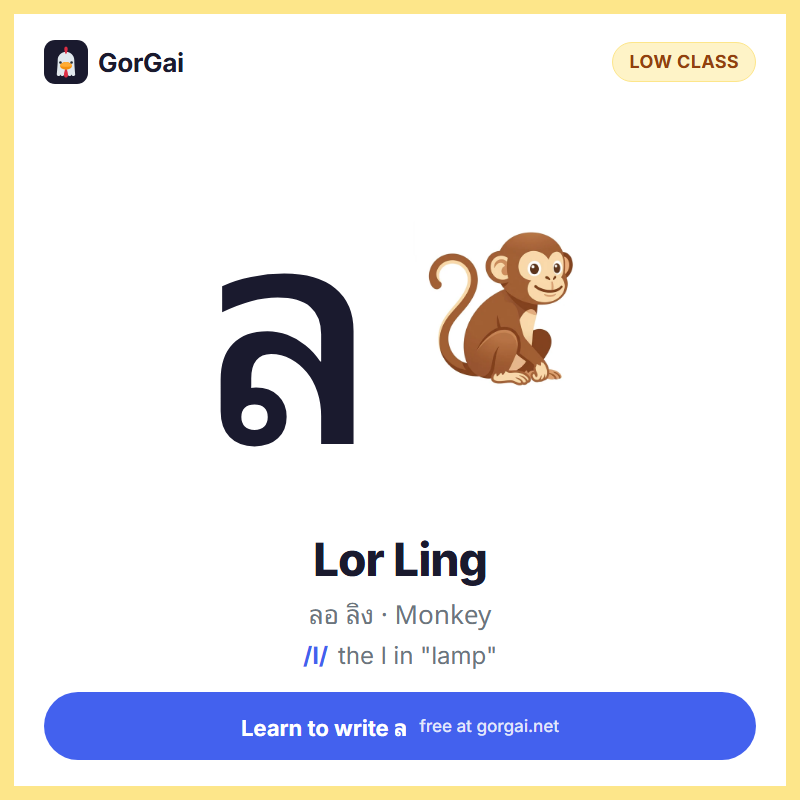
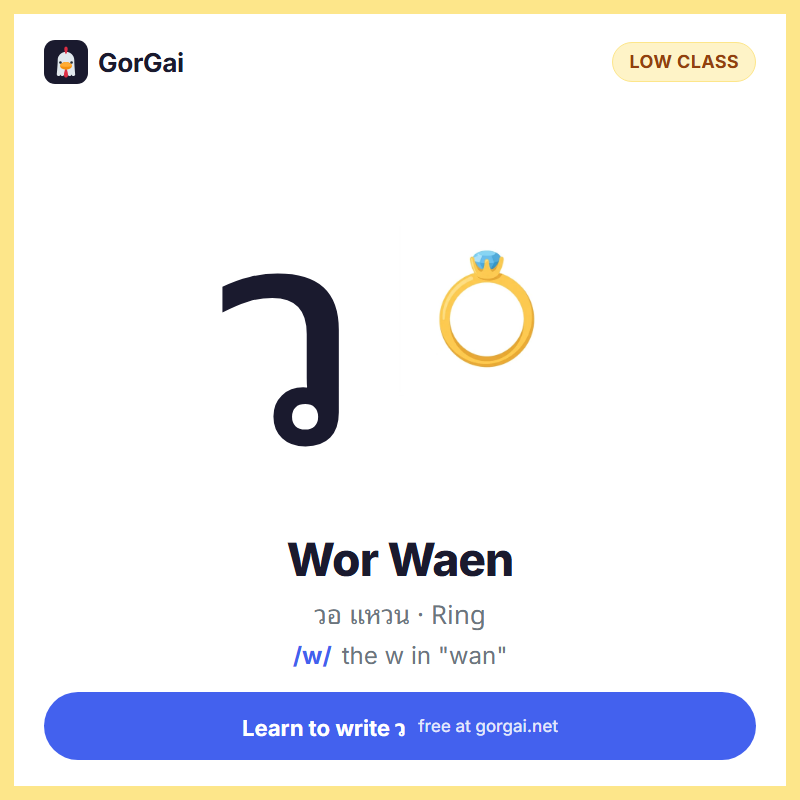
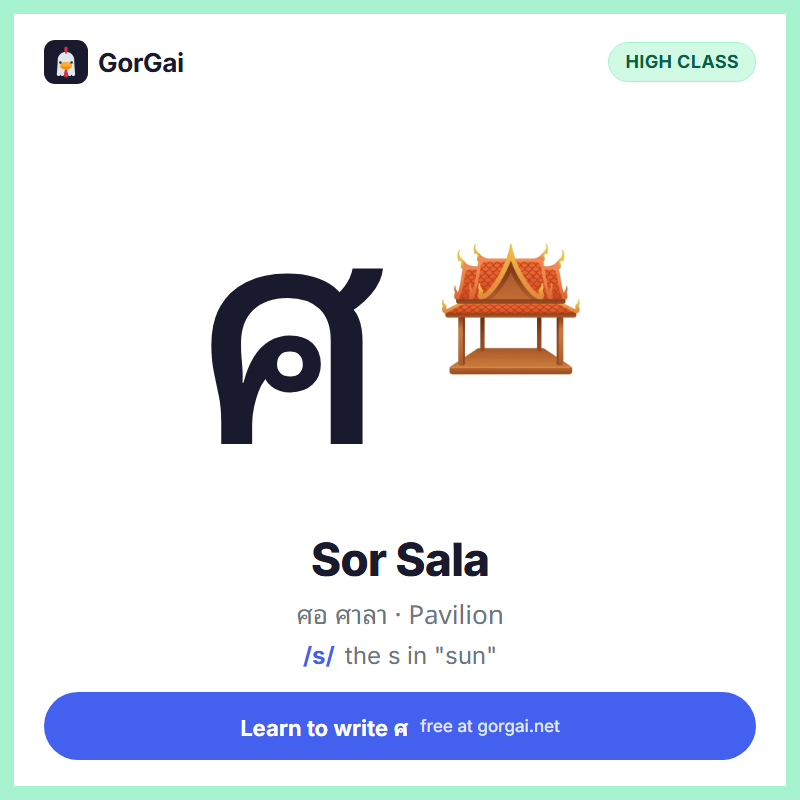
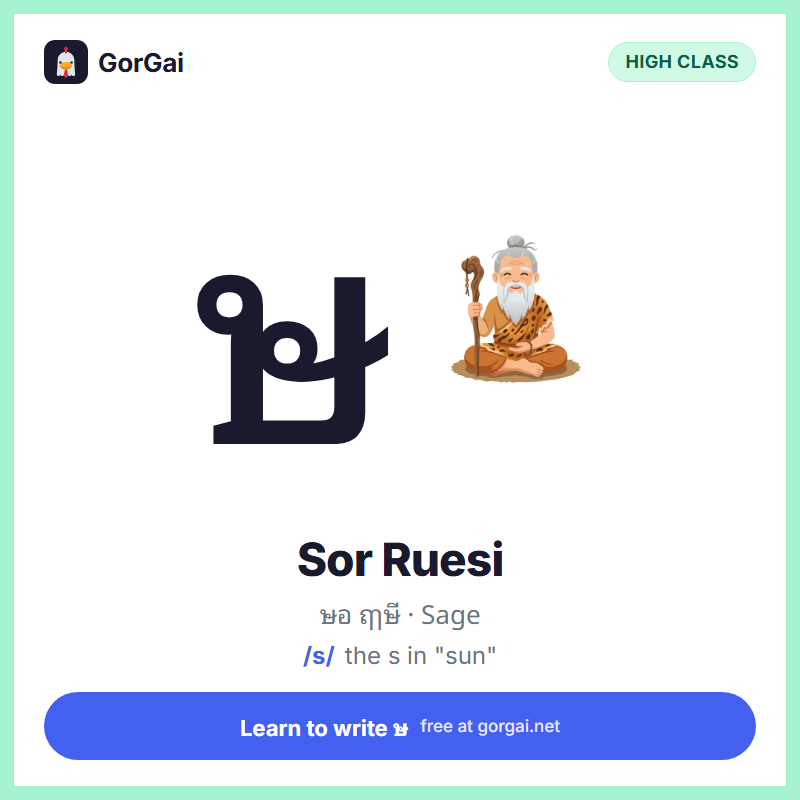
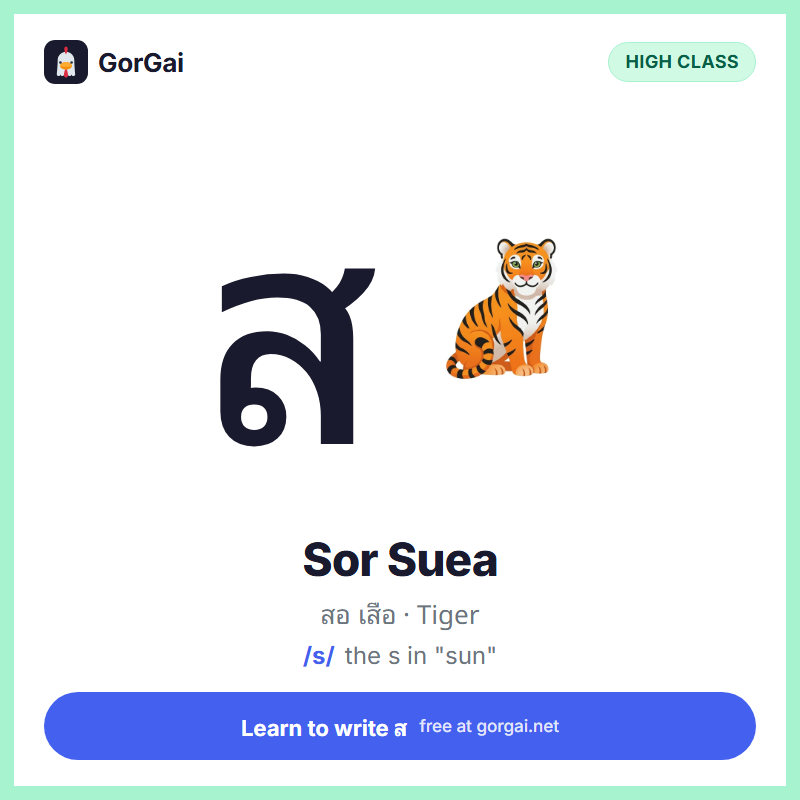

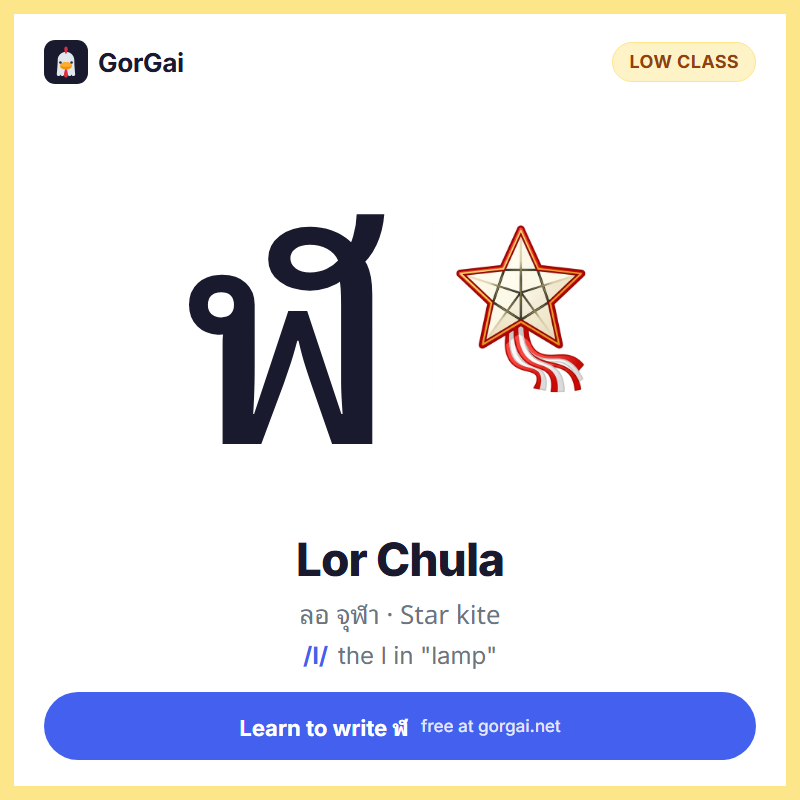
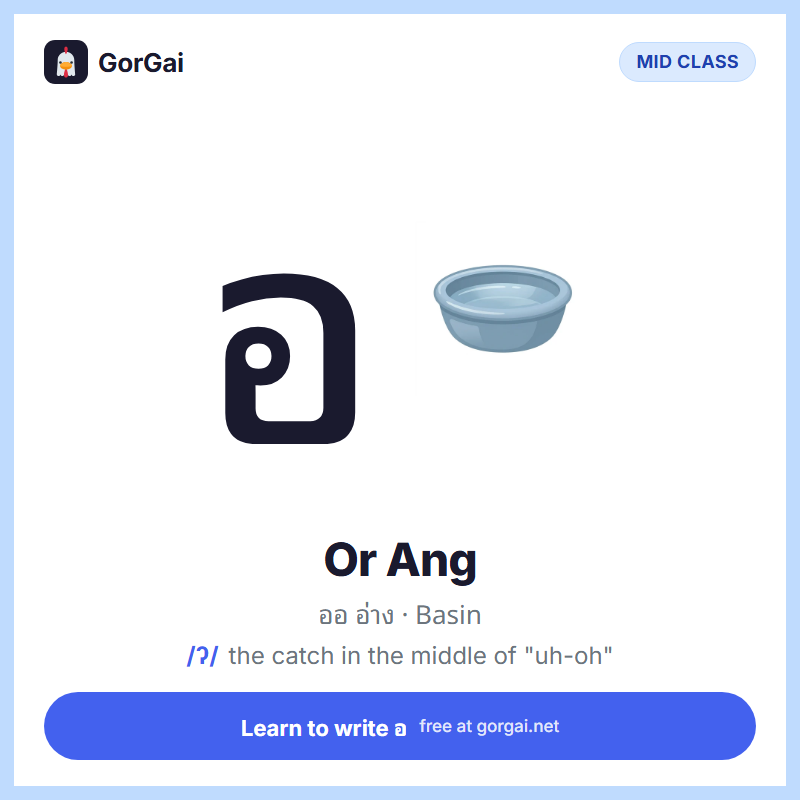
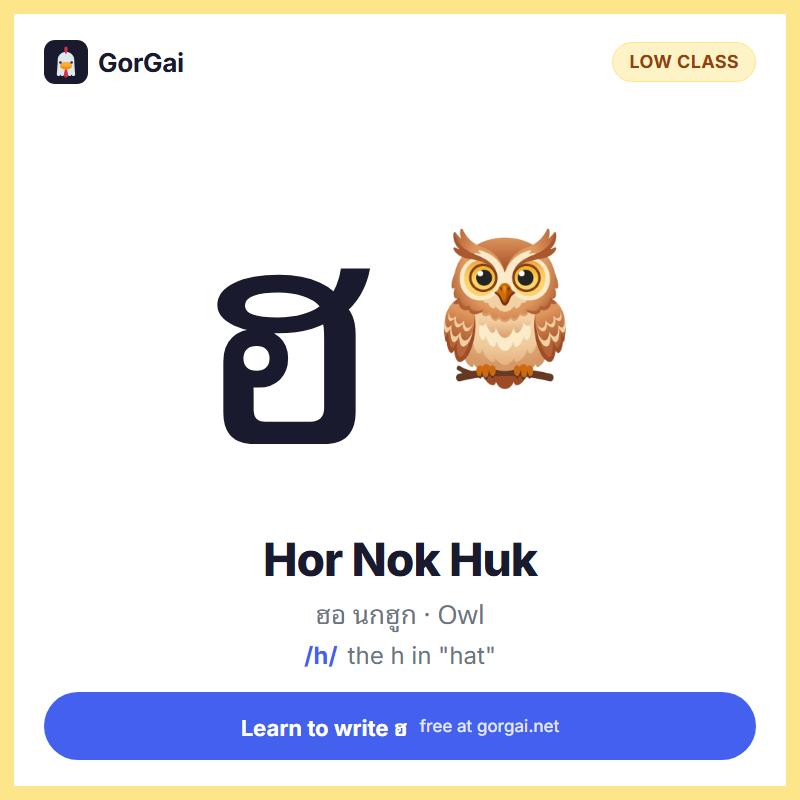
Seen a letter you cannot place? Hear it on the chart at the top, then go and trace it, write it from memory and read it until it sticks. For the whole set together, in Anki or on paper, see Thai alphabet flashcards.
Which Thai letters to learn first: the chart in frequency order
Alphabetical order is for looking things up. It is a terrible order to learn in, because the second letter you meet (ข) is only the 20th most common and the third (ฃ) has not been used in a century. The "Most used" toggle on the chart above sorts by how often each letter actually appears in written Thai, based on the ThaiStat corpus from Chulalongkorn University. These 15 come first:
Learn those 15 and you can already pick out most of the words on a menu, a road sign or a shop front. ร and น alone are in a huge share of Thai words. The bottom of the list is the obsolete pair ฃ and ฅ and the Sanskrit letters ฌ ฑ ฬ, which you will meet in names and formal words and almost nowhere else. Leave them for last with a clear conscience.
All 32 Thai vowels: positions, lengths and pronunciation
📄 Take just the vowels: download all 32 plus the marks on one A4 page, or open the Thai vowels chart for the full table with frequency ranks and the vowels that change shape.
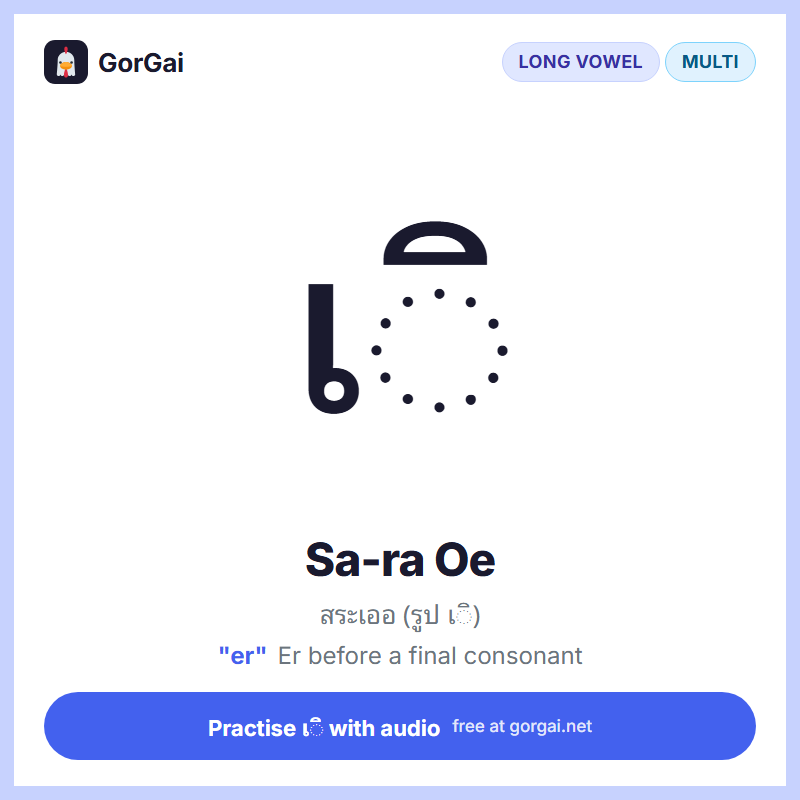
Thai has 32 vowel forms (สระ) that combine with consonants to form syllables. Unlike English vowels that sit between consonants in a line, Thai vowels can appear in five different positions relative to the consonant they modify. The placeholder symbol ◌ shows where the consonant goes. For every vowel in one table with its frequency rank, the vowels that change shape before a final consonant and the hidden vowels, see the Thai vowels chart.
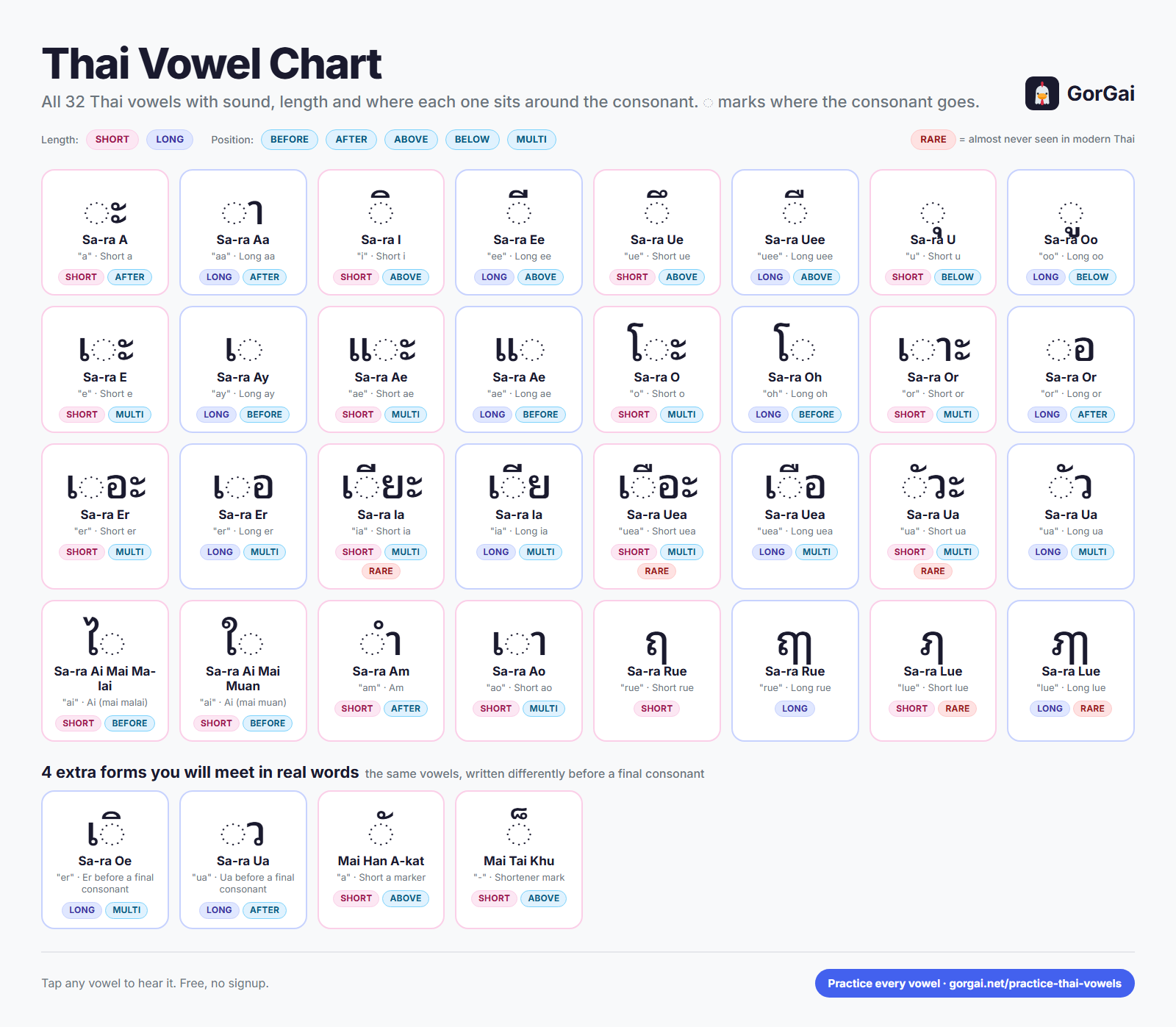
Thai vowel position system
Understanding where vowels are written is one of the biggest challenges for learners coming from alphabets like English or Latin script. Here's how the five positions work:
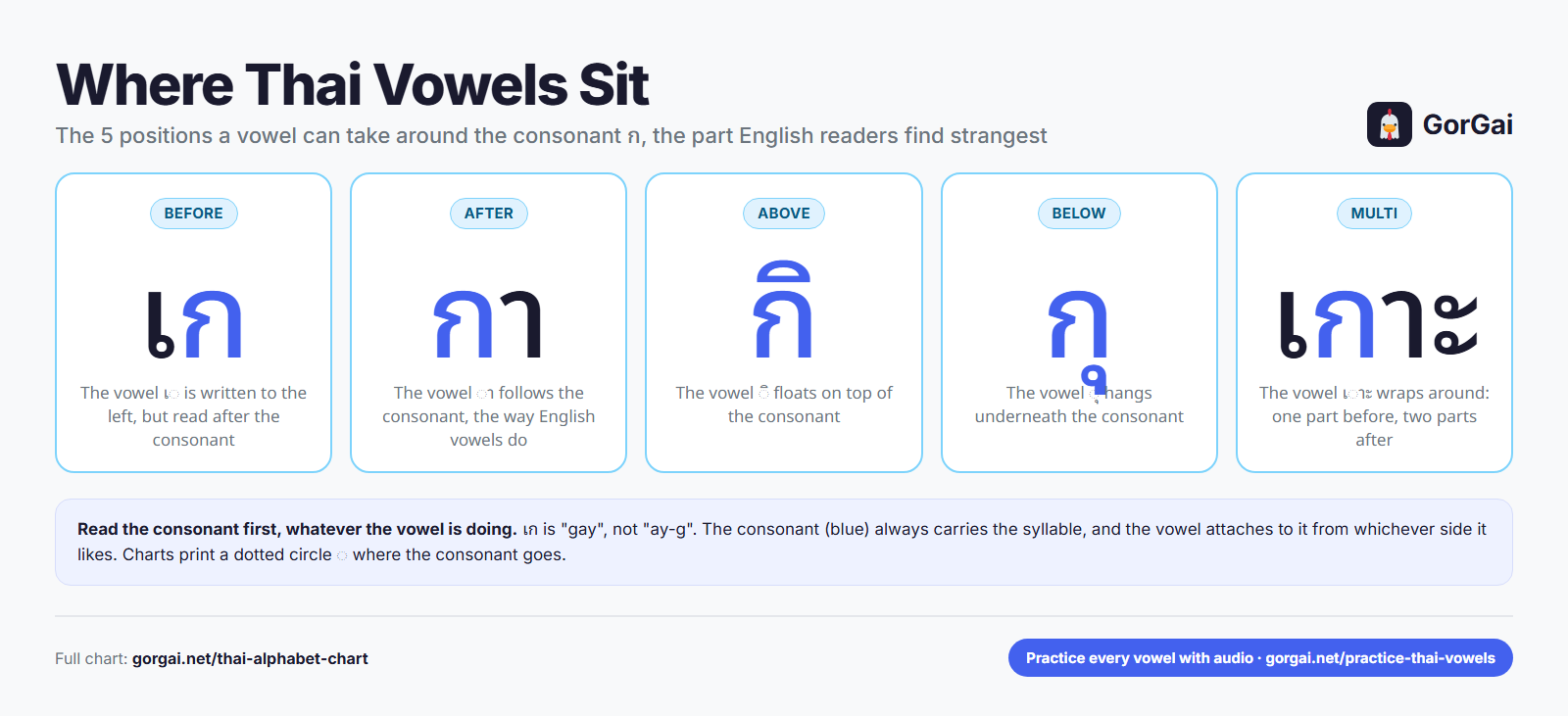
- After (ขวา): Written to the right of the consonant: ◌า, ◌อ. Example: กา (kaa, crow).
- Above (บน): Sit on top of the consonant: ◌ิ, ◌ี, ◌ึ, ◌ื, ◌ั, ◌็. Example: กิ (ki, branch).
- Below (ล่าง): Written underneath the consonant: ◌ุ, ◌ู. Example: กุ (ku).
- Before (ซ้าย): Written to the left of (before) the consonant: เ◌, แ◌, โ◌, ไ◌, ใ◌. Example: เก (gay). Even though เ appears first, you read the consonant first.
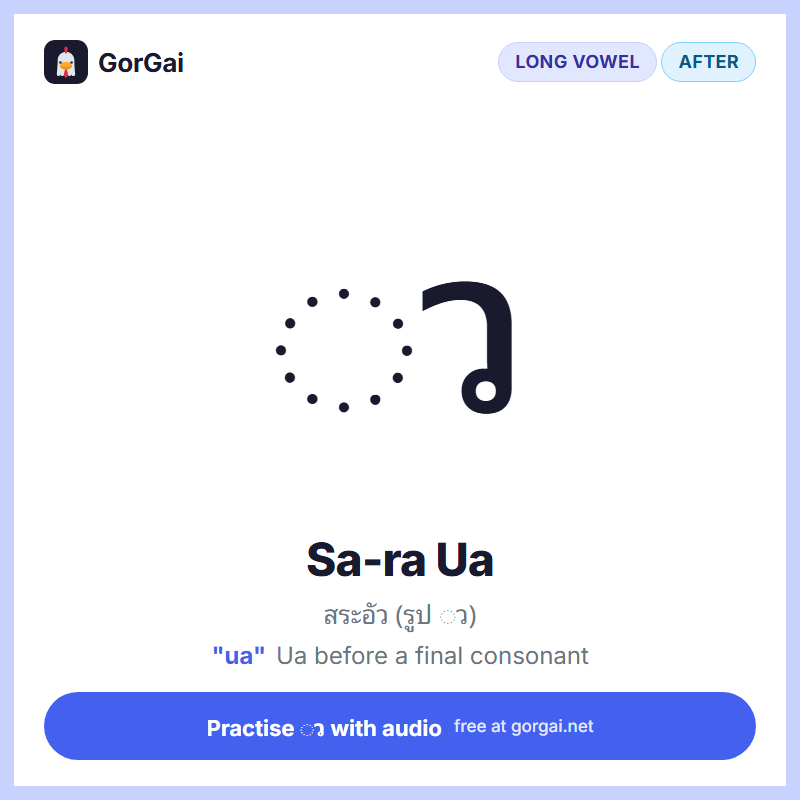
- Multi-position (หลายตำแหน่ง): Components wrap around the consonant: เ◌ะ, เ◌า, เ◌ีย, เ◌ือ, ◌ัว, and others. Example: เกา (gao, to scratch).
Short and long vowel pairs
Most Thai vowels come in short-long pairs. The sound is the same, but duration differs, and this changes the meaning of words entirely. Vowel length also affects tone rules in dead syllables.
| Short | Sound | Long | Sound | Romanized |
|---|---|---|---|---|
| ◌ะ | a | ◌า | aa | A / Aa |
| ◌ิ | i | ◌ี | ee | I / Ee |
| ◌ึ | ue | ◌ื | uee | Ue / Uee |
| ◌ุ | u | ◌ู | oo | U / Oo |
| เ◌ะ | e | เ◌ | ay | E / Ay |
| แ◌ะ | ae | แ◌ | ae | Ae (short / long) |
| โ◌ะ | o | โ◌ | oh | O / Oh |
| เ◌าะ | or | ◌อ | or | Or (short / long) |
| เ◌อะ | er | เ◌อ | er | Er (short / long) |
| ◌ัวะ | ua | ◌ัว | ua | Ua (short / long) |
Special vowels
Several Thai vowels don't follow the short-long pair pattern:
- เ◌ีย (ia): a long diphthong whose short pair เ◌ียะ is vanishingly rare. Used in words like เบียร์ (beer).
- เ◌ือ (uea): another long diphthong. Found in เสือ (tiger), เมือง (city).
- ไ◌ / ใ◌ (ai): two vowels with the same "ai" sound but different spellings. ใ◌ (mai muan) is used in only 20 common Thai words; ไ◌ (mai malai) is used everywhere else.
- ◌ำ (am): a combined vowel-consonant symbol representing the sound "am". It always ends with an "m" sound.
- เ◌า (ao): a short diphthong written around the consonant, as in เรา (rao, we).
- ฤ / ฤๅ (rue) and ฦ / ฦๅ (lue): independent vowels inherited from Sanskrit. ฤ appears in common words like ฤดู (season) and ฤทธิ์ (power). ฦ and ฦๅ are obsolete.
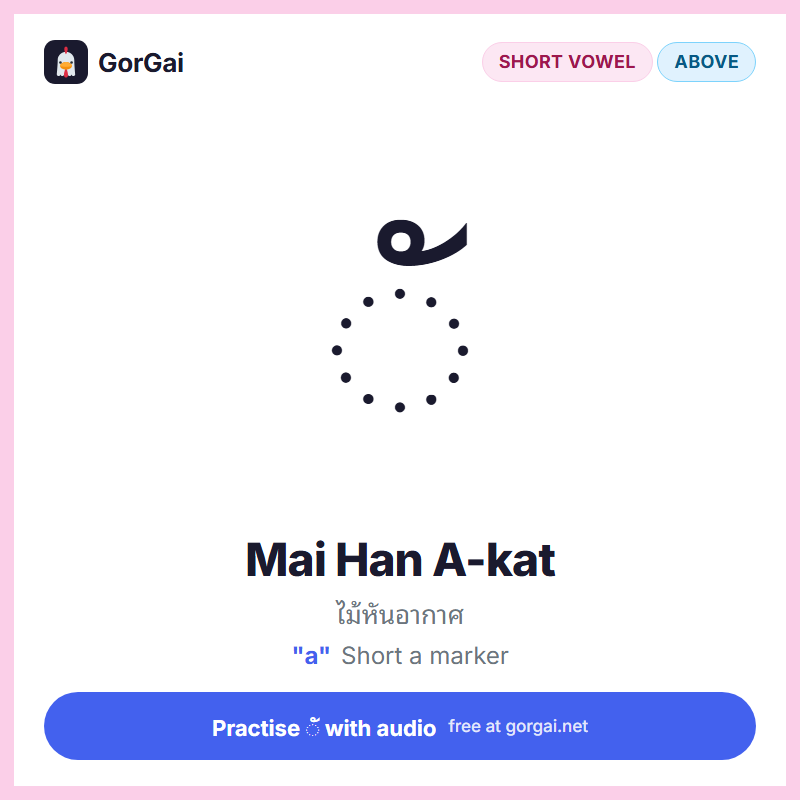
- ◌ั (mai han akat): the short "a" written above the consonant when a final consonant follows, as in กัน (gan). Not a standalone vowel.
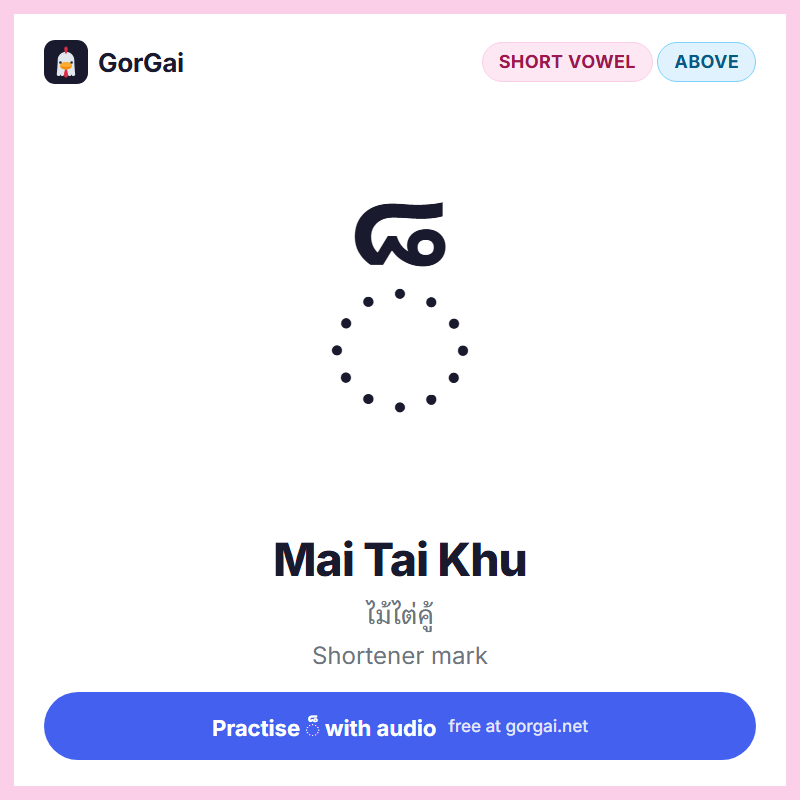
- ◌็ (mai tai khu): shortens the preceding vowel. Used in words like เด็ก (dek, child).
Practice writing all 32 vowel forms with GorGai's vowel tracing mode, or test your recognition with vowel flashcards.
Save any vowel as a card image
The same idea for the vowels: 32 cards plus the 4 extra written forms, each showing the vowel around the dotted consonant, its name, its sound, and whether it is short or long and where it sits. Tap a card for the full-size PNG.
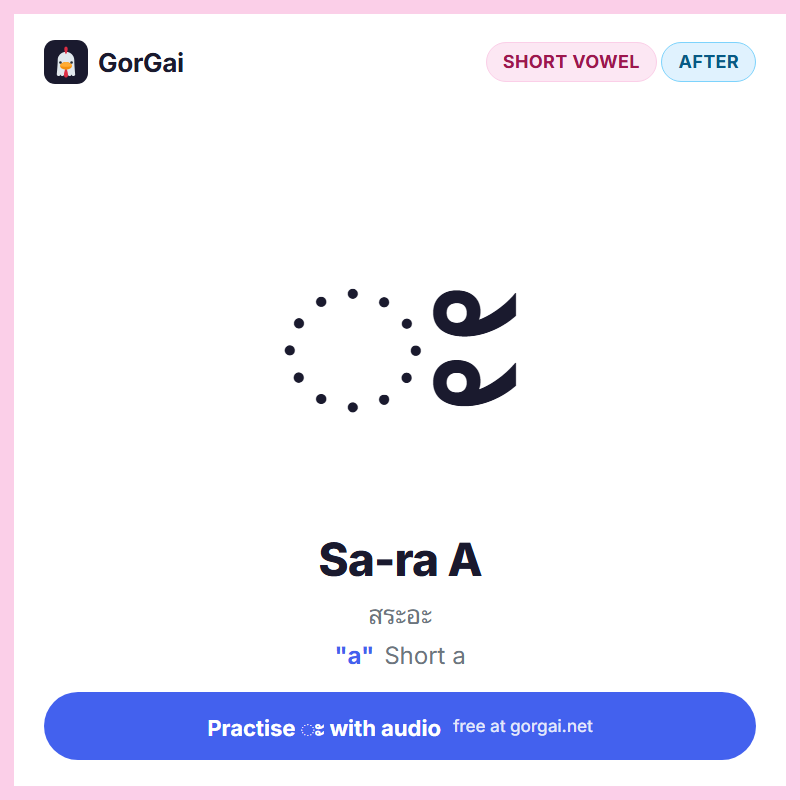
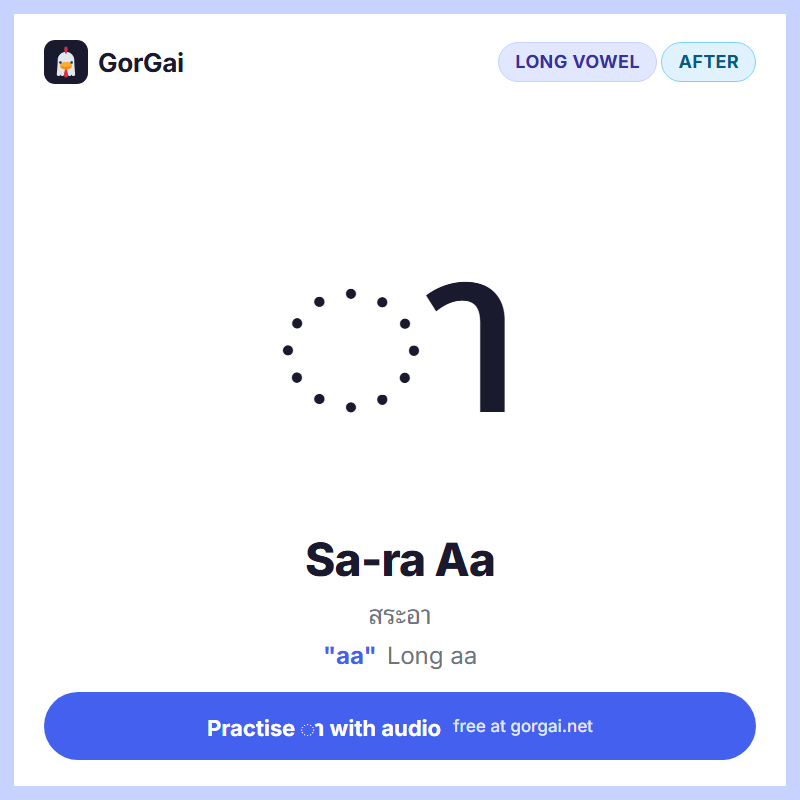
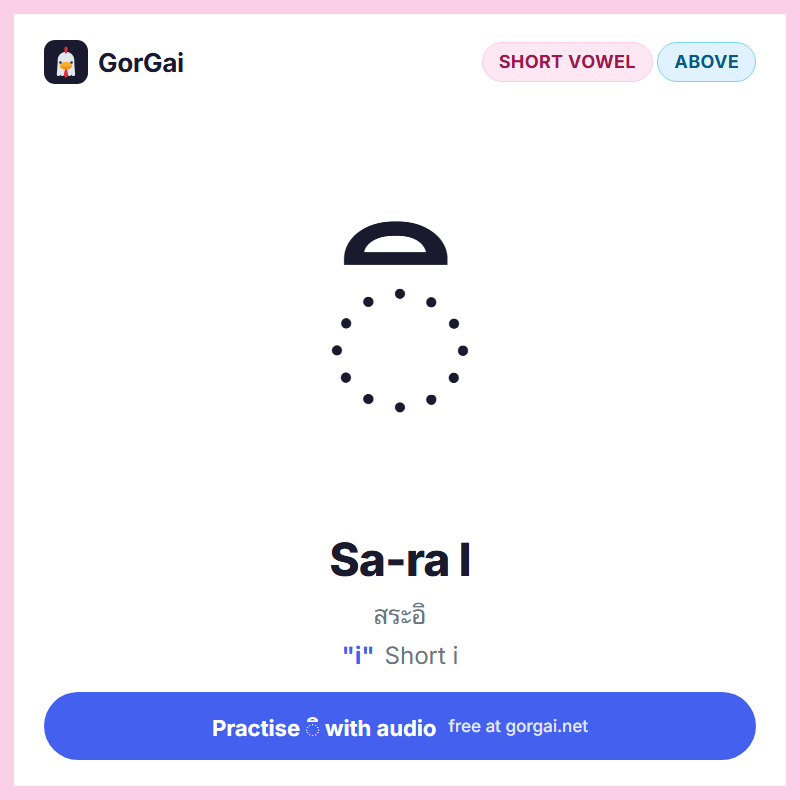
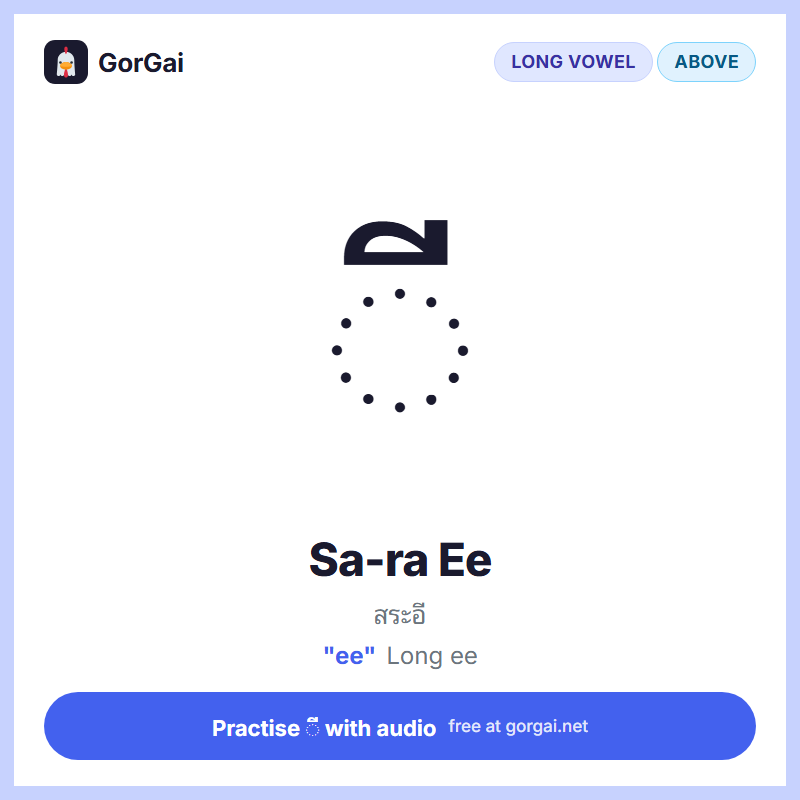
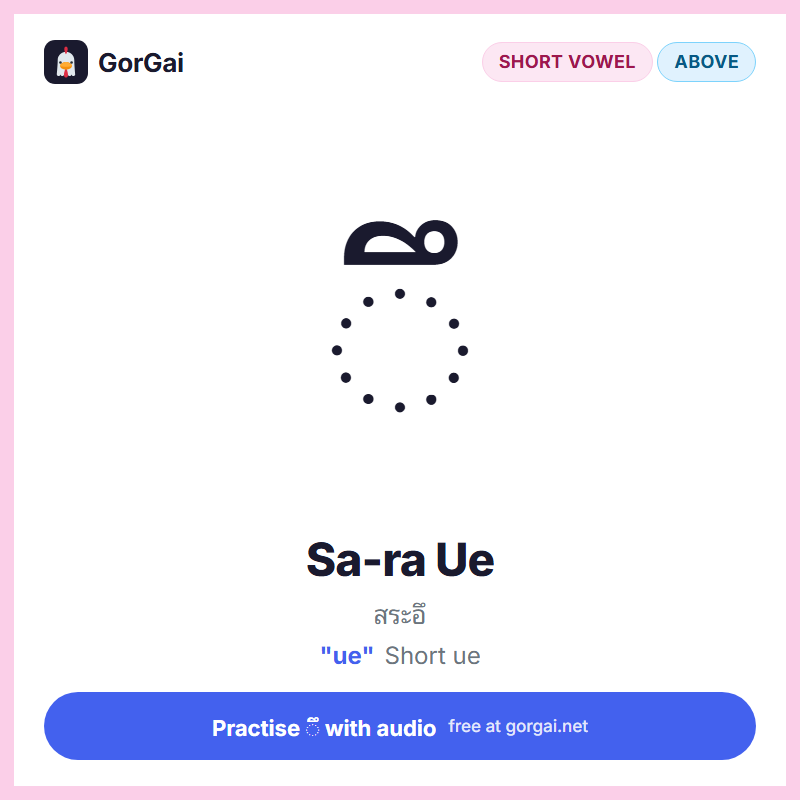
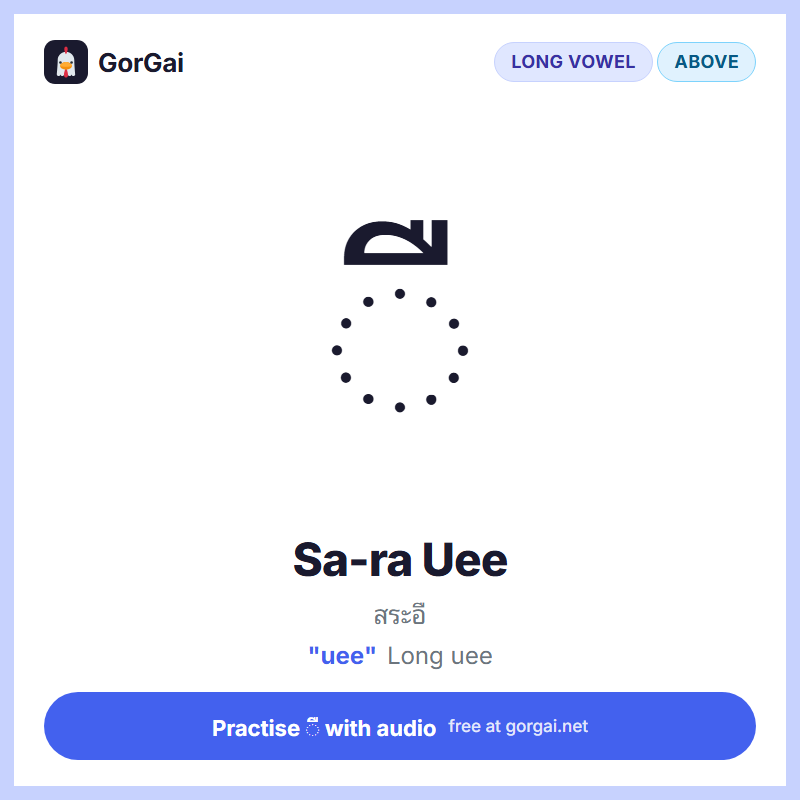
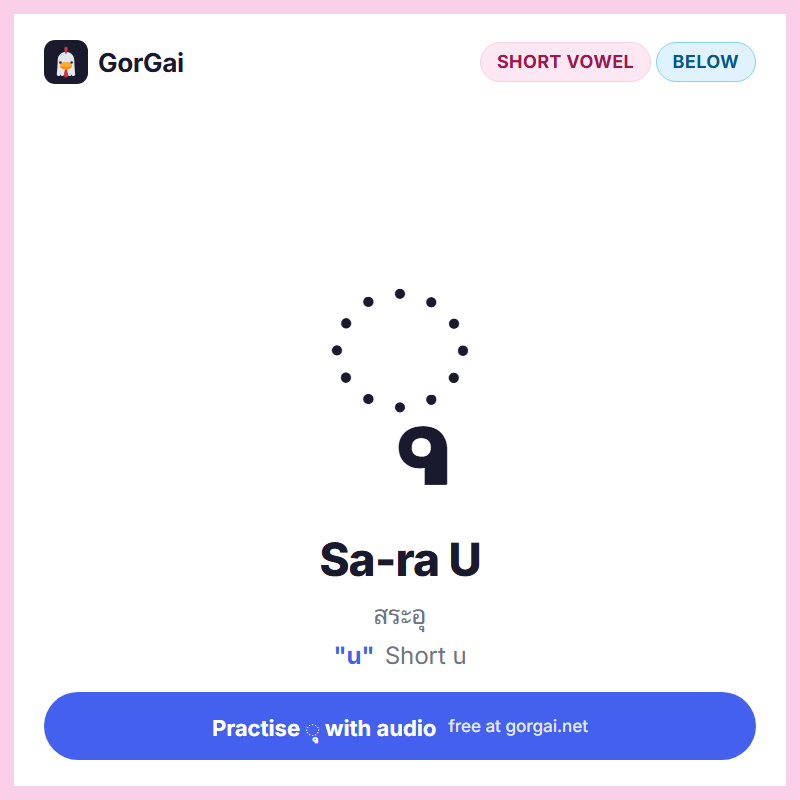
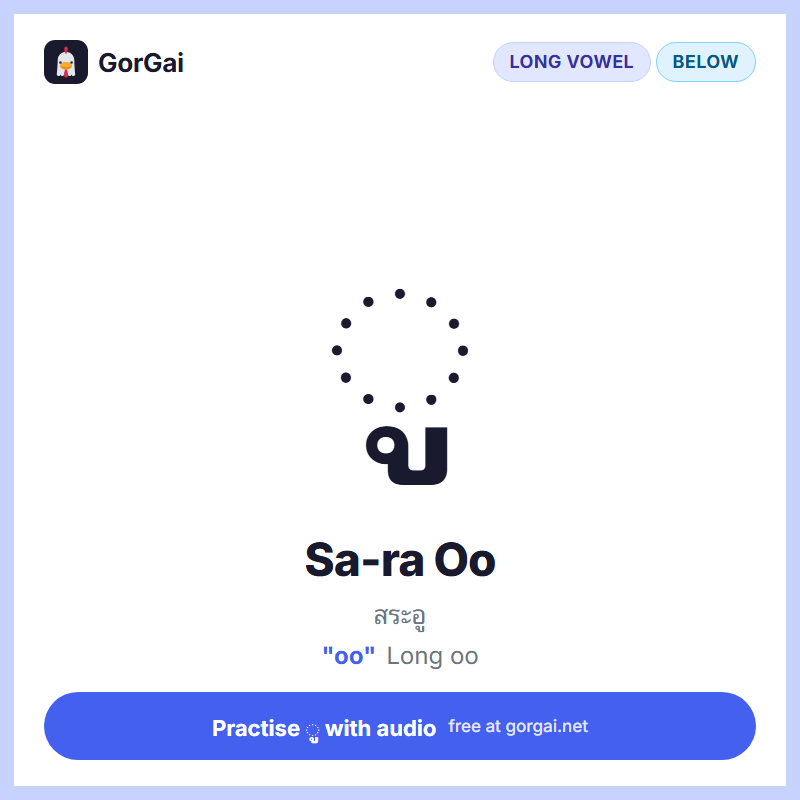
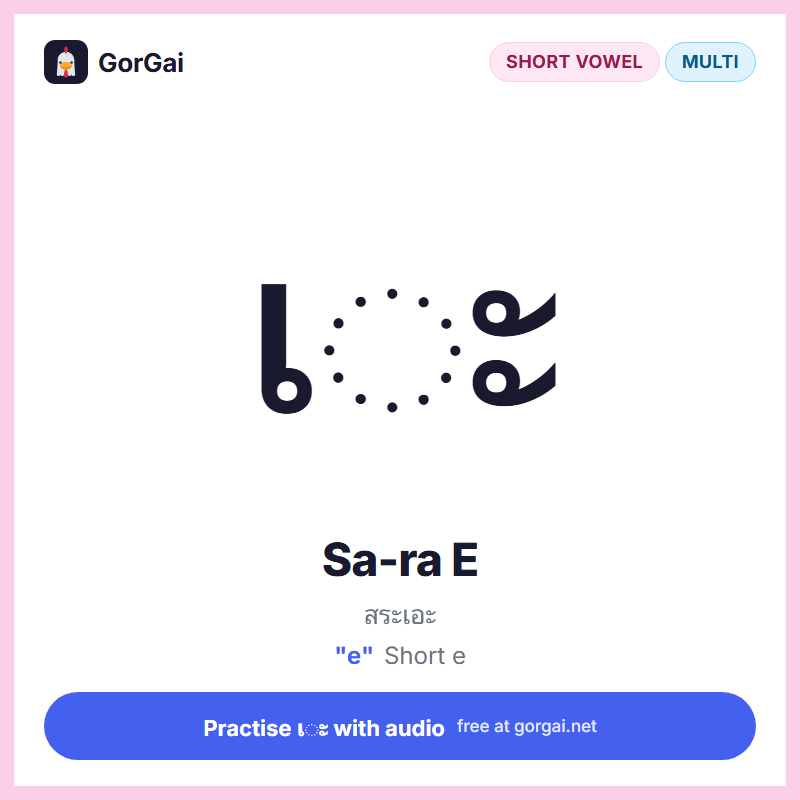
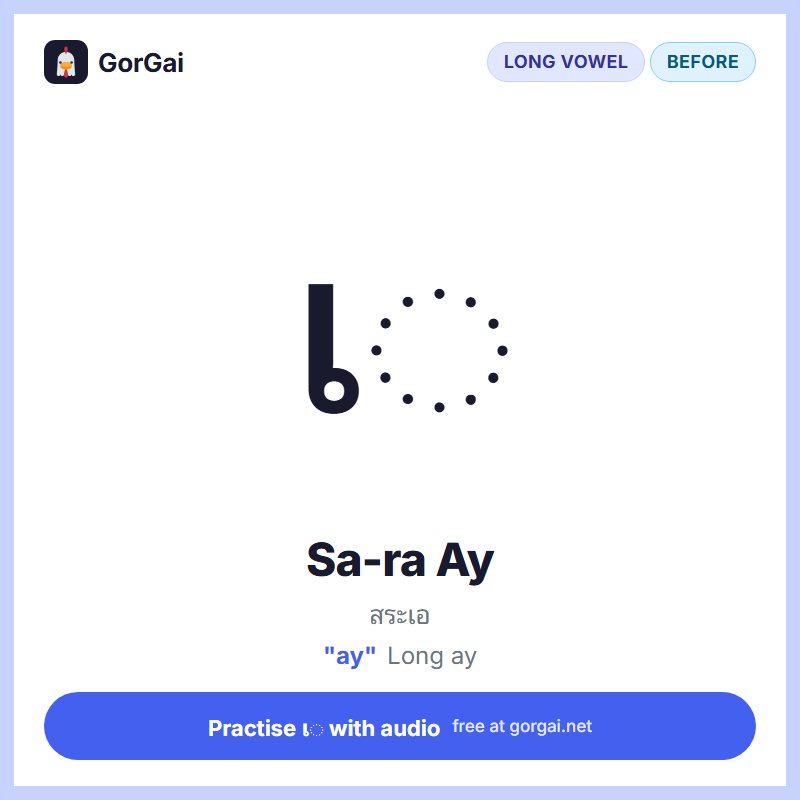
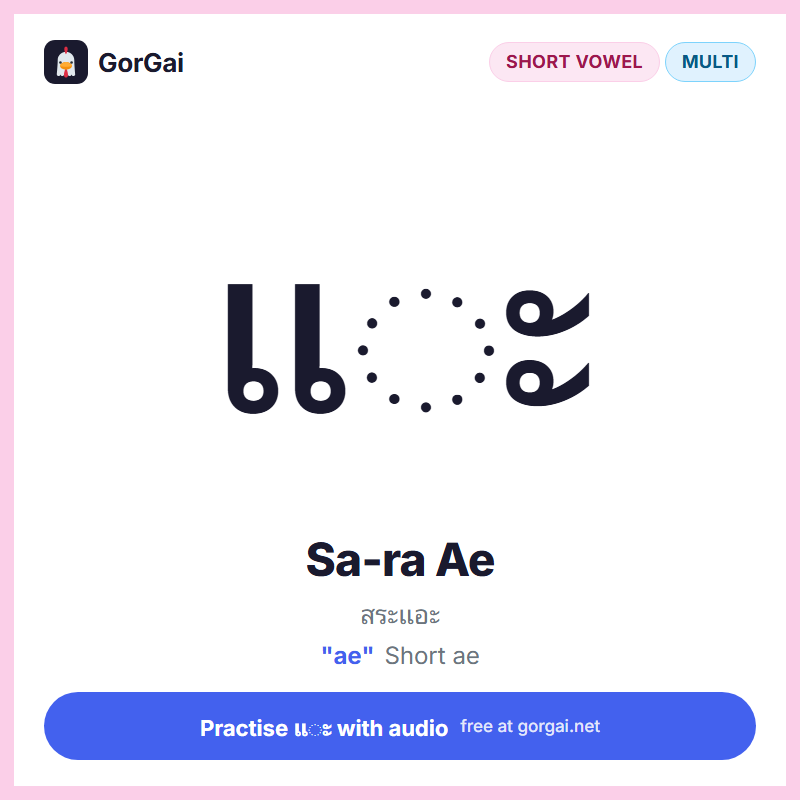
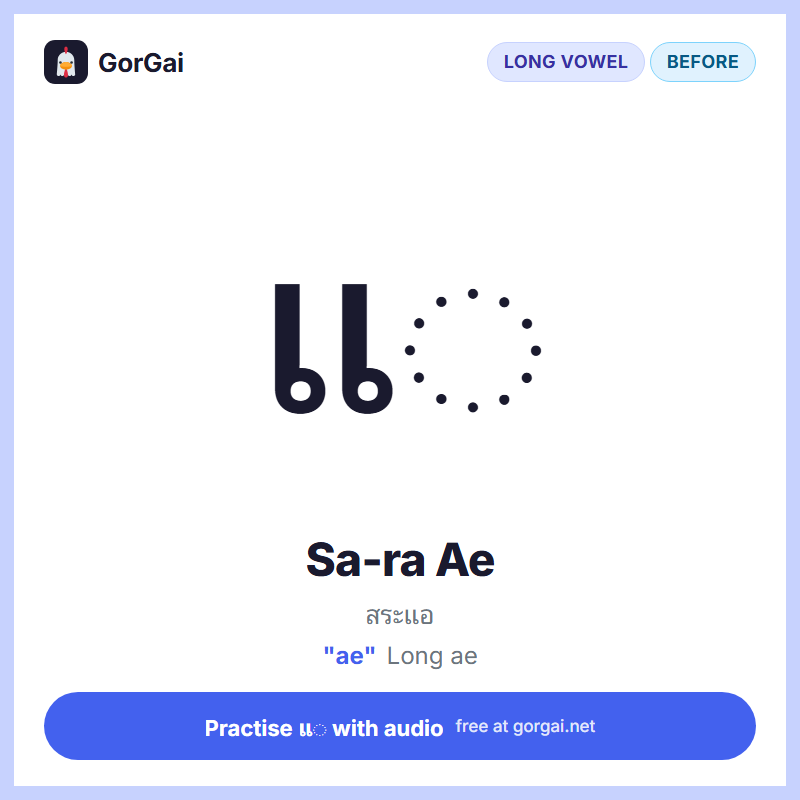
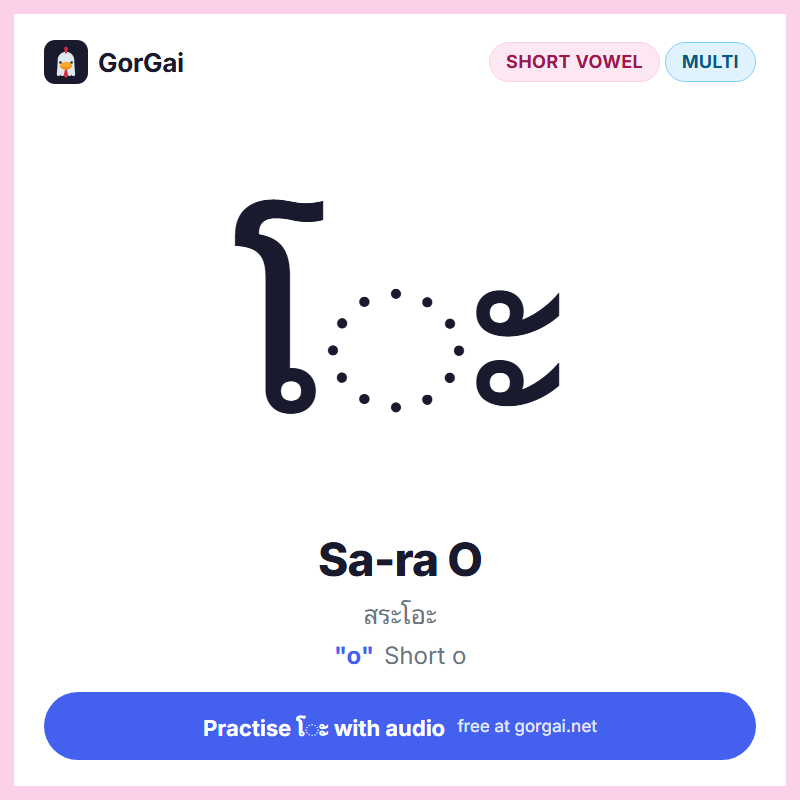
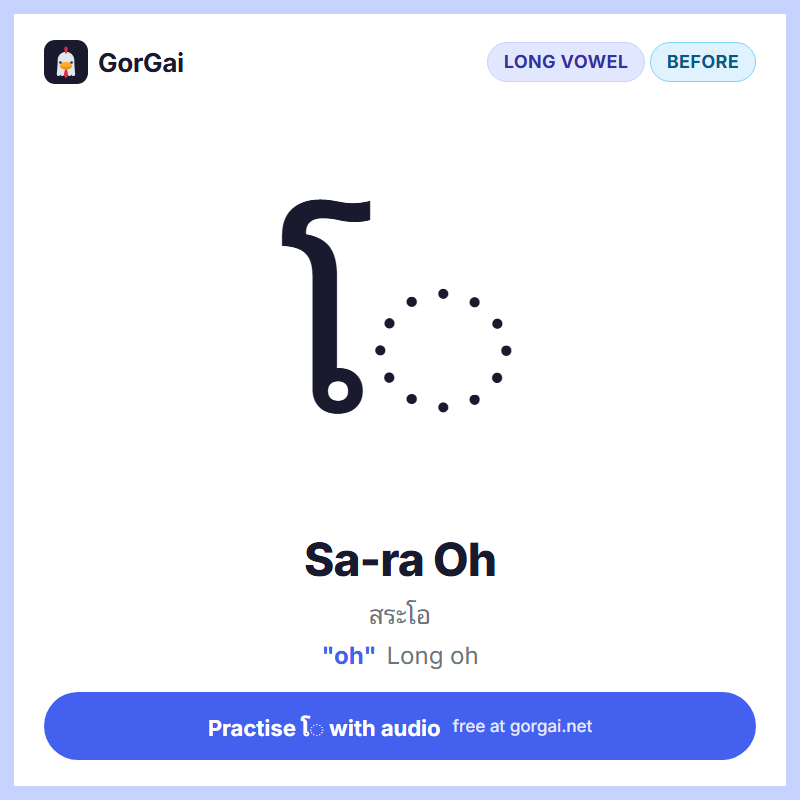
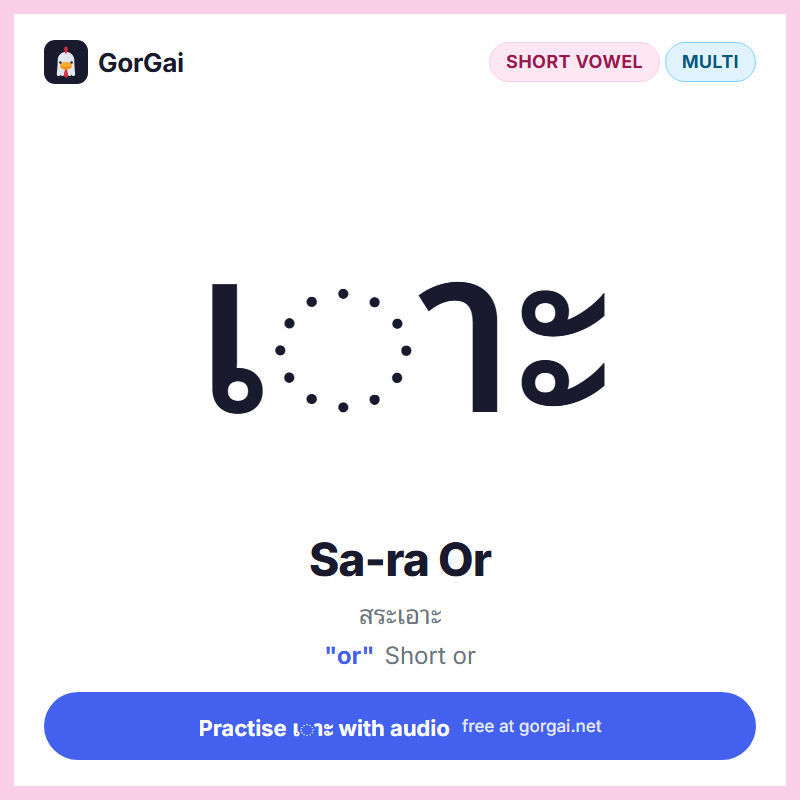
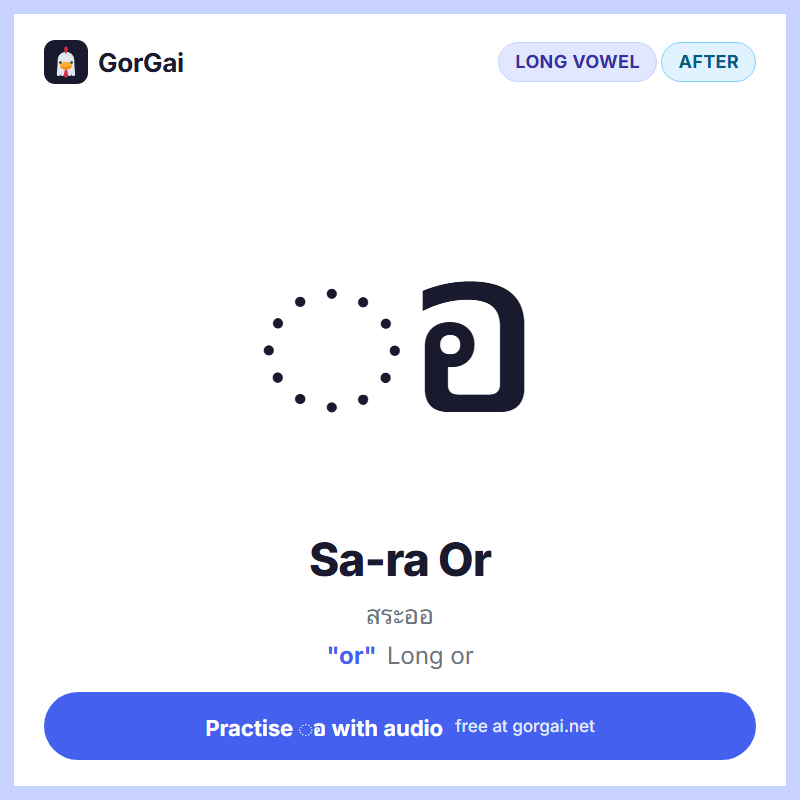
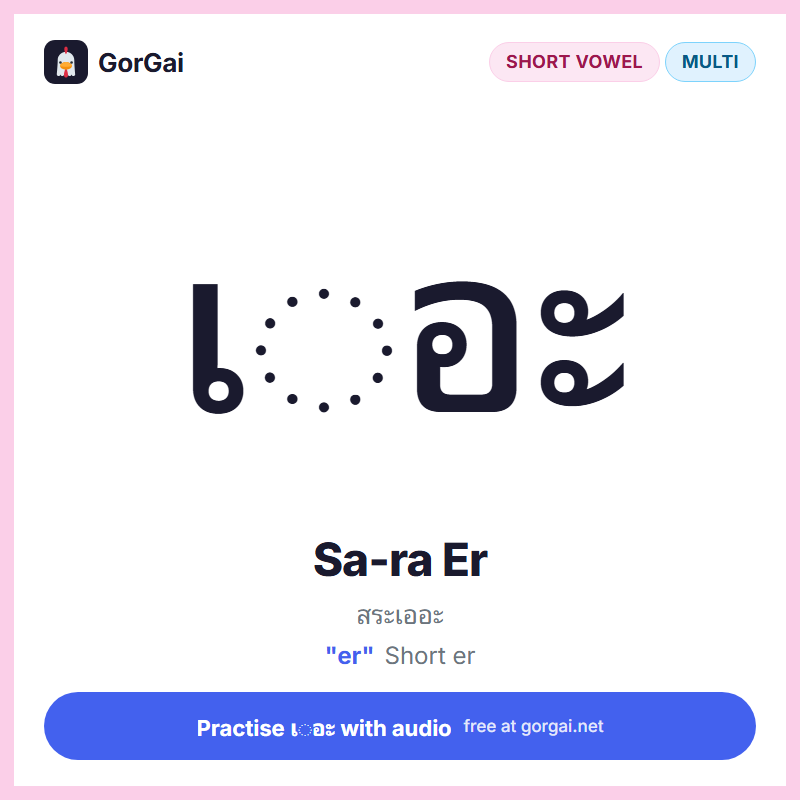
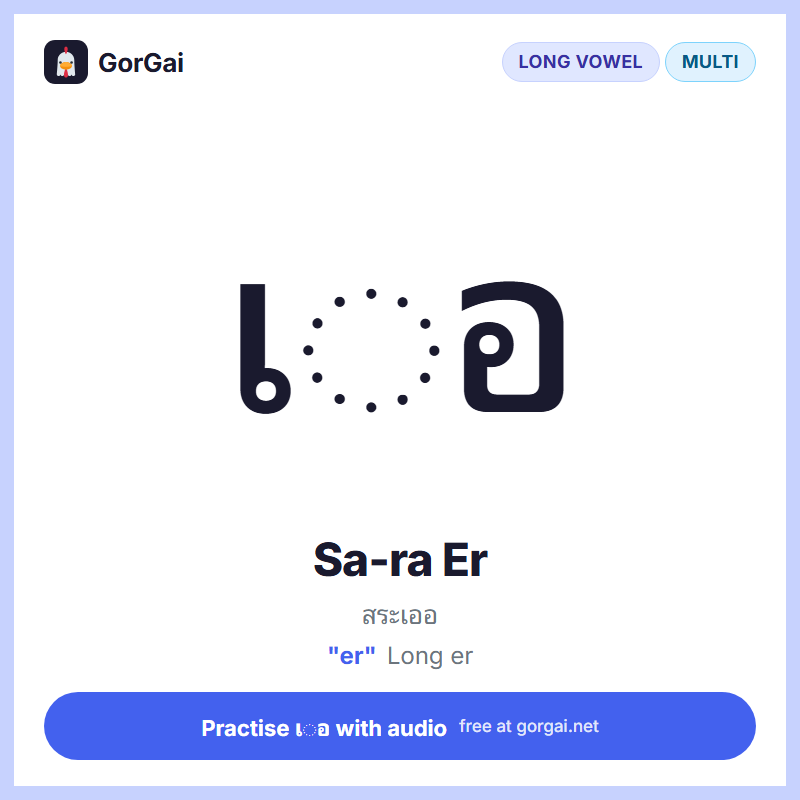
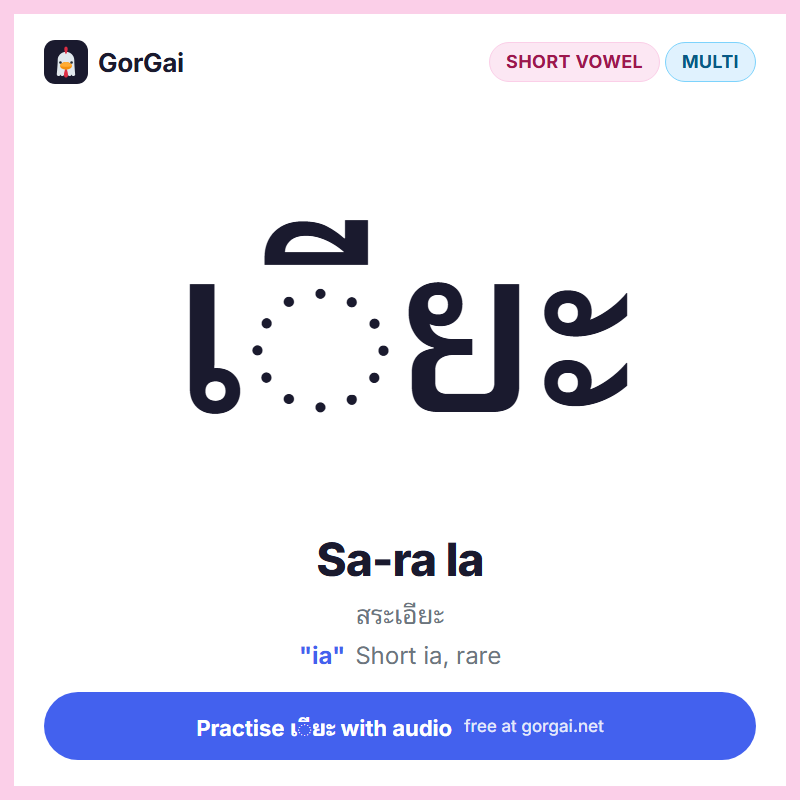
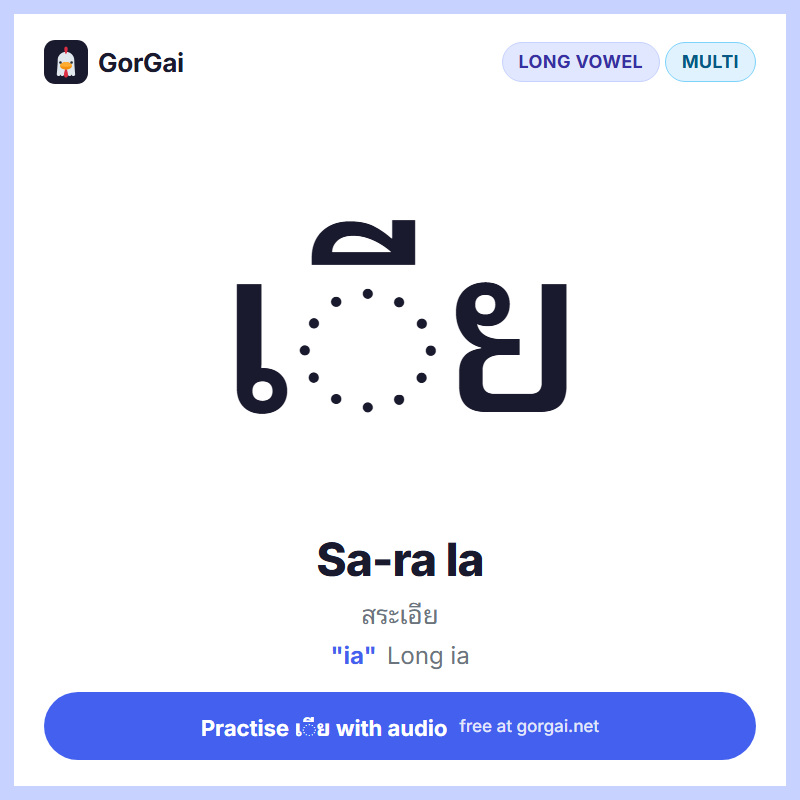
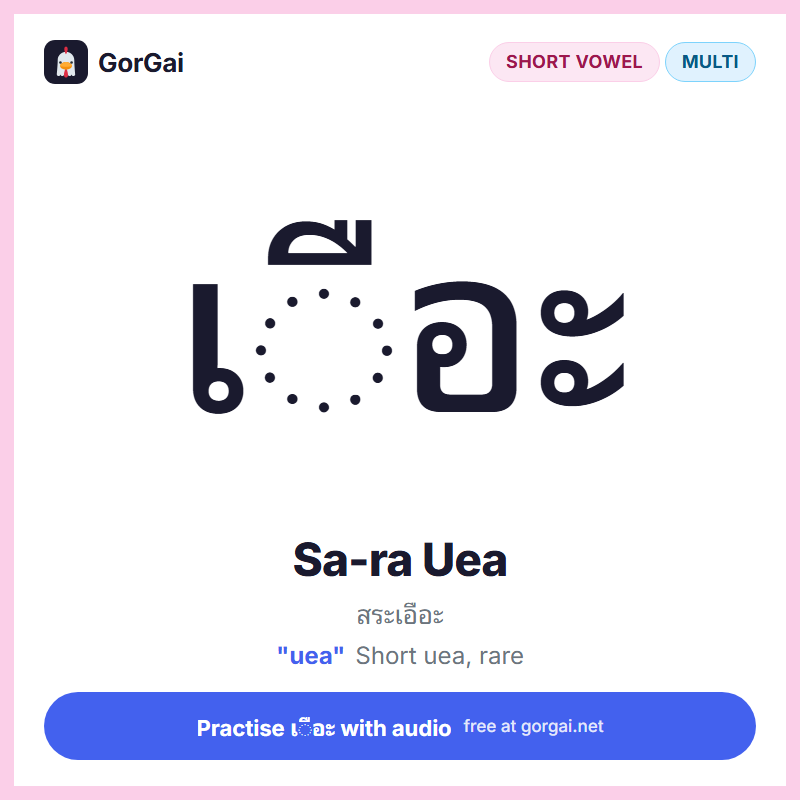
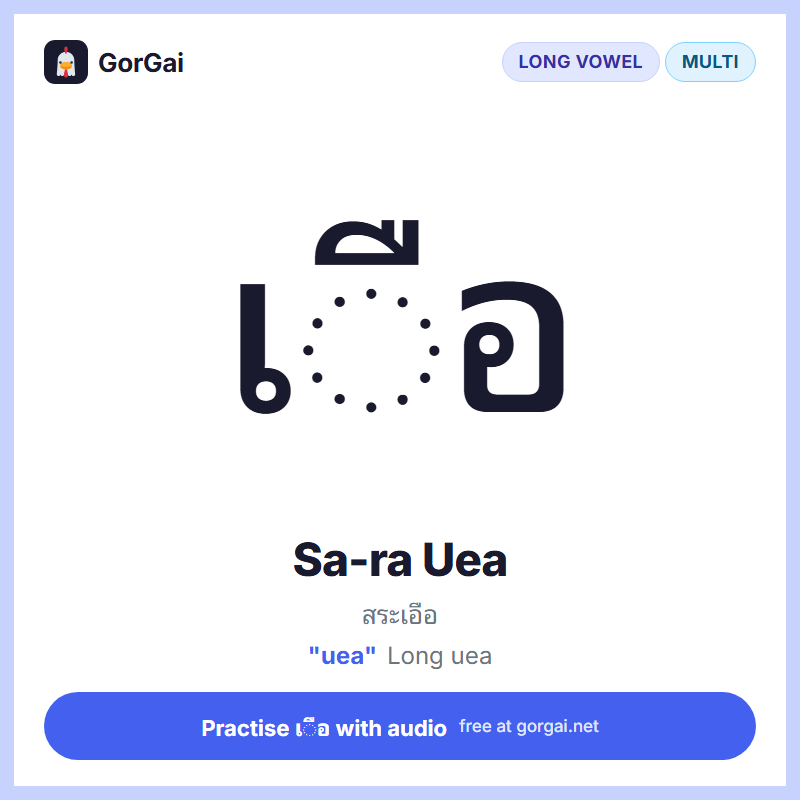
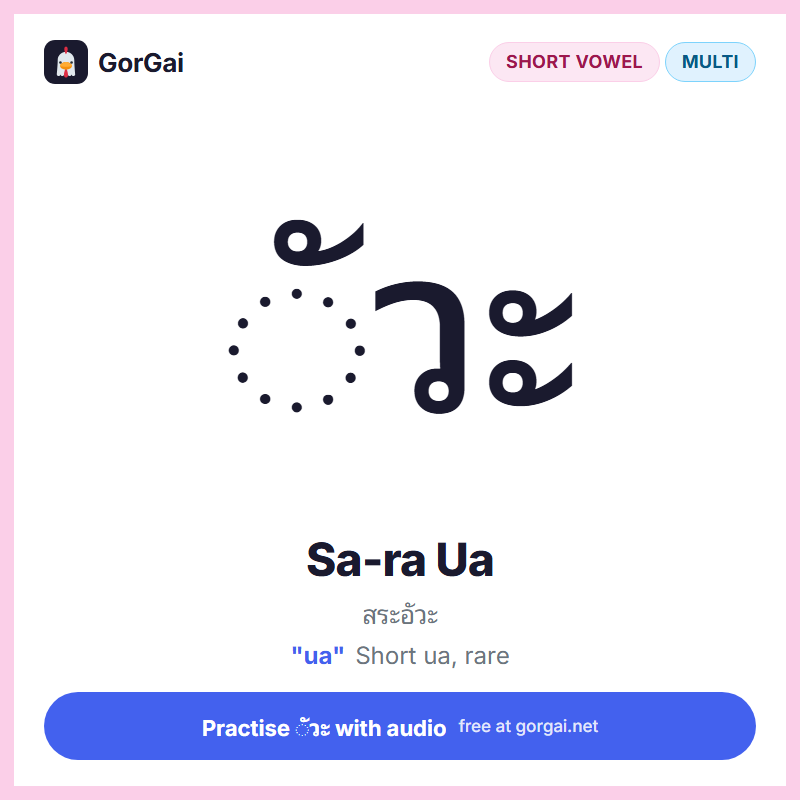
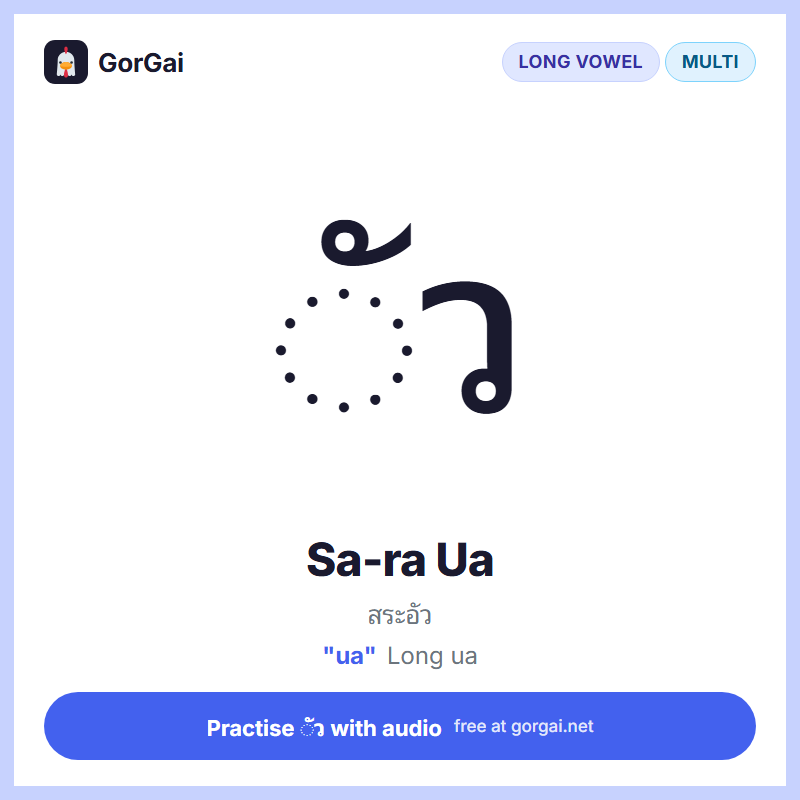
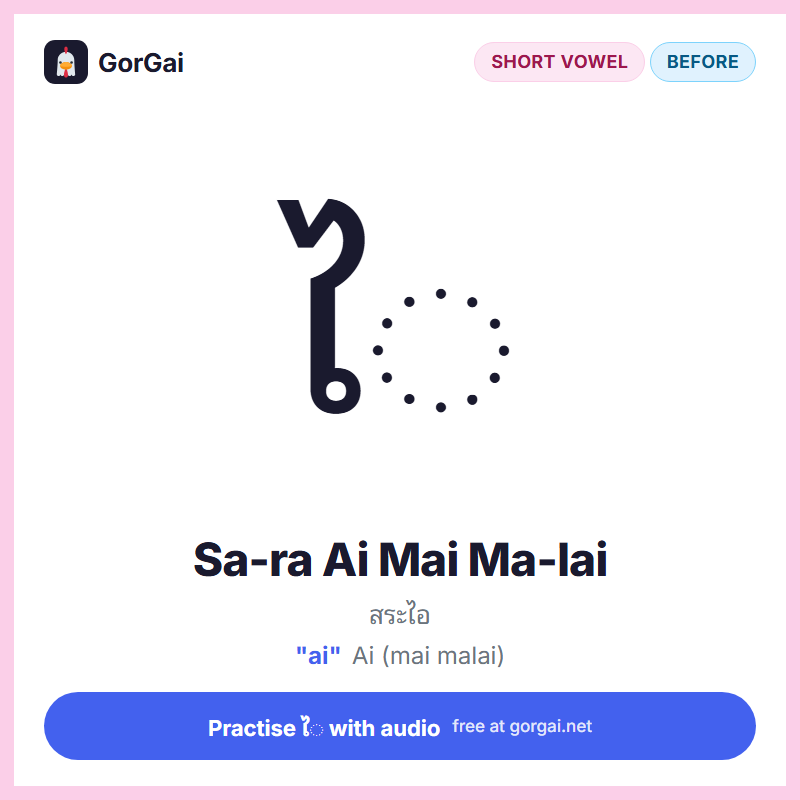
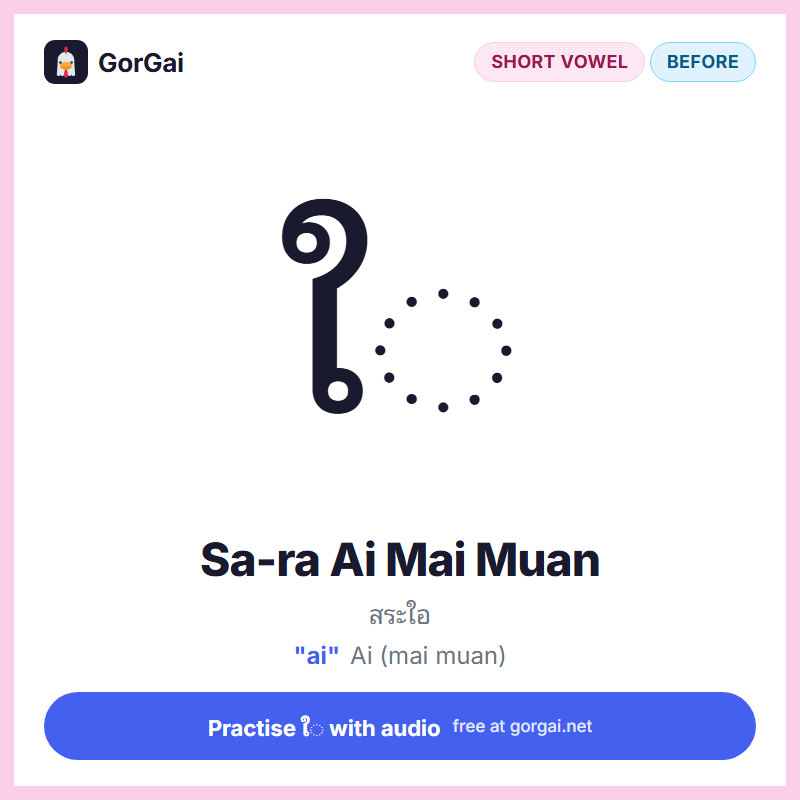
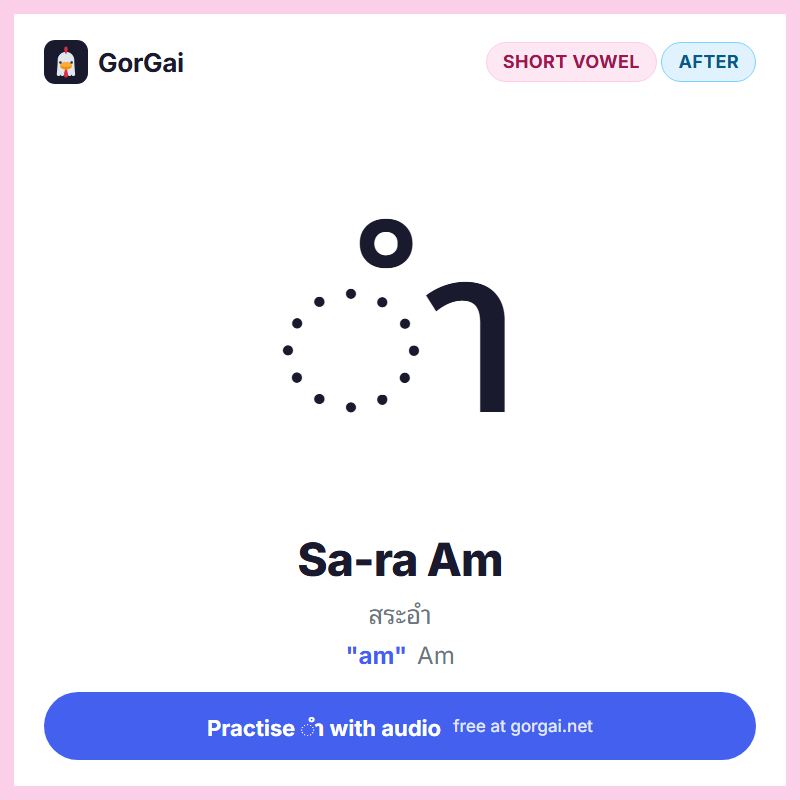
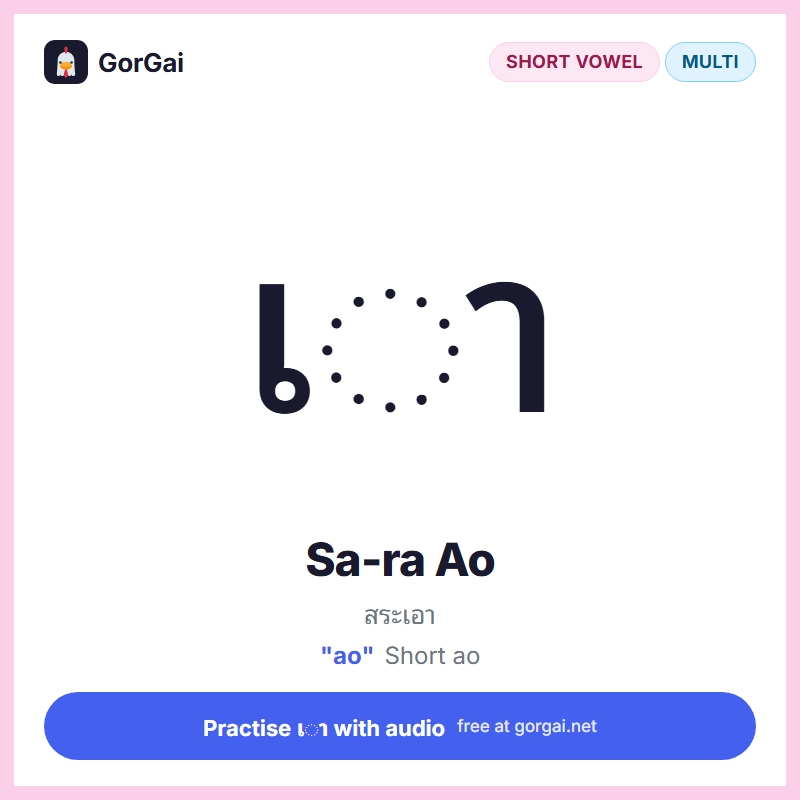
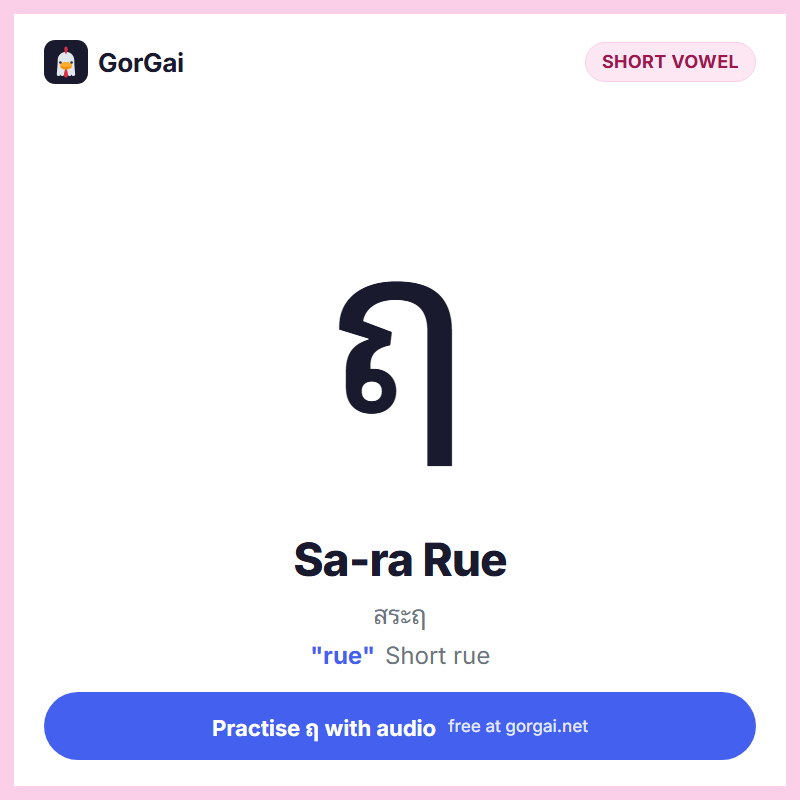
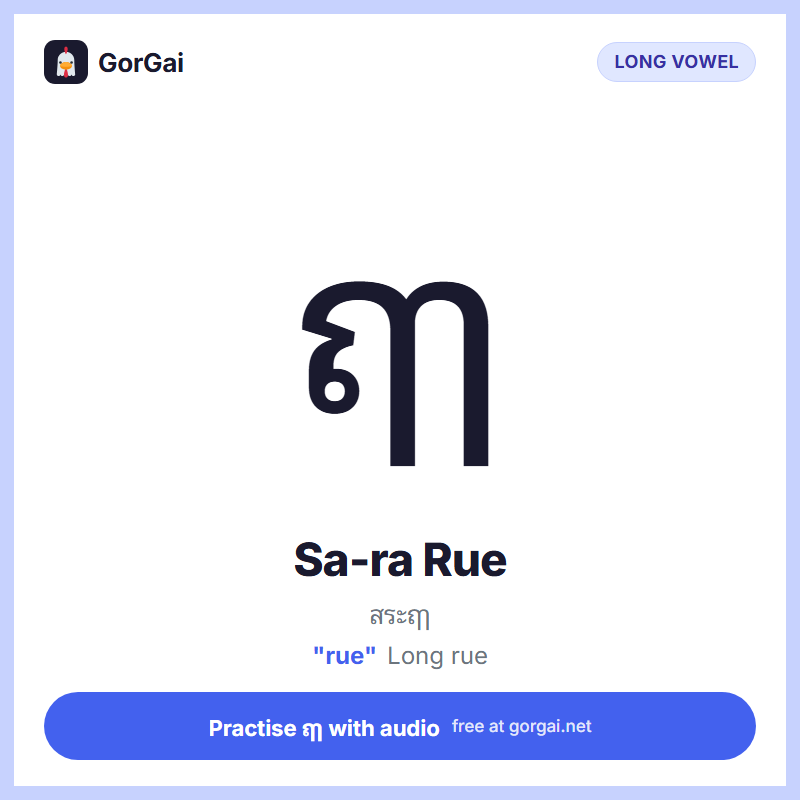
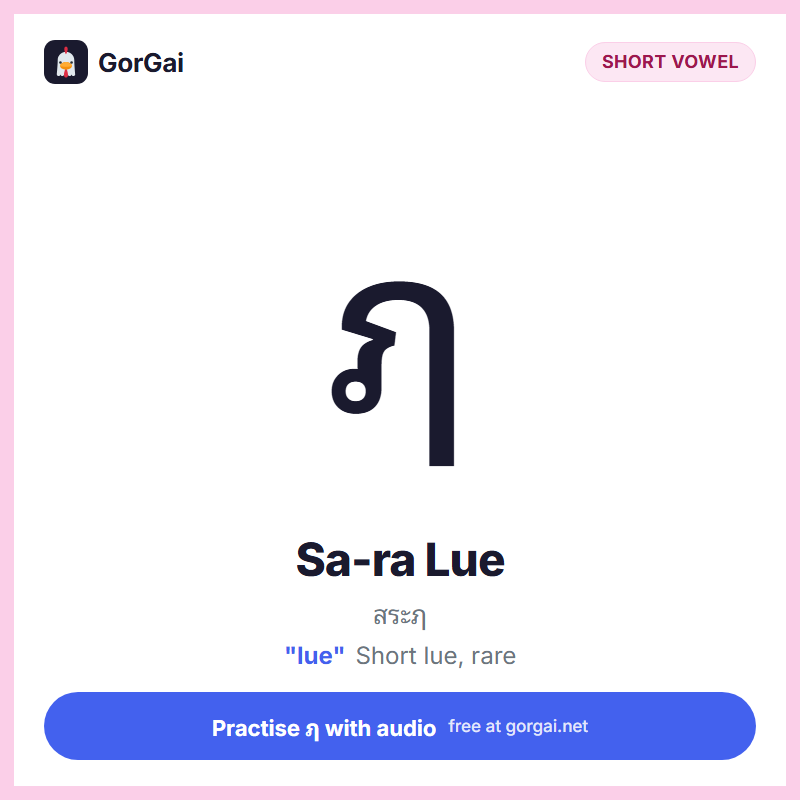
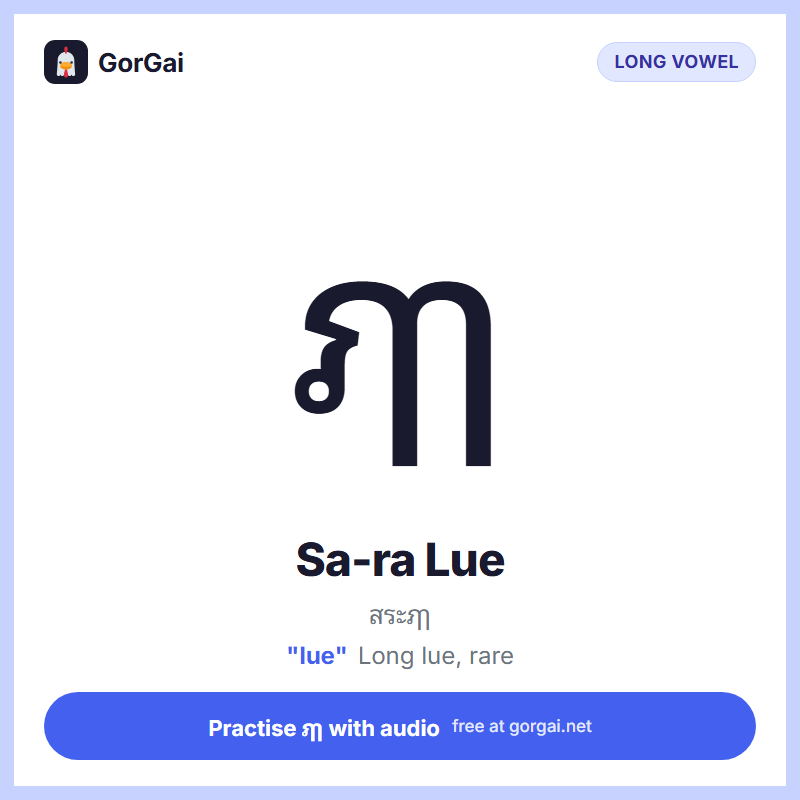
Then drill them with audio in vowel practice.
pls whitelist us :(
We promise our ads will never get in the way of your learning.
An ad was meant to go here. Ads are what keep GorGai free, and not one of them is allowed inside the practice area, so nothing ever pops up while you are tracing.
Thai tone marks and special marks
Thai has four tone marks (วรรณยุกต์), all written above the consonant. Together with the consonant's class and the syllable ending they decide which of the five tones you say. Then there are four more marks that are not about tone at all, and they are the ones printed charts usually skip. You will meet ◌์ in your first week, sitting on the silent r of เบียร์ (beer), so it belongs on the chart.
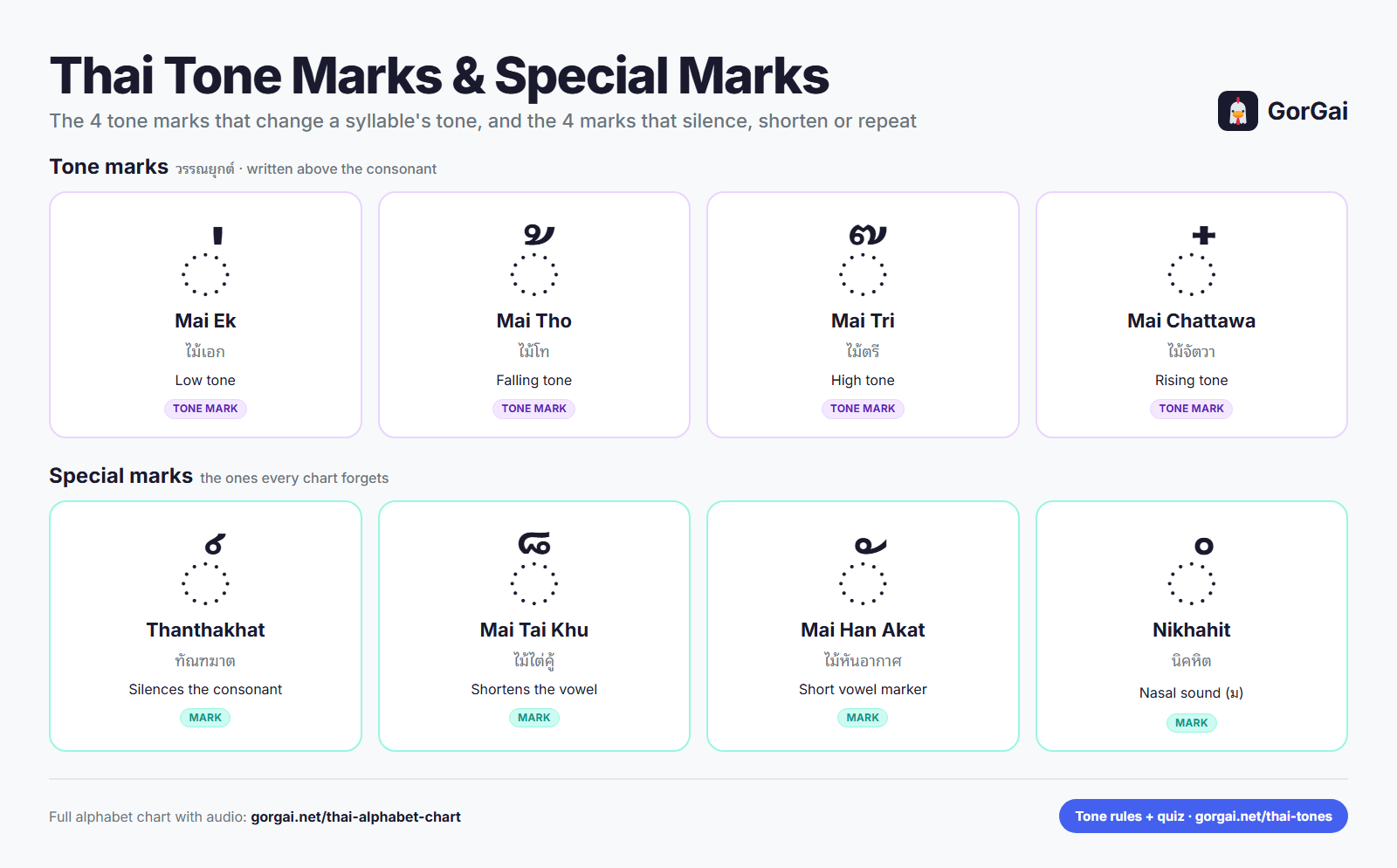
| Mark | Name | Romanized | What it does | Type |
|---|---|---|---|---|
| ◌่ | ไม้เอก | Mai Ek | Low tone | Tone mark |
| ◌้ | ไม้โท | Mai Tho | Falling tone | Tone mark |
| ◌๊ | ไม้ตรี | Mai Tri | High tone | Tone mark |
| ◌๋ | ไม้จัตวา | Mai Chattawa | Rising tone | Tone mark |
| ◌์ | ทัณฑฆาต | Thanthakhat | Silences the consonant | Special mark |
| ◌็ | ไม้ไต่คู้ | Mai Tai Khu | Shortens the vowel | Special mark |
| ◌ั | ไม้หันอากาศ | Mai Han Akat | Short vowel marker | Special mark |
| ◌ํ | นิคหิต | Nikhahit | Nasal sound (ม) | Special mark |
The tone a mark produces depends on the consonant class underneath it. Mai ek on a mid-class letter gives a low tone, and on a low-class letter it gives a falling tone. That table is the whole subject of the tone rules page, which also has a quiz.
Thai consonants that look alike: common confusions
Several Thai consonants look nearly identical and cause frequent confusion for learners. Recognizing these tricky pairs early saves you from persistent reading errors later.
- บ (Bor) vs ป (Por): บ has a small notch at the bottom-left; ป has a taller vertical stroke. Both are mid-class.
- ด (Dor) vs ค (Khor): ด (mid, child) curves inward at top; ค (low, buffalo) has a more open top loop.
- ถ (Thor) vs ภ (Phor): ถ (high, bag) and ภ (low, junk ship) share a similar body shape. Check the top. ภ has a distinct serif-like extension.
- พ (Phor) vs ฟ (For): Both low-class. พ (tray) has a shorter descender; ฟ (teeth) has two matching descenders like actual teeth.
- ศ (Sor) vs ษ (Sor) vs ส (Sor): Three high-class consonants all romanized as "Sor" with the same "s" sound. They differ in shape and origin (Sanskrit/Pali distinctions).
- ฎ (Dor) vs ฏ (Tor): These mid-class retroflex consonants from Sanskrit look similar to ด and ต but have small curls. Rarely seen outside formal or Pali-derived words.
The best way to overcome look-alike confusion is active writing practice. When you draw a character by hand, you internalize the subtle differences. Try writing from memory to build that muscle memory.
How tone classes work: why they matter for reading Thai
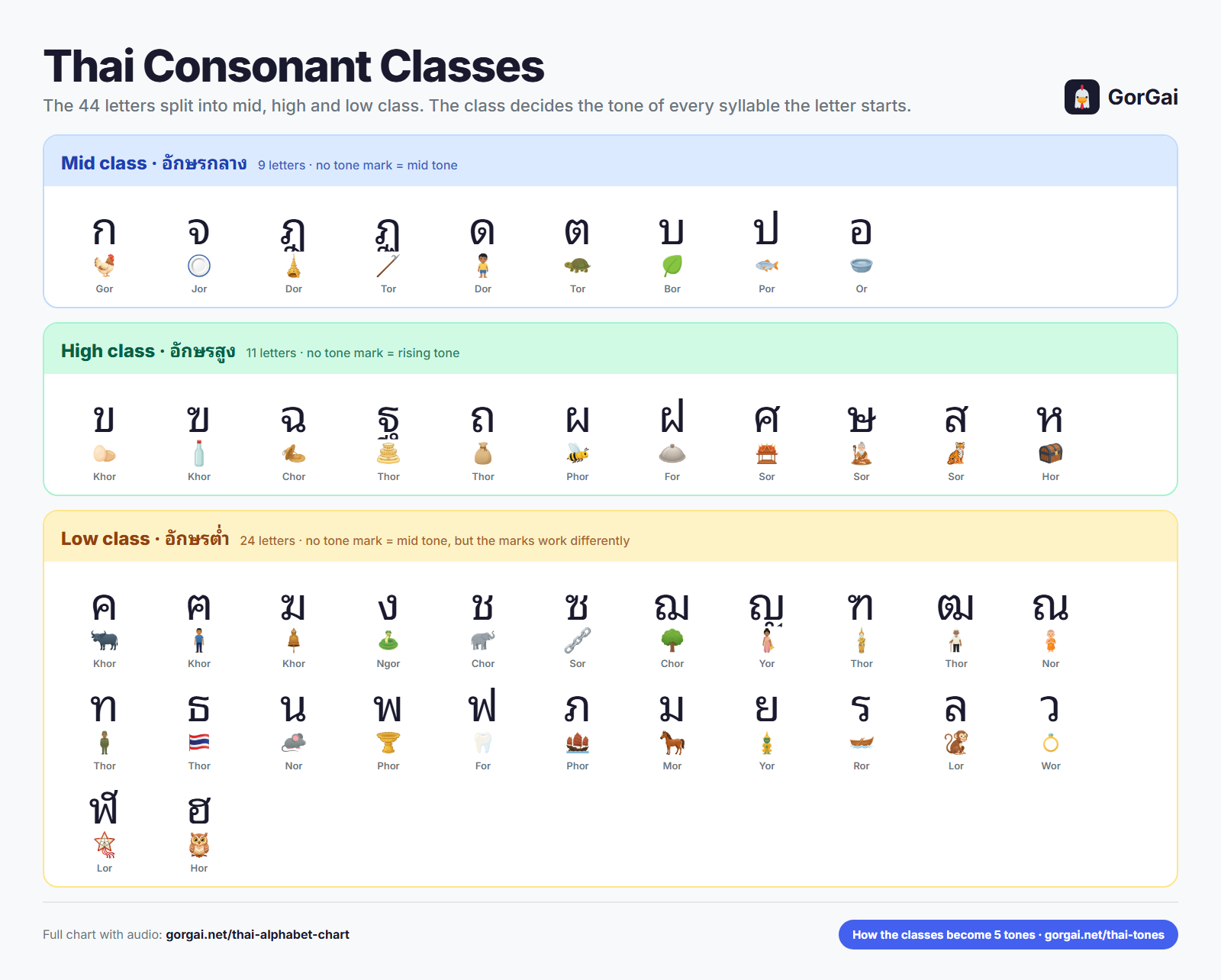
Every Thai consonant belongs to one of three tone classes: mid (กลาง), high (สูง), or low (ต่ำ). The tone class is not about pitch. It's a category that determines which of the 5 Thai tones (mid, low, falling, high, rising) a syllable receives when combined with tone marks and syllable structure.
Tone class quick reference
- Mid class (9 letters: ก จ ฎ ฏ ด ต บ ป อ): The most flexible. Can use all 4 tone marks. Default tone in live syllables: mid. These are all unaspirated stops or the glottal stop อ.
- High class (11 letters: ข ฃ ฉ ฐ ถ ผ ฝ ศ ษ ส ห): Only use mai ek and mai tho. Default tone in live syllables: rising. These are all aspirated stops or voiceless fricatives.
- Low class (24 letters): Only use mai ek and mai tho (but produce different tones than high class). Default tone in live syllables: mid. Includes voiced stops, nasals, and approximants.
When you see an unfamiliar Thai word, the first thing you need to identify is the initial consonant's tone class. This, combined with any tone mark and whether the syllable is "live" or "dead", gives you the tone. GorGai's chart color-codes every consonant by class so you build this association visually. For a deep dive into tone rules with interactive examples, visit the Tone Rules & Quiz page.
Thai consonant sound groups: same sound, different class
A distinctive feature of Thai is that multiple consonants can produce the same initial sound but belong to different tone classes. This means the same "kh" sound in two different words might be spelled with different consonants, and produce different tones. Here are the major sound groups:
| Sound | High Class | Low Class | Mid Class |
|---|---|---|---|
| K (no puff) | n/a | n/a | ก |
| Kh | ข (ฃ) | ค (ฅ) ฆ | n/a |
| Ch | ฉ | ช ฌ | n/a |
| J | n/a | n/a | จ |
| D | n/a | n/a | ด ฎ |
| T (no puff) | n/a | n/a | ต ฏ |
| Th | ฐ ถ | ฑ ฒ ท ธ | n/a |
| B | n/a | n/a | บ |
| P (no puff) | n/a | n/a | ป |
| Ph | ผ | พ ภ | n/a |
| F | ฝ | ฟ | n/a |
| S | ศ ษ ส | ซ | n/a |
| H | ห | ฮ | n/a |
| N | n/a | ณ น | n/a |
| M | n/a | ม | n/a |
| Y | n/a | ญ ย | n/a |
| R | n/a | ร | n/a |
| L | n/a | ล ฬ | n/a |
| W | n/a | ว | n/a |
| Ng | n/a | ง | n/a |
Notice the pattern: mid-class consonants are all unaspirated (no puff of air). The aspirated version of each sound is split between high and low class. This is why Thai has multiple "Kh" and "Th" consonants. They represent the same sound in different tone contexts. Understanding these groupings is critical for fluent reading.
How to read the Thai alphabet: from letters to a syllable
A chart tells you what each letter is. Reading is putting them together, and the order you look at them in is fixed. Take กิน (gin, to eat):
- Find the consonant. ก. Mid class, unaspirated k. It is the anchor of the syllable, whatever else is around it.
- Find the vowel around it. ◌ิ, the short "i", is sitting on top. Read it after the consonant: "gi".
- Check for a final consonant. น at the end. As a final it keeps its n sound: "gin".
- Work out the tone. Mid class, no tone mark, live syllable (it ends in a nasal). That is a mid tone. Done.
Now ข้าว (khao, rice). ข is high class and aspirated, ◌า is the long "aa" written after it, ว is the final w, and the ้ on top is mai tho. High class plus mai tho gives a falling tone. Two words and you have used every part of the chart. The word reading practice walks through 89 words exactly this way, with each syllable broken down.
Final consonants: the letters that change sound at the end of a word
Thai only allows eight sounds at the end of a syllable, so the 44 letters collapse into eight when they are finals. This is the rule beginner charts leave out, and it is why ประเทศ (country) ends in a t sound even though ศ is an s. The three stop finals (k, t, p) are unreleased: your mouth goes to the position and stops, with no puff.
| Final sound | IPA | Letters that make it | Example |
|---|---|---|---|
| k | /k̚/ | ก ข ค ฆ | มาก (maak, very) |
| t | /t̚/ | ด ต ถ ท ธ ฎ ฏ ฐ ฑ ฒ จ ช ซ ศ ษ ส | รถ (rot, car), ประเทศ (pra-thet, country) |
| p | /p̚/ | บ ป พ ฟ ภ | ครับ (khrap, polite particle) |
| n | /n/ | น ณ ญ ร ล ฬ | กิน (gin, to eat), การ (gaan, work) |
| m | /m/ | ม | ตาม (taam, to follow) |
| ng | /ŋ/ | ง | ของ (khong, of) |
| y | /j/ | ย | ไทย (thai) |
| w | /w/ | ว | ข้าว (khao, rice) |
The dividing line matters for tone, too. A syllable ending in k, t or p (or a short vowel with no final) is "dead", and dead syllables follow different tone rules from "live" ones ending in n, m, ng, y, w or a long vowel. That is the second half of the tone rules.
Is there a Thai alphabet "A to Z"? How the order works
Thai has a fixed alphabetical order, ก ข ฃ ค ฅ ฆ ง จ ฉ ช ซ ฌ ญ ฎ ฏ ฐ ฑ ฒ ณ ด ต ถ ท ธ น บ ป ผ ฝ พ ฟ ภ ม ย ร ล ว ศ ษ ส ห ฬ อ ฮ, and it does the same job A to Z does: it is how dictionaries are sorted and how Thai children recite the alphabet. It is not a translation of the Latin one, though. Thai has 44 consonants against English's 21, several of them share a sound, and the vowels are marks written around the consonant rather than letters in the line. So there is no letter that "is" the Thai B. There is บ, which makes a b sound.
The order is inherited from Sanskrit and groups letters by where in the mouth they are made: the k sounds first, then the ch sounds, then the retroflex and dental t sounds, then p, then the sonorants. Once you notice that, the sequence stops feeling random. If you were searching for "Thai alphabet to English", the Romanized column in the tables above is what you want. It follows the Royal Thai General System, the one used on road signs.
Thai numbers ๐ to ๙
Thai has its own digits, and they turn up on official documents, temple signs and price boards at places with a two-tier price. Everyday Thai uses Arabic numerals, so these are a quick win rather than a must: ten shapes and you are done.
| Thai | Number | Word | Say it |
|---|---|---|---|
| ๐ | 0 | ศูนย์ | suun |
| ๑ | 1 | หนึ่ง | nueng |
| ๒ | 2 | สอง | song |
| ๓ | 3 | สาม | saam |
| ๔ | 4 | สี่ | sii |
| ๕ | 5 | ห้า | haa |
| ๖ | 6 | หก | hok |
| ๗ | 7 | เจ็ด | jet |
| ๘ | 8 | แปด | paet |
| ๙ | 9 | เก้า | gao |
The 20 ใ◌ (mai muan) words: a unique Thai spelling rule
Thai has two vowels that both produce the "ai" sound: ไ◌ (mai malai) and ใ◌ (mai muan). They sound identical, but ใ◌ is used in only 20 specific Thai words. Every other "ai" word uses ไ◌. Thai students memorize these 20 words, often as a poem:
ใกล้ ใคร ใคร่ ใจ ใช่ ใช้ ใด ใต้ ใน ใบ ใบ้ ใฝ่ ใย ใส ใส่ ใหญ่ ใหม่ ให้ ใหล สะใภ้
Common examples: ใจ (jai, heart), ใน (nai, in/inside), ใหม่ (mai, new), ใหญ่ (yai, big), ให้ (hai, to give), ใช้ (chai, to use), ใกล้ (glai, near), ใส่ (sai, to put on/wear). If you're reading Thai and see ใ◌, you know it's one of these 20 words.
How long does it take to learn the Thai alphabet?
Honest answer: recognising all 44 consonants and the common vowels takes most people two to four weeks at fifteen minutes a day. That is enough to sound out signs and menus, slowly. Writing them from memory takes another few weeks, and reading at a comfortable pace is measured in months, because the tone rules and the vowel positions only become automatic through volume.
The fastest learners do two things. They learn the letters in frequency order rather than ก to ฮ, and they stop looking at charts as soon as possible and start recalling. A chart is a lookup tool. It cannot tell you whether you actually know ฉ from ฌ; only covering the answer and trying can. If you want a structure, the 30-day Thai reading plan lays out what to do each day.
How to use this chart effectively
A reference chart is most useful when combined with active practice. Here's a study strategy that maximizes retention:
- Browse the chart first: Scroll through all 44 consonants and 32 vowels. Click each one to hear the sound. Don't try to memorize, just build familiarity.
- Sort by Most used: Flip the toggle at the top of the consonant grid and work down from ร. The first 15 letters cover most of what you will read.
- Switch to active practice: Go to consonant tracing mode and filter by tone class. Trace each character while saying its name aloud.
- Test yourself: Use write mode to draw consonants from memory. Come back to this chart whenever you need to check.
- Read words: Move to word reading to see consonants and vowels working together in real vocabulary.
- Study tone rules: Once you know the characters, visit the tone rules page to understand how classes, marks, and syllable types combine to produce the 5 Thai tones.
Keep this chart bookmarked or install GorGai as an app for instant access. It works offline after your first visit, and the printable PDF works with no battery at all.
Thai vs other Southeast Asian scripts
Thai script belongs to the Brahmic script family and shares ancestry with several Southeast Asian writing systems. If you're learning Thai, you may find these connections interesting:
- Lao: The most similar script to Thai. Many consonants are nearly identical, and a Thai reader can partially decode Lao text. Lao simplified the Thai system by eliminating redundant consonants (Lao has 27 consonants vs Thai's 44).
- Khmer (Cambodian): Thai script historically descended from Khmer script, which itself came from Indian Pallava/Grantha. The connection is visible in character shapes but the modern scripts look quite different.
- Myanmar (Burmese): Uses rounded characters from the same Brahmic family. The vowel-position system is similar (before, after, above, below) but the character shapes are distinct.
- Devanagari (Hindi/Sanskrit): Thai inherited many concepts from Sanskrit via Pali, including the consonant class system. Several Thai consonants (ฎ ฏ ฑ ฒ ณ ศ ษ) exist primarily for Sanskrit and Pali loanwords.
Learning Thai gives you a conceptual foundation that transfers to other Brahmic scripts, particularly the ideas of consonant classes, combining vowels, and tone/accent marks.
Thai alphabet chart FAQ
Is there a printable Thai alphabet chart PDF?
Yes, and it is free with no email required. The printable Thai alphabet chart PDF is two A4 pages: page one has all 44 consonants with their pictures, names, IPA sounds and tone classes, page two has all 32 vowels, the 4 extra vowel forms and the 8 tone and special marks. Both consonant and vowel charts are also available as PNG images you can save to your phone.
How many consonants are in the Thai alphabet?
There are 44 consonants in the Thai alphabet (พยัญชนะไทย). They are divided into three tone classes: 9 mid-class (อักษรกลาง), 11 high-class (อักษรสูง), and 24 low-class (อักษรต่ำ). Two letters, ฃ (Khor Khuat, bottle) and ฅ (Khor Khon, person), are obsolete in modern Thai but are still included in the official alphabet count and appear on standard Thai keyboards.
How many vowels are in Thai?
Thai has 32 vowel forms (สระ). They come in short and long pairs. For example, อะ (short "a") and อา (long "aa"). Vowels can appear before, after, above, below, or wrapping around the consonant they modify. This multi-positional system is unique to Thai and related Southeast Asian scripts. Some vowels like ◌ำ (am) and ไ◌/ใ◌ (ai) don't have a short-long pair.
Is there a Thai alphabet "A to Z"?
Thai has its own fixed order, which runs ก ข ฃ ค ฅ ฆ ง ... through to ฮ. That is the order dictionaries use and the order Thai children learn, so it plays the same role A to Z does in English. There is no letter-for-letter match with the Latin alphabet, though: Thai has 44 consonants to English's 21, several of them share one sound, and vowels are written as marks around the consonant rather than as letters in the line. When people search for "Thai alphabet to English" they usually want the romanized names in the chart above, which follow the Royal Thai General System.
How do you read the Thai alphabet?
Find the consonant first, then look around it for the vowel. Thai vowels can be written before, after, above or below the consonant, but the consonant is always read first: เก is "gay", not "ay-g". Next check whether the syllable ends in a consonant, since several letters change sound at the end of a word. Finally the consonant's class, any tone mark and the syllable ending together decide the tone. That is the whole system, and the chart above colour-codes the class for every letter so you can see it at a glance.
Which Thai letters should I learn first?
The ones you will actually see. Fifteen letters (ร น ก อ ง ม ย ว ท ด ล ต ส ห บ) cover the overwhelming majority of written Thai, so learning those first means you can start picking out words on signs and menus within a week. The obsolete pair ฃ and ฅ, along with rare Sanskrit letters like ฌ, ฑ and ฬ, can wait. Switch the chart above to "Most used" to see the whole alphabet in frequency order.
How long does it take to learn the Thai alphabet?
Recognising all 44 consonants and the common vowels takes most people two to four weeks at about fifteen minutes a day. Writing them from memory takes longer, usually another few weeks, and reading real words at a comfortable pace is a matter of months rather than days. The chart is for looking things up; the practice modes on this site are where the time actually goes.
What are the three Thai consonant tone classes?
Every Thai consonant belongs to a mid, high, or low tone class. Mid class has 9 consonants (ก จ ฎ ฏ ด ต บ ป อ), high class has 11 (ข ฃ ฉ ฐ ถ ผ ฝ ศ ษ ส ห), and low class has 24. The tone class determines which of Thai's 5 tones (mid, low, falling, high, rising) a syllable receives. It's the most important piece of information to memorize about each consonant.
What is the Gor Gai mnemonic system?
Gor Gai (ก ไก่) is Thailand's official system for learning the alphabet. Each of the 44 consonants is paired with a common word, like "A for Apple" in English. The name comes from the very first pair: ก (Gor) paired with ไก่ (Gai, meaning chicken). Thai children memorize all 44 pairs in school. The mnemonic words help distinguish consonants that share similar sounds.
Why do multiple Thai consonants make the same sound?
Thai has groups of consonants that produce the same initial sound but belong to different tone classes. For example, ค (low), ฅ (low), ฆ (low), ข (high), and ฃ (high) all produce a "kh" sound. The same sound in different classes creates different tones in syllables, which changes meaning. Historically, these consonants may have had distinct sounds in Old Thai. Today the distinction is purely tonal and orthographic.
What do the vowel positions (before, after, above, below) mean?
"Position" refers to where a vowel is written relative to the consonant it modifies. The placeholder ◌ shows the consonant position. For example, เ◌ means the vowel เ is written before (to the left of) the consonant, while ◌า means า is written after (to the right). Above vowels like ◌ิ sit on top of the consonant, and below vowels like ◌ุ go underneath. Multi-position vowels like เ◌ีย have components in multiple locations.
Which Thai consonants are obsolete?
Two consonants are obsolete in modern Thai: ฃ (Khor Khuat, bottle) and ฅ (Khor Khon, person). They were replaced by ข and ค respectively. Despite being unused, they remain in the official 44-consonant alphabet, appear on Thai keyboard layouts, and are included in most alphabet charts. You may encounter them in very old texts or historical documents.
How do I pronounce Thai consonants?
Thai consonants are spoken with a two-syllable pattern: the consonant sound plus อ ("or"). So ก is "Gor", ข is "Khor", ง is "Ngor". The Gor Gai mnemonic then adds a word: ก ไก่ = "Gor Gai". Be careful with the romanized names, though. ก is not the g in "go", it is the unaspirated k in "skin", and the "th" in Thor Thahan is never the th in "think". The chart shows the real sound in IPA next to every letter, and a puff or no puff marker for the pairs English readers mix up. Click any consonant on this page to hear it.
What's the difference between ไ◌ (mai malai) and ใ◌ (mai muan)?
Both produce the same "ai" sound, but ใ◌ (mai muan) is used for only 20 specific Thai words. Every other "ai" word uses ไ◌ (mai malai). Thai students memorize the 20 ใ◌ words, which include common vocabulary like ใจ (heart), ใน (in), ใหม่ (new), ใหญ่ (big), and ให้ (give). There's no pronunciation difference. It's purely a spelling rule.
Can I use this Thai alphabet chart offline?
Yes. GorGai is a Progressive Web App (PWA) that works offline after your first visit. You can install it to your home screen on any device for instant access. Audio pronunciation uses locally cached files, so most sounds play without an internet connection. And if you would rather have paper, the printable PDF above puts the whole alphabet on two sheets.
About this reference
GorGai's Thai Alphabet Chart is maintained as part of GorGai, a free educational tool for learning to read and write Thai. The data on this page (character names, romanizations, tone classes, and audio) follows Thailand's Royal Institute standards and the official Gor Gai curriculum taught in Thai schools. Letter frequencies come from the ThaiStat corpus at Chulalongkorn University. Audio pronunciation is sourced from native Thai speakers via Google's Thai text-to-speech engine.
This page is designed to be a single-stop reference for anyone studying the Thai writing system: students, travelers preparing for a trip to Thailand, expats, heritage learners, and linguists. All content is free, requires no signup, and works on any device. The chart images and the PDF are released under CC BY 4.0, so teachers can print and share them freely with a credit to gorgai.net. Last updated 2026-09-06.