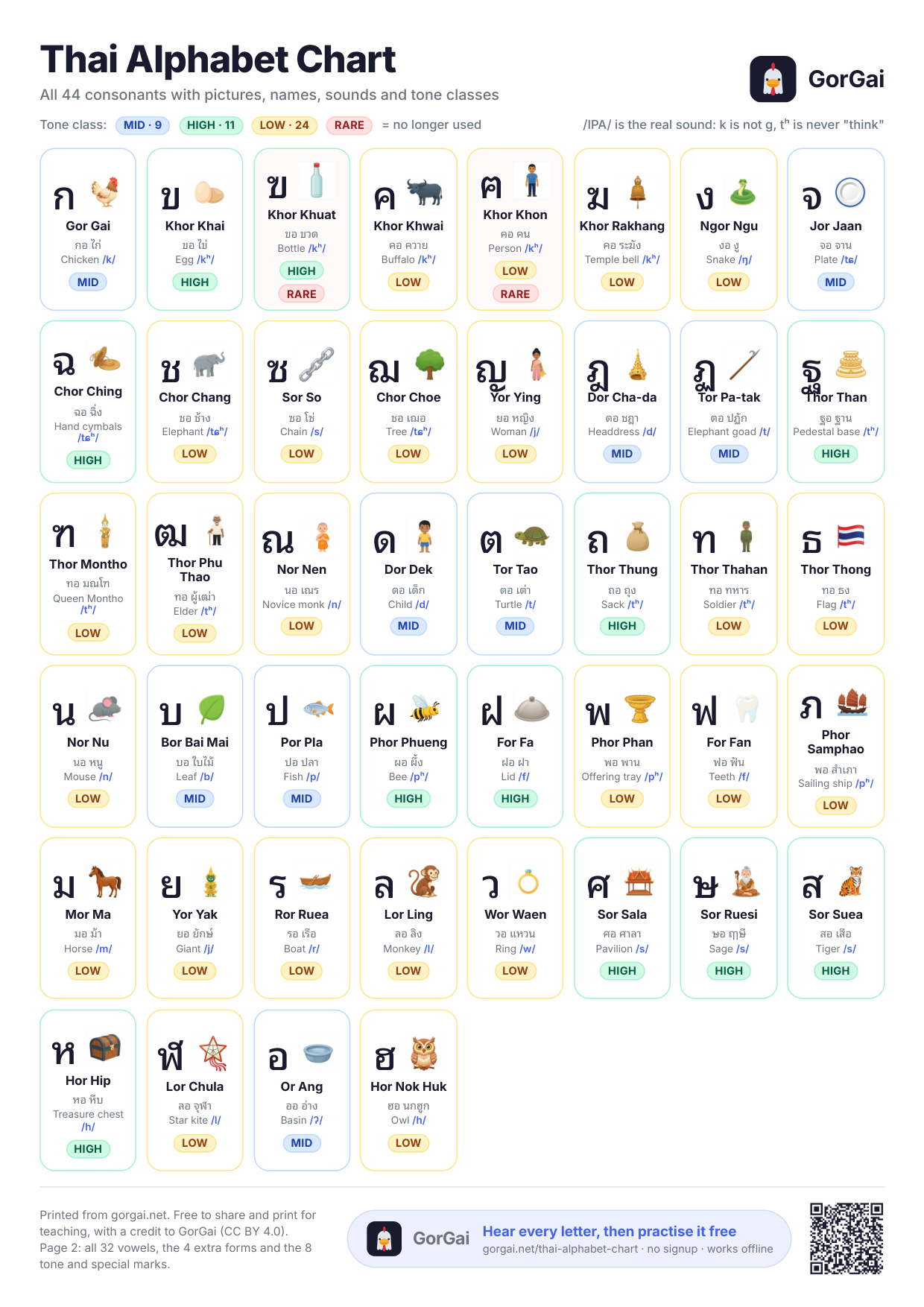
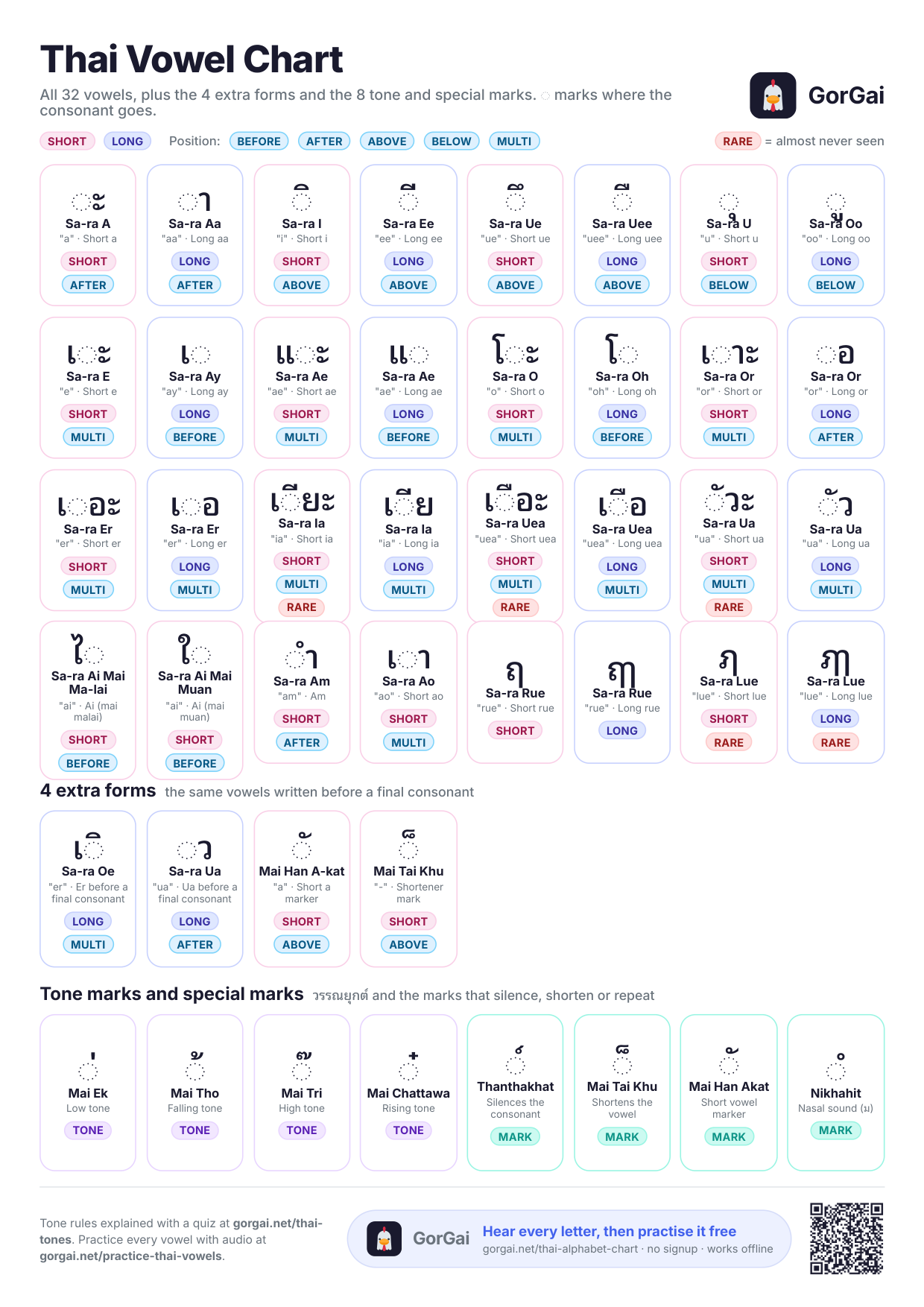
All 44 consonants and all 32 vowels on two A4 pages, with a picture for every letter, the real sound, and the tone class in colour. No email, no signup, no watermark.
We promise our ads will never get in the way of your learning.
An ad was meant to go here. Ads are what keep GorGai free, and not one of them is allowed inside the practice area, so nothing ever pops up while you are tracing.
What is in the printable Thai alphabet chart
This is the same chart as the interactive Thai alphabet chart, saved for paper. It is generated from the same data, so a letter says exactly the same thing on the wall as it does on your phone, and if you are ever unsure how one sounds you can tap it on the site and hear it.
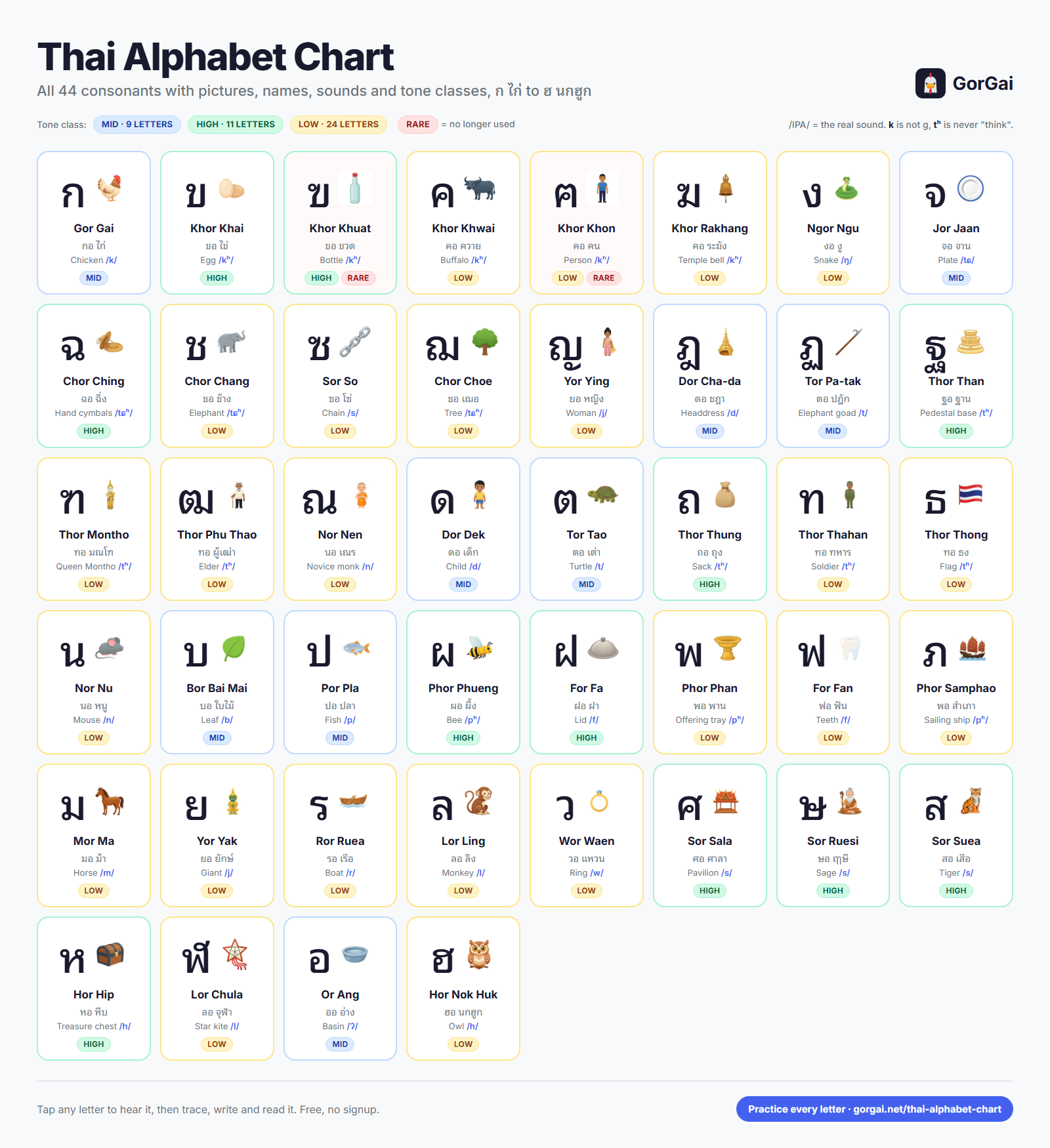
Page 1: the 44 Thai consonants
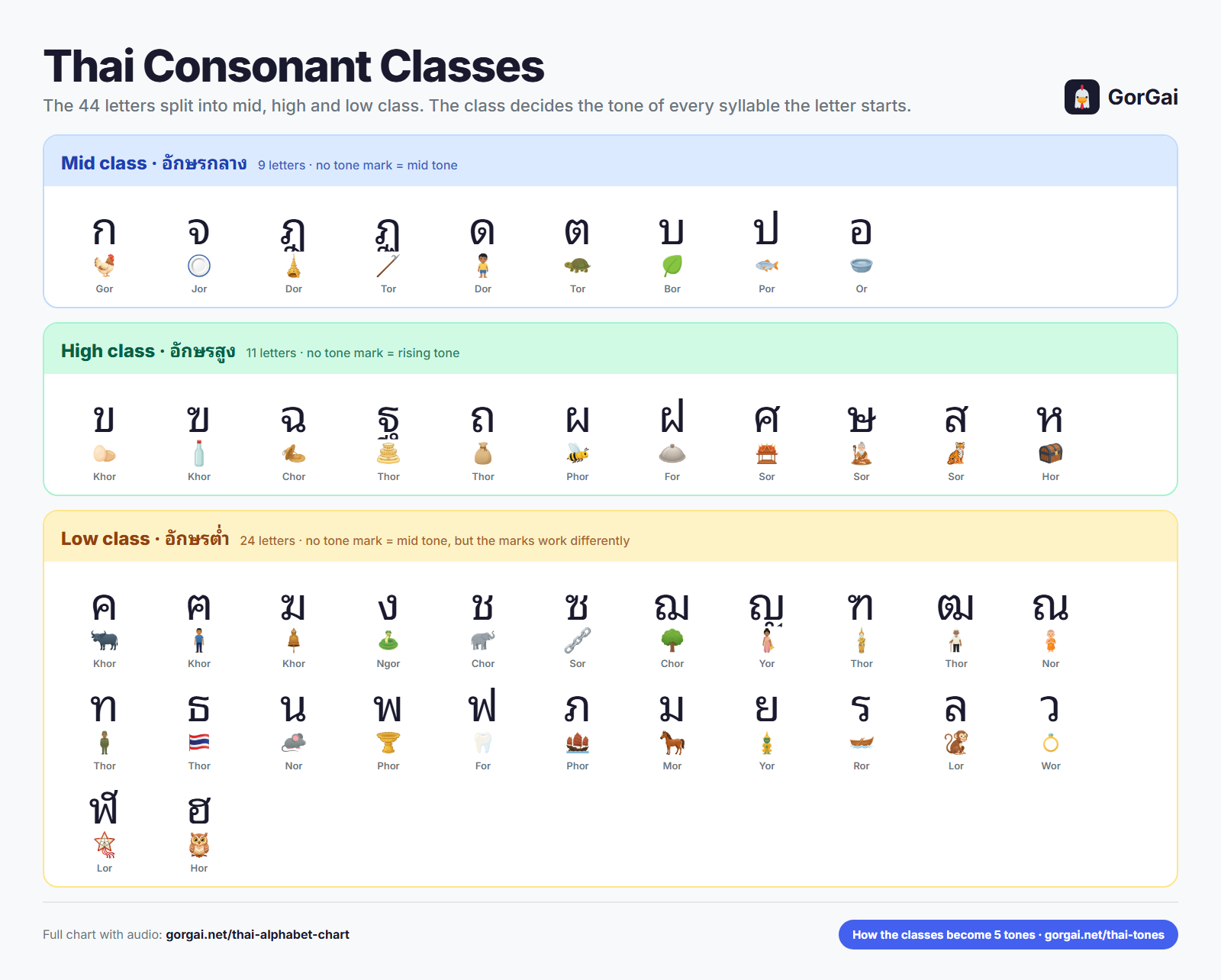
Every letter with its picture word, ก ไก่ (chicken) through ฮ นกฮูก (owl), the way Thai children learn them.
The traditional name in Thai and in English letters: Gor Gai, Khor Khai, and so on.
The real sound in IPA. The romanized names mislead English readers (ก is not a g, and the "th" in Thor Thahan is never the th in "think"), so each card prints the actual sound next to the name.
The tone class in colour: blue for mid, green for high, amber for low. The class decides the tone of every syllable the letter starts, which is why it is the one fact worth memorising about each consonant.
The two obsolete letters ฃ and ฅ marked as rare, so you do not waste time on them.
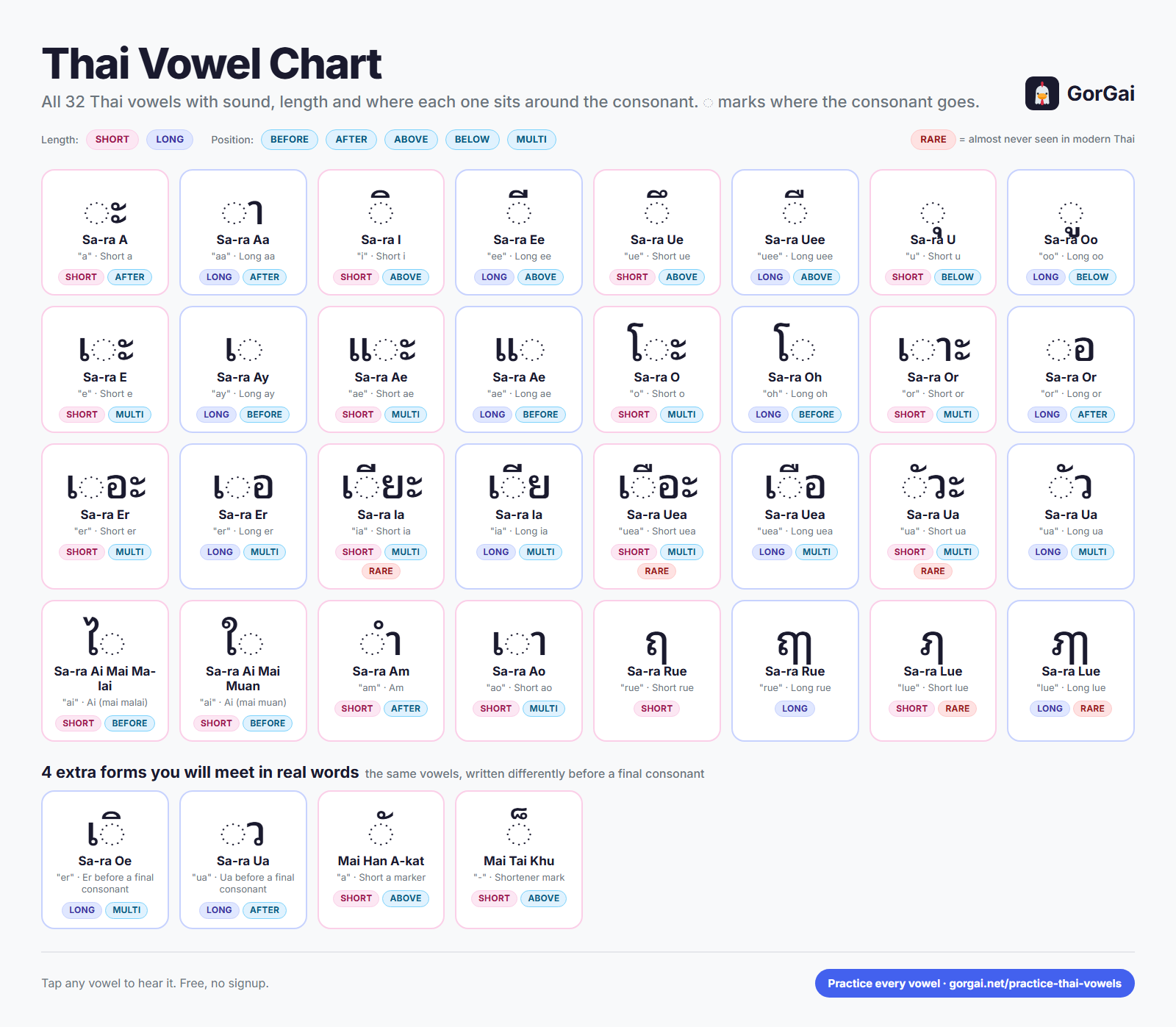
Page 2: the 32 vowels, the extra forms and the marks
All 32 vowels with their sound, a short or long chip, and where each one sits around the consonant: before, after, above, below, or wrapped around. The dotted circle ◌ shows where the consonant goes.
The 4 extra written forms (เ◌ิ, ◌ว, ◌ั, ◌็) that most charts leave out and that you will meet in your first week of real words.
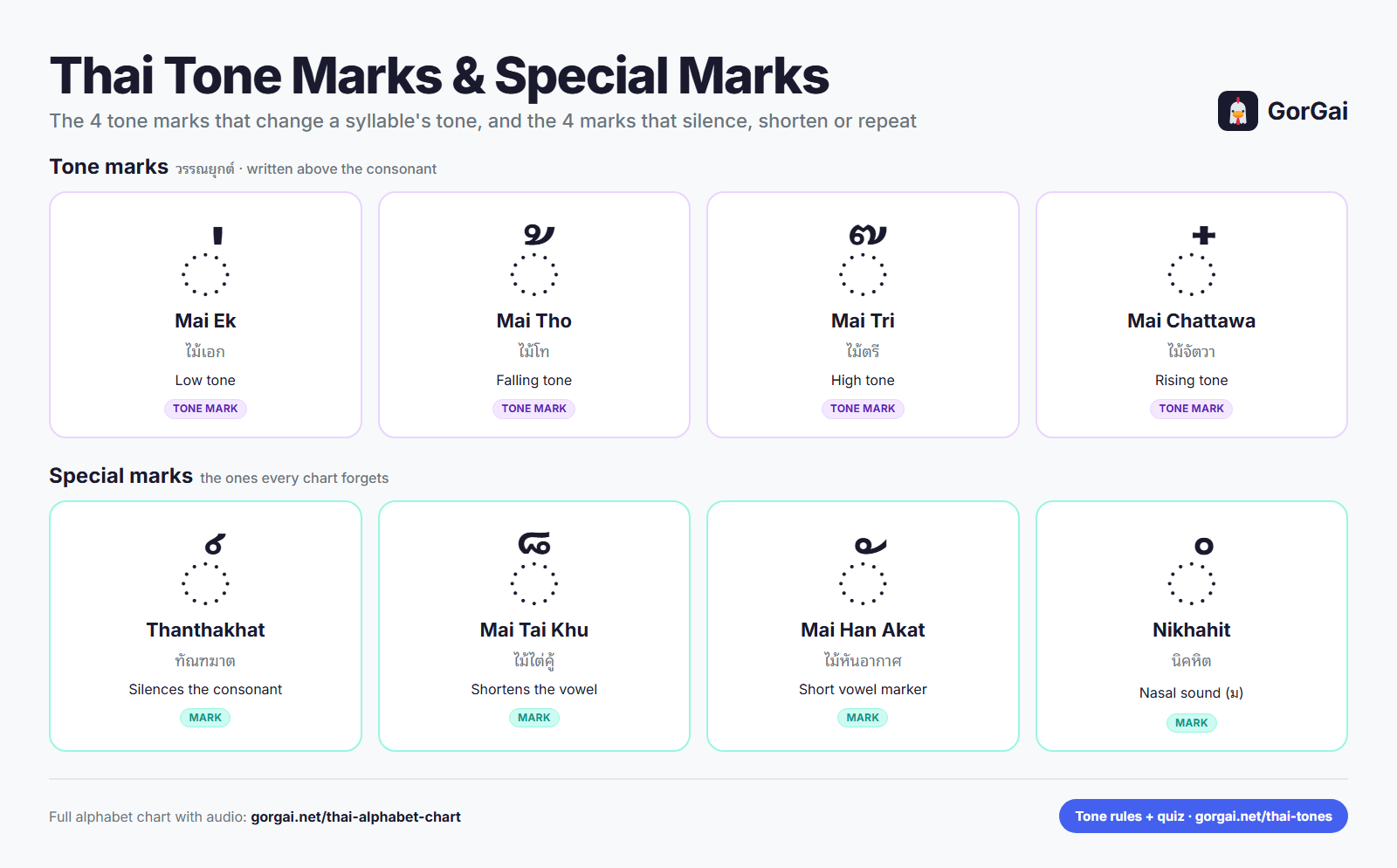
The 4 tone marks and the 4 special marks, including ◌์, the mark that silences a letter and that nobody warns you about.
Both pages carry a QR code back to the interactive chart, so a printed copy on a classroom wall still gets students to the audio.
Prefer an image? The same charts as PNG
If you want the chart on a phone lock screen, in a slideshow or in a document rather than on paper, each page is also a poster image. These are 1600 pixels wide, sharp enough for a phone screen and fine for a slide.
There is also a square flashcard image for every single letter, 44 consonants and 36 vowels, with the sound and the class printed on it. They are on the consonant chart page and the vowel chart page.
Printing tips
Paper size. The file is A4. On US Letter, choose "fit to page" in the print dialog. Everything scales down by a few percent and nothing is cut off.
Colour or black and white. Colour is nicer because the tone classes are colour coded, but each card also prints the class as a word, so greyscale loses nothing.
Two sides of one sheet. Print double-sided with "flip on long edge" and you get consonants on the front and vowels on the back. Laminated, it survives a year on a fridge.
Half size. Print at 50% (two pages per sheet) for a bookmark that fits inside a textbook. The letters stay readable; the IPA gets small.
Class sets. Print as many as you need. If you put it in a handout or on a website, a line saying it came from gorgai.net is all we ask.
How to actually use a printed alphabet chart
A chart on the wall does not teach you the letters. Looking things up does not build memory; recalling them does. So use the paper as the answer key, not as the lesson.
Cover the romanized names with a strip of paper and go down a column saying each letter's name out loud. Lift the strip only when you are stuck.
Learn in frequency order, not chart order. The second letter on the chart, ข, is only the twentieth most common, and the third, ฃ, is obsolete. The most used letters are listed on the chart page; tick them off on your printout first.
Write each letter you learn, by hand, several times, saying the name as you go. The tracing mode shows the stroke order for every letter, and write mode tests you from memory.
Check the sound, not just the shape. When a letter has a puff marker on the chart, hold a hand in front of your mouth and say it: you should feel air. That single habit fixes the most common pronunciation mistake English speakers make in Thai.
Move to words as early as you can. Once you know about fifteen letters, the word reading practice starts to be possible, and words are where letters finally stick.
Who this chart is for
Beginners who want the whole alphabet on one sheet before a trip or a course. Teachers who need a handout that shows tone class and real pronunciation, not just romanized names. Parents of bilingual kids who want a fridge chart with pictures. And anyone who has been learning from an app and wants something to glance at without unlocking a phone.
Yes. No email address, no account, no watermark, and nothing to unlock. It is the same chart the interactive page uses, saved as a two-page PDF so you can print it. Teachers can print a class set; the only thing we ask is a credit to gorgai.net if you republish it.
What is on the two pages?
Page one is the consonant chart: all 44 letters, each with its picture word, the traditional name in Thai and in English letters, the real sound in IPA, and its tone class in colour. Page two is the vowel chart: all 32 vowels with their sound, whether they are short or long and where they sit around the consonant, then the 4 extra written forms and the 8 tone and special marks.
Will it print on US Letter paper?
Yes. The file is laid out for A4, which is slightly taller and narrower than Letter. Tick "fit to page" (or "scale to fit") in the print dialog and it prints cleanly on Letter with a small margin. Without that setting the bottom row can be clipped.
Does the chart have English pronunciation?
Every consonant carries its romanized name (Gor Gai, Khor Khai and so on) plus the actual sound in IPA, and the pairs English speakers mix up are marked as a puff or no puff of air. That second part matters: the romanized names alone make ก sound like a g and ท sound like the th in "think", and neither is right.
Is there a version with just the consonants, or just the vowels?
Yes, and they are separate one-page PDFs rather than a page you have to pull out of the big file. The consonants PDF has all 44 letters on one A4 sheet; the vowels PDF has all 32 vowels plus the 4 extra forms and the 8 marks. Both are free, both are linked at the top of this page, and each half also has its own chart page with a searchable table and frequency ranks.
Can I get the chart in black and white?
It prints fine in greyscale. The tone classes are colour coded, but each card also prints the class name (mid, high, low) as a word, so nothing is lost on a mono printer.
How is this different from the chart posters sold online?
Most printed charts show the letter, the picture and a romanized name, and stop there. This one adds the real sound, the aspiration marker, the tone class, the 4 extra vowel forms and the special marks, and it is generated from the same data as an interactive chart with audio, so you can hear any letter you are unsure of.
About this file
The PDF is produced by GorGai from the same data that drives the interactive chart: letter names and classes follow Thailand's Royal Institute standards and the Gor Gai curriculum taught in Thai schools, and the IPA follows the standard description of Thai initial consonants. It is released under CC BY 4.0. Last updated 2026-09-06.
What Learners Say
”Straight from the learnersCollected through Testimonial, not written by usUnedited
A note when something new lands, and nothing else. No spam, promise!
Thanks! Check your inbox to confirm.
🐔
pls whitelist us :(
We promise our ads will never get in the way of your learning.
An ad was meant to go here. Ads are what keep GorGai free, and not one of them is allowed inside the practice area, so nothing ever pops up while you are tracing.